Showing posts with label BC. Show all posts

Thursday, January 4, 2018

Tracking Cretaceous Birds in South Korea: Bito Island

Happy New Year, Dear Readers!

I'm going to forgo the usual "Here are my goals for the New Year" post because...well, things are still up in the air, plan-wise. We still have no funding to continue the field documentation and excavation (a.k.a. research) of the Six Peaks Dinosaur Track Site (guest blog post on Real Scientists) near Hudson's Hope, British Columbia. This will be Year 2 of an uncertain field season. Right now, I'm just taking my work one day at a time, working on projects that I'm excited about. Some projects are research, while another is more literary in nature.

One of the projects I'm excited about is my science communication, and I must continue, Dear Reader, with my tale of Cretaceous bird tracks from South Korea!

We last left our ichnology heroes on September 13, 2017, at lunch at a Chinese restaurant after a morning of documenting tracks at Dr. Kim Kyung-soo's lab at Chinju University. We timed our lunch and travel to get from the University to Bito Island to hit the right part of the tide cycle, as our prospective field stops were all along the shoreline of the island. Doing field work in a tide-influenced area means you have to be aware of the local tide tables if you want to see outcrop. Our outcrops would be exposed during mid- to late afternoon.

The drive to Bito Island was lovely, with lots of coastal scenery (that does not photograph well at highway speeds). When we arrived at Bito Island around 2:45pm, Dr. Kim pointed out imagery of the Hare and the Tortoise, representing the Korean folktale of "The Hare's Liver." The Hare (representing the peasantry) had to be clever and quick to escape the Tortoise (representing nobility), who was tasked with fetching the liver of the Hare to cure the Dragon King. Here's a link to the story of "The Hare's Liver:" if you know of a better version, please let me know!

"The Hare's Liver." The Tortoise is likely happy because he thinks he's fulfilling his mission to retrieve the Hare's liver for the Dragon King, while the Hare is pleased that he's going to outwit the Tortoise and save his innards.
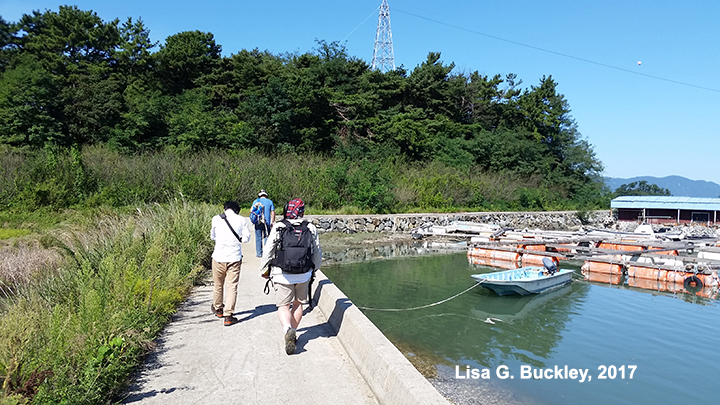
Our first stop was a possible reptilian track site. The area is a popular fishing spot, so there was good parking for the boat launches and anglers. We started our hike down to the first track site.
Strolling along one of the moorings for the small fishing boats on Bito Island.
The track site was a small exposure of finely-bedded (layered) silty sand that has some horizontal exposures. Here's Dr. Richard McCrea standing next to the track surface.

There are a great many similarities between doing fieldwork in South Korea and fieldwork in northeastern British Columbia. First, the bulk of the vertebrate fossil record for the Early Cretaceous in both areas is from the track record. There is skeletal material, but it is not common enough to tell an accurate story of life during the Early Cretaceous for South Korea and British Columbia. Second, both areas are heavily vegetated. We have to rely on either natural exposures along waterways and mountain tops, or those rocks exposed by the extensive industrial activity in both areas.

One thing we do not have in northeastern British Columbia is intertidal invertebrates occupying the track surfaces. Thankfully these snails were huddled in the cracks on the vertical part of the rock exposure and didn't hide the tracks.

Here is a close-up of the tracks exposed on the surface. They are very likely tracks of a large, Early Cretaceous turtle.

Our next stop was a larger track site that was a short car trip and a short hike away from Stop 1. It was a glorious day for a walk along the shoreline, and the scenery was beautiful.
The gorgeous coastal scenery on Bito Island.
I could look for bird tracks here all day.
Left to right: Drs. Richard McCrea, Martin Lockley, and Kim Kyung-soo, en route to the track site.
The track site is where the didactyl (two-toed) theropod tracks named Dromaeosauripus jinjuensis (Kim et al. 2012) were discovered (link to paper abstract).

We spent a little time sweeping off the small shoreline pebbles that covered the track surface.
Rich and Sujin standing behind the uncovered trackway of Dromaeosauripus jinjuensis.
Rich and our other grad student, Jason, at the Dromaeosauripus jinjuensis track site.
Here is a close-up of a section of the Dromaeosauripus jinjuensis trackway. Do you see the large theropod track stepping on the trackway?

Once we uncovered the Dromaeosauripus jinjuensis trackway, Rich got to work taking the pictures for a photogrammetry model.
Rich demonstrating photogrammetry in bright light conditions on the Dromaeosauripus jinjuensis trackway. Red arrows show the Dromaeosauripus jinjuensis tracks.
Site visits such as these are an important part of fossil heritage conservation. This trackway was described in 2012, but that doesn't mean that once it is published that it is forgotten about. This track site (and any other fossil site) will be examined every year to monitor its condition.

While the photogrammetry was taking place, I started hunting out my quarry: bird tracks! At this site, the smallest tracks we would see were those of Dromaeosauripus. We did see tracks of a small sauropod (think Brontosaurus for the trackmaker) on the same surface.
Sauropod manus (hand) and pes (foot) tracks, Bito Island. The arrow on the scale is 10 cm.
While I did not find any bird tracks at this track site, I did make a new friend. Meet (tentative identification) Scolopendra subspinipes, sometimes known as the Orange-legged Centipede.

I'm not the largest fan of encountering critters with more than six legs. I have been known to perform the Spider Dance at inopportune times. One such time was while using an outhouse in the field...admittedly not my most dignified moment. Thankfully I didn't find my new friend on my leg or in my backpack, although I did close all of the zips on my backpack after taking pictures of the centipede.

We were approaching 4:30pm when we went to the last field site for the day: a long stretch of shoreline on which large ornithopod tracks had been discovered. I immediately went into bird track mode and started with the rocks exposed near the edge of the forest.

I did find a suspicious-looking small trace, but there was not enough of it exposed for me to be sure that it was a vertebrate trace.

I also came across a medium-sized theropod track.

At this time the light was beginning to fade. Lighting plays a huge roll in seeing tracks in the field. The dimmer the light, the less likely you are to see small tracks. The best condition for seeing bird tracks in the field is a bright sunny day that casts shadows on low-relief surfaces. These were not ideal light conditions.
Dim light is not ideal for finding any track, let alone small, shallow bird tracks.
I started working my way down to the edge of the water around 6:30pm. I'll be honest: I was not expecting to find bird tracks this late in the day. I was still looking, but I knew my chances of recognizing bird tracks were slim. What caught my attention were all of the tiny hermit crabs. I knelt on to the wet, slippery rocks to try to get a picture of the hermit crabs...and my brain focused on a familiar pattern on the rock.

BIRD TRACKS!
I called people over, and we immediately started outlining the bird tracks that we could see using white chalk. Because this is a tidal-influenced area, Dr. Kim and his grad students began to salvage the track surface for removal back to the lab.

This part made me extremely nervous because the rock layer the bird tracks are on is very, but the surface came up in good condition. It turns out these were the first bird tracks to be found at this particular locality on the island. This was a good year for me finding bird tracks!

This was a full day! After we deposited the tracks in Dr. Kim's lab, we went to dinner at a sushi restaurant and ate more sushi in one sitting than I ever have in my entire life. We made it back to the Happy Owl Hotel by 11:00pm.
A very small part of the owl collection at The Happy Owl Hotel.
I downloaded all of my pictures and updated my field notes, and was definitely ready for bed at 11:30pm. The next day's adventure would prove to be just as busy, as we would visit the Jinju Innovation City track sites, and the Gajin-ri track site!

References

Kim JY, Lockley MG, Woo JO, Kim SH. 2012. Unusual didactyl traces from the Jinju Formation (Early Cretaceous, South Korea) indicate a new ichnospecies of Dromaeosauripus. Ichnos 19(1-2): 75-83.

Monday, August 7, 2017

The $0.00 Field Budget Season - Heavy Bird Tracks

Happy August (YIKES) Dear Readers!

Yes, August caught up with us. We've been as busy as a $0.00 field work budget season can allow us to be: this means no multi-week or multi-day expeditions to work on our many large-scale projects. I outlined a small list large projects we should be doing this summer in my last blog post. Spoilers: like all work of value, working to protect, preserve, and interpret fossil heritage has a price tag. Anyone who thinks you can do field work for free is lying to themselves and others.

We have a great member of our field crew, Dr. Charles Helm. To say that he is a passionate and avid outdoors person is an understatement. To say that he is one of our most dedicated and passionate volunteer is an understatement. Medical doctor by training, Charles has authored books, been an author on some of our scientific papers, and is now first-authoring his own papers on an ichnology site he has been surveying for years (stay tuned!)

We have a list of "Helm Sites" that we check out every field season. On August 01, after checking out a report of ankylosaur tracks from Conuma Coal's Wolverine Mine, we visited three other sites to confirm fossil tracks that Charles found and, of course, to look for more!

This expedition fell on a Tuesday, which is the day of the week I run #NameThatTrack on Twitter, the fun ichnology game!

Confession time, Dear Readers: I work on Cretaceous-age bird tracks, but until now I had never found a really clear Cretaceous bird track in the field. Don't get me wrong: I'm perfectly happy sciencing the heck out of Cretaceous bird tracks found by others. It's just that the irony of never having found a Cretaceous bird track was not lost on me.

All of that changed on August 1. Charles and Rich were checking out different parts of the outcrop, and I looked at what I obsessively look at: really fine-grained bedding surfaces of rock. My lack of personal Cretaceous bird track discoveries was not for lack of trying, my friends. I posted tweets of tracks we were coming across.

Lighting is EVERYTHING for tracks, and even more so for small tracks. Dim overcast light, or super bright straight-on light, will wash out shadows that highlight subtle surface relief. The lighting was not exactly on my side that day...but I finally got to post this tweet:


Based on the geology of the area, these tracks are Early Cretaceous in age (about 100 million years old), and are similar in age to bird tracks that we research in Alberta, the United States, and China. Here's a close-up of one of the tracks!
You can see (barely) one of the toes of a bird track right above the third black square from the left of the scale. This was horrid lighting for a picture.
Our only problem with the specimen was this:

At over two meters long and half a meter thick, this slab of rock must have weighed close to 400 kg (Note: at the time, we thought the whole slab was only 300 kg. Oh, were we wrong. So wrong.) There was no way Charles, Rich, and I could move it in its current state. But we needed to collect this specimen.

Fast forward to August 5. We were scheduled to be interviewed for a news broadcast on the work our Research Centre has been doing in the region since 2003. Rich asked the reporter, Kraig Krause, if he would be interested in including the recovery of the bird tracks in his segment. He was definitely on board, so we planned a morning tour of the research centre and then off to collect the bird track slab!

We arrived at the site around 12:30 pm. It was starting out to be a hot day, with no cloud cover in sight.

Step 1: Build a temporary bridge over the ditch. This part was simple. We weren't worried about the steep part leading down to the bridge: after all, there were four of us, and the slab would be much lighter. What could possibly go wrong?
(Note: I can feel every field person cringe at that statement. You never, ever ask that on an expedition.)
Dr. Richard McCrea (left) positioning the temporary bridge boards while Dr. Charles Helm (right) brings over more bridge material.
Step 2: Trim the track slab. We needed to remove at least half of the track slab thickness to make it portable. Here's the specimen before the trimming.

Removing some of the thickness from the slab was easy: there was already a fracture in the rock that we could exploit, and the bottom half of the slab separated with three chisels and maybe half a dozen hits with the crack hammer.
Success Part 1! Now we needed to drill holes to separate the non-track surface part of the slab from the birdy-goodness part of the specimen.
The next step was to remove the eroded (no track surface) part of the rock at the bottom of the picture. Rich and I took turns: one would drill holes along the bottom edge of the track surface while the other watched the track surface. Rotary hammers cause vibrations that could shake loose bits of track surface.
Dr. Rich McCrea adding punch holes to the non-track part of the slab, while Dr. Charles Helm selects more potential specimens for careful viewing later.
Kraig Krause getting some footage of the slab trimming process while Rich drills the punch holes.
Of course, when you're in the middle of doing a delicate job such as track slab trimming, you hope there isn't going to be a big "Oops!" that ends up on camera. Thankfully the trimming went smoothly, and the non-track part of the slab came off easily.
The piece off to the left was at least a good 30 kg that we didn't need to carry.
Step 3: Haul the specimen.
This was the Hard Part: hoisting the slab on to the wheelbarrow. First we wrapped it with a heavy tow strap to give ourselves more hand holds for potentially hand-hauling the block over the ditch bridge. Then we muscled the specimen on to one of the 2" by 8" boards so that the specimen would sit evenly across the wheelbarrow. Then...HEAVE! That specimen was heavier than we anticipated: it had to be close to 225 kg.
Kraig (top), Charles (middle), and Rich (bottom) preparing for the mighty lift while I brace the wheelbarrow.
Then Rich noticed an issue with the wheelbarrow: the cotter pin that keeps the wheel from slipping off of the axle was missing for the left wheel. The last thing we wanted to have happen was the wheel fall off while we were moving 250 kg of solid rock. Before we continued, Rich improvised an ersatz cotter pin out of a small awl.

Walking the track slab down to the bridge was a group effort: we made sure that the slab wasn't going to bounce or slide off as the wheelbarrow jostled over uneven terrain. Then we approached the ditch.

Because of how steep the bank of the ditch was, we had to slide the track slab off of the wheelbarrow to get it on to the bridge. We stood around the slab, not really relishing the thought of pushing it across the bridge and then putting it back on the wheelbarrow, when the thought hit us: we have a field truck and a tow strap.

New Plan: pull the track slab the rest of the way across the bridge and up the ditch slope on to the road, and then lift the slab into the back of the truck.

We hooked the tow strap up to the truck hitch...
Notice another field improvised pin?
...and then pulled the track slab gently on to the road.
Charles keeps an eye on the front of the truck while Kraig and I keep an eye on the track slab. The surface on which the tracks are found is facing up, of course. Success!
After the specimen was on the road, we positioned a 2" X 8" under the end that was closest to the truck crossways. This gave all four of us enough room to lift the front end up to tailgate level. Once the front end of the specimen was airborne, Rich left us to hold the front end up while he SLOWLY backed the end of the truck as close as possible. One great HEAVE and the specimen was resting on the tailgate!

Whew. The whole operation was finished by 2:30 pm.

Now that the track slab is back at the Research Centre, we get to do the fun part: examining the surface! This will involve turning off all of the overhead lights and shining a low angle light across the surface to create shadows from the small-scale surface details. This really makes small tracks POP. We'll also use the same technique at the field site: we're planning an overnight at the outcrop where we can examine all of the potential track surfaces with a flashlight in the evening. Once we do the low angle light examination, we'll have a better idea of what type of bird tracks these are.

Until then,

Strange Woman.

Friday, May 26, 2017

Calling All Shorebirds!

Hello Dear Readers!

We have returned from the Canadian Society of Vertebrate Palaeontology 2017 conference in Dinosaur Provincial Park, and it was a blast! It was great to catch up with our friends and colleagues, and also great to see all of the ground-breaking research being done by early career paleontologists.

There's a lot happening in the next month for me. Tomorrow I grade for my next level in karate - this will be the first exam I've had since my candidacy! On June 3 I'll be leading the annual birding hike to Bullmoose Marshes, hosted by the Wolverine Nordic and Mountain Society. June 9 - 11 I am involved with hosting the British Columbia Field Ornithologists meeting, and am giving the afternoon keynote presentation...on Cretaceous birding, of course! I am also working with colleagues to finalize plans for a track site visit - stay tuned!

One aspect of my upcoming summer that is not busy is my field work life. With this year's field budget of a whopping $0.00 (don't spend it all in one place!) we do not have any large field excursions scheduled. That doesn't mean that we don't have plans were funding to materialize. Here's a list of the palaeontology projects we could  be working on this summer:

1. We still have at least four years of work to do on the Six Peaks Dinosaur Track Site near Hudson's Hope, British Columbia. Here's a video showcasing the site,


2. A hadrosaur bonebed (duck-billed dinosaurs), the first dinosaur bonebed for British Columbia. This site was featured in "Dino Hunt Canada," with an airlift of the articulated skeleton of one of the hadrosaurs. We've done as much digging as we can by hand. Watch the video!


3. Uncovering more of the world's first tyrannosaur trackways (described in our paper in PLoS One,) mentioned in this post on field work fails, and in this post on injuries in theropod tracks, and

4. A potential new dinosaur excavation site that needs several test pits dug to determine the extent of the bone-bearing section.

What this summer does is give me an opportunity to spend more time at my neoichnology (modern track) sites. My first step was to see what shorebirds have arrived in the area, so I went out yesterday to spot check my usual sites.

My first trip was to Bullmoose Marshes, about 30 km away from the Research Centre. This site is in important stop-over and summer breeding ground for a fantastic variety of birds. It was a gorgeous day to be outside.
Me, squinting into the sun, which gives me a pensive look. No one can look pensive at this marsh.
While I did hear and see a great variety of birds, including two Trumpeter Swans, I only saw one shorebird: a Solitary Sandpiper.

My submission for Worst Bird Pic. There's a Solitary Sandpiper in here!

Of course, visiting sites always provides reminders of Why We Can't Have Nice Things. These boardwalks were put in by volunteers who had to raise funds for the materials. But I guess that all pales in comparison to twue wuv.


Yes, we're all very impressed that your love for C.C. is so great that vandalism is your answer.
The water levels are very high at the marshes right now, so there was no exposed ground to check for shorebird footprints. In addition to the Solitary Sandpiper, Spotted Sandpiper and Greater Yellowlegs also frequent this marsh, but perhaps they have not yet set up their breeding territories.

My next stop was to the local dump. I often find myself going to to the dump for bird-related activities. The sewage treatment ponds are full of breeding Canada Goose, and several species of ducks and swallows can also be found. I discovered in 2016, while I was dropping off my recycling, that Killdeer also frequent one of the cleared off, rocky areas.

The dump did not disappoint! Here's a trackway of a Killdeer!

Killdeer trackway. 10 cm from outer dot to outer dot.
This made me a very happy ichnologist! These tracks were made that morning. If they were any more fresh, the Killdeer would still be standing in them.


I also saw some tracks that were made a day to a few days before, meaning that the Killdeer were not just making a one-time stop at the site. I'm hoping this means that they are getting ready to establish their breeding territory, and that I haven't missed all of the fun of them doing their nest scrape displays!

A not-so-fresh Killdeer trackway at the same site. Notice the edges are less clear than the above trackway.
Over the next few days I'll be paying this site early morning visits to see how active these Killdeer are, and where they feel is a good spot to build a nest.

Stay tuned!

Thursday, March 31, 2016

Fool Me At All, Shame On You Always: How Not To Do April Fools' Day

April Fools' Day is tomorrow, and I am waiting with mild trepedation over what faux science gags I am going to see on the Internet. What I was not prepared for was to have someone actively try to recruit me to deceive the public in a pretty rotten way.

Let's be clear right from the start, Dear Reader: I love a good prank. I've been on the receiving end of many a gag courtesy of my colleagues. The most recent prank was having my office filled with toy spiders - we refer to it as The Spidering...this happened over a year ago, and I'm still finding spiders. We have a rather cute, so obviously over the top so as not to be taken seriously video that we're going to post tomorrow that is 100% fun, and in no way would ever be confused with real science. What we do not do, nay, what we REFUSE to do is to actively deceive the public with regards to fossil discoveries, fossil heritage appreciation, and fossil conservation.

Enter my phone conversation from Tuesday afternoon.

I'm out of town, picking up some supplies for the up-coming field season. My cellphone interrupts my browsing. It's a phone number from British Columbia. NOTE: As technologically slow as I am, I am pretty good at Googling phone numbers - I know exactly which organization made this call.

I will refer to the person on the other end as Skippy. Skippy was all excited to tell me of their great idea. There is a project that is going ahead somewhere in British Columbia (not in my neck of the woods), and those involved thought that a great way to get publicity would be to announce a fake dinosaur skeleton discovery as a result of said project. This plan was considered a good idea because, well, April Fools' Day. Skippy continued: they even wanted to get the public involved in submitting names for their new fake dinosaur find. Skippy was wondering if they could use our institution's name to lend their April Fools' prank credibility.

Dear Readers, guess how I responded. I think I was quite polite under the circumstances.

The first words out of my mouth were "Absolutely not!" I went on to say a version of this:

There is already a culture of mistrust in the general public towards science and scientists. The public is also deeply interested in fossil discoveries and news, and trusts that when such news is announced, it's for real. Faking a fossil discovery in British Columbia, using the name of a well-respected institution such as ours, would only serve to fuel such public distrust of scientists. There is no way that we could in good conscience take part in such a scheme.

I ended the conversation with Skippy by saying "And I had better not see our names anywhere near anything that you publicize." Skippy's response was "You won't be included," wording that makes me think that they are actually still planning to go ahead with this Scicomm Wrong.

Half-assed publicity stunts such as these give me nothing but anger and frustration. This is nothing more than manipulating people's natural curiosity about dinosaurs and fossils for a project that will do absolutely nothing to further their appreciation of their province's fossil heritage. There is no way that this can be spun as a scicomm opportunity: had our name been associated with this scheme, we would have lied to the public - April Fools' Day or no - and given them a reason to get excited about dinosaurs in British Columbia. People trust us, whether they consciously recognize that trust or no, to give them trustworthy and factual information about the fossil heritage in British Columbia.

I will not apologize for this: I respect and greatly appreciate the public's natural interest in their fossil heritage. For as long we are at the helm of our institution, we will never abuse that interest for the sake of tacky publicity.

British Columbia is only just starting to develop a cultural appreciation and respect for the province's fossil heritage. The idea that the public has a sense of ownership and pride over their province's heritage is not yet at the levels we see in Alberta, where fossils have been part of the cultural identity for decades. Being an institution operating in British Columbia and actively promoting a culture of pride and responsibility for fossil heritage resources is a serious business for us. We also rely on the goodwill of the public to be supportive of fossil heritage protection and conservation. We will not lightly throw that hard-earned trust away for the sake of a "joke".

Unfortunately for many of us scientists engaging in science communication about our respective fields, we are bombarded with examples of credible-looking fake-umentaries presented by organizations that are trusted by the public as providers of accurate information, all for the sake of publicity. Pick your favorite cryptozoology hunter show - my favorite examples are anything involving Bigfoot, which I have written about previously. Newsweek recently put out a special issue on Bigfoot. National Geographic has also jumped into the realm of presenting Bigfoot "research"Discovery Channel's Megalodon fakery. Discovery Channel's Mermaids fakery. These are all communication brands that have the trust of the public, and that trust is manipulated each and every time a fake-umentary or sensationalized show is presented as fact.

Public Service Science Announcement (PSScA): there is indeed such as thing as bad publicity, especially when it deliberately exploits people's science curiosity for the sake of clicks or views.

So, Dear Readers, I will be online this April Fools' Day, making sure that I keep track of this newest plan to exploit the public's love of fossils. I hope the group involved has had a sober second thought and will abandon this plan. Stay tuned.

Saturday, April 25, 2015

We Need Help to Fund Summer Dinosaur Track Research!

Hello Dear Readers!

Regardless of the snow that is on the ground as I type, this is the time of year our planning kicks into high gear for this summer's field season. We have an exciting new dinosaur ichnology project (for new readers, ichnology is tracks, traces, and other "signs" left by dinosaurs other than their body parts), thanks to the sharp-eyed residents of the Peace Region who reported the site to us, and the guarantee that we can operate this year.

"Wait, Strange Woman - didn't you say you were office bound this summer in your last post?"

Indeed I am, friends. However, that doesn't mean I'm not hard at work ensuring the field season can happen for my Research Team. As a Museum Of Unusual Size (MOUS), we struggle every year to not only convince the Powers That Be that our institution (the Peace Region Palaeontology Research Centre) is a worthy project for conserving, archiving, researching, and interpreting British Columbia's fossil heritage, we have to justify WHY research should be funded. We have no access to research funding through provincial or federal means. We always approach the natural resource companies operating in the region for potential partnerships, and are usually given the same rebuff: "Our head office decides funding levels based on population size. You live in a small population center. You will get a small amount." Trying to convince them that this project is regional and provincial in scale does not make an impression.

This year we're trying something different. Two days ago I launched an Indiegogo campaign to crowd fund the research for our Williston Lake Tracksite (link to the "Research Dinosaur Tracks in Northeast BC, Canada!" campaign site here.)

There's good background information on the campaign page, but I'll also provide a summary here.

The new Williston Lake Tracksite is a large, flat exposure of the Gething Formation (Early Cretaceous, approximately 115 million years old). Dinosaurs in BC - and specifically dinosaur footprints - have a long, but little known history in the province. Tthe cultural history of many British Columbia residents of European descent (there may be First Nations historical recognition for the tracks - still hunting out info) has long assumed that "there are no dinosaurs in BC, they're found in Alberta" - I heard this so often growing up in BC that I wanted to scream. However, dinosaur prints were first found in northeast BC by geologist F. H. McLearn in 1922-23. Paleontologist Charles M. Sternberg led the first paleontology expedition to the Peace Region in 1930.

C. M. Sternberg named many new ichnotaxa (footprint types) from the Peace River Canyon Gething Formation sites in 1932 and on. This was the first extensively published description of Cretaceous tracks as a footprint community (ichnofauna). Several ichnotaxa were named:

Amblydactylus gethingi - here's a footprint and handprint pair from a different tracksite, not the original Sternberg locality.  Amblydactylus is thought to be made by a dinosaur related to Iguanodon.

Medium-sized herbivorous dinosaur print Gypsichnites pacensis (image not Sternberg's original site):

The small theropod footprint Irenichnites gracilis. This specimen is not from the original Sternberg localities:

Medium-sized theropod footprint Columbosauripus ungulatus (image not from Sternberg's sites):

Large-sized (and likely allosaurid) theropod prints Irenesauripus (from Sternberg 1932):

Last, but certainly not least, the ankylosaur footprints of Tetrapodosaurus borealis (image not from the Sternberg localities, but from our Flatbed Creek Trackway Tour site):

Later, Currie (1981) named what was, at the time, the oldest bird footprints known, and the second
bird footprints named from North America: Aquatilavipes swiboldae.
From Currie (1981).

There are two things I'm sure you have noticed by now:
1. The Peace River Canyon tracksites are important. Several type specimens come from there, and they are an important part of not only British Columbia's history, but the history of paleontology. The Province of British Columbia agreed, and in 1930 the Peace River Canyon site was designated as a Provincial Heritage Resource. Cool, right?
2. Most of the images are not from the original Peace River Canyon localities. Why? The Peace River Canyon localities, a Provincial Heritage Resource, are now flooded under the "Dinosaur Lake" reservoir of the Peace Canyon Dam. Despite a huge salvage effort by the Provincial Museum of Alberta (now the Royal Alberta Museum), led by paleontologist Dr. Philip Currie between 1976-1979 that recovered over 90 footprints, mapped 1000 prints, and in total documented 1700 prints, the sites and the in-place tracks were lost to future science, science outreach, and tourism opportunities.

This new site, the Williston Lake Tracksite, is the first large-scale track-bearing surface from the Gething Formation that has been seen since the flooding of the Peace River Canyon. We have this fantastic opportunity to continue Sternberg's and Currie's work.

First, we simply need to documenting the site. It won't really be simple: there's A LOT of site to be cleared (in yellow):

We need to map all of the footprints in place as they appear on the surface. We need to take latex and silicone molds of significant footprints and trackways. We also need to 3D-digitize the ENTIRE site.
We can take an entire tracksite back to the lab with us in 3D-digital replica format. Image from McCrea et al. (2014b).

Why do we need to do this?

We need to know a) what track types are there, b) what proportion each track type is in this slice of the paleo-ecosystem, and c) update or revise Sternberg's footprint identifications (as needed) with our advanced understanding of how footprints work - Sternberg did a great job in 1932, but our understanding of footprints has increased and changed a lot since then, and since the original Sternberg sites are inaccessible, we have this golden opportunity to research a site that is as close to what Sternberg saw as possible.

We can't miss this scientific opportunity. This is why we need your help. Some of the tracks are exposed, and we know from experience that the longer tracks are exposed, the more likely they are to be damaged by weathering (slow) and human selfishness (fast). We need to get in, uncover, document, and securely cover the site this summer. To do this safely and efficiently we need to replace our old equipment (truck, all-terrain vehicle) and pick up a new item: a secure cargo trailer in which we can store gear (we've had all of our sites robbed) and store specimens. We also need to feed our crew of staff and volunteers.

Once this site is documented, we hope that it can one day be used as a science-based tourism initiative. Our research this summer will be the basis for all of the exciting stories we'll discover about Early Cretaceous dinosaurs. We want to bring the Peace River Canyon tracks from their watery obscurity, if only by proxy, and tell their story to the world.

You can help us tell that story. The most important way you can help is to share the "Research Dinosaur Tracks in Northeast BC, Canada!" site with anyone interested in history, heritage, dinosaurs, and science education. If you have the means, we would greatly appreciate any contributions.

I know we can do this.


References

Currie PJ. 1981. Bird footprints from the Gething Formation (Aptian, Lower Cretaceous) of northeastern British Columbia, Canada. Journal of Vertebrate Paleontology 1(3-4):257-264.

McCrea RT, Buckley LG, Plint AG, Currie PJ, Haggart JW, Helm CW, Pemberton SG. 2014a. A review of vertebrate track-bearing formations from the Mesozoic and earliest Cenozoic of western Canada, with a description of a new theropod ichnospecies and reassignment of an avian ichnospecies. New Mexico Museum of Natural History Bulletin 62: 5-94.

McCrea RT, Buckley LG, Farlow JO, Lockley MG, Currie PJ, et al. 2014b. A ‘Terror of Tyrannosaurs’: The First Trackways of Tyrannosaurids and Evidence of Gregariousness and Pathology in Tyrannosauridae. PLoS ONE 9(7): e103613. doi:10.1371/journal.pone.0103613

Sternberg CM. 1932. Dinosaur tracks from Peace River, British Columbia. National Museum of Canada Bulletin 68:59-85

Thursday, March 12, 2015

Early Bird (Tracks) in British Columbia: Introducing Paxavipes!

Hello, Dear Readers!

It's been awhile since I've dusted off the Blog: it's been a stressful time for the Strange Woman, and while Tolkien made the apt observation that harrowing tales make the best stories (The Hobbit), I'm bored of thinking about it, and would much rather talk about paleontology! Our research group had a fun time publishing on my favorite subject: BIRDS! Specifically, we have a recent paper in Cretaceous Research on a new avian ichnotaxon (footprint type) from the Peace Region of British Columbia!

Please join me in welcoming Paxavipes (Peace bird footprint, in reference to the Peace Region) babcockensis (in reference to Mount Babcock, the mountain on which the specimen was discovered) to the ichnological family! OK, that's not taxonomically accurate, as Paxavipes is also part of a new ichnofamily. Bear with me.

Bird tracks have been known from British Columbia, and specifically the Peace Region, since their scientific debut in 1981 with Aquatilavipes swiboldae (Currie, 1981). This specimen was recovered as part of the salvage and study operation performed by the then Provincial Museum of Alberta before the completion of the Peace Canyon hydroelectric dam. The area was so well-known for its palaeontological heritage that it was officially designated a Provincial Historic Resource in the 1930s. Today you would need gills and fins (and a whole bunch of de-silting equipment) to see these localities, as they are now underneath what is known as Dinosaur Lake. The type slab for Aquatilavipes swiboldae now resides in the Royal Tyrrell Museum of Palaeontology (RTMP). At the time of its scientific write-up, it was the earliest known bird track type, being from Gething Formation deposits that are Lower Cretaceous (Aptian, approximately 125 - 113 million years old). Since then, no bird footprints have been published on from British Columbia...until now.

The rock slab on which Paxavipes are preserved was discovered in 2005 by a (then) doctoral student Curtis Lettely (University of Alberta). The slab was discovered in an area locally called The Boulder Gardens. The Boulder Gardens is series of hiking trails leading outdoor adventurers through a gorgeous sup-alpine terrain of visually stunning sandstone erosional features. Check out more information on the PDF here. Boulder Gardens is within the boundaries of the newly established Tumbler Ridge Global Geopark. The Boulder Gardens showcases rock from the Boulder Creek Formation, which is Early Cretaceous (middle-upper Albian, approximately 100 to 105 million years old.)

This was an interesting slab. The rock slab was found vertically embedded in eroded rubble and dirt, and what was exposed was covered in many lichen colonies. Lichen is hard, crusty, and hides any surface details it covers. We could see that there were small theropod footprints (Irenichnites-looking prints), and a few visible bird footprints, but did not know how many prints were preserved on the surface, or anything detailed about their shape, with all of that crusty lichen. That lichen had to go...

Fig. 2 of PRPRC 2005.001.015 from Buckley and McCrea (2009). It's easy to see which part of the slab was exposed for lichen colonization.
...but carefully. Lichen is a resistant organism - what else can you expect when fungi and cyanobacteria form an alliance (symbiotic relationship)? Mechanically scraping off the lichen was not an option, as that would have risked mechanically scraping the track surface and the prints it preserved. After trying out a few different chemicals, we saw that a dilute bleach solution effective at breaking down the lichen to a point where it could be gently brushed away with a soft toothbrush. The technique worked so well that it became the topic of my first first-author publication (Buckley and McCrea, 2009).

Once the lichen was removed, the surface was revealed...and what a reveal! A grand total of 72 bird footprints were visible, which enabled us to make out five trackways - series of footprints made by one bird walking from Point A to B. Single footprints are like an isolated bone or tooth - they give us good information, but not as much as a whole skeleton does. Trackways are like the whole skeleton.

Fig. 4 from Buckley and McCrea (2009) So many bird footprints were visible once the lichen was removed!

Another cool "after lichen" reveal was that the small theropod footprints had tiny skin impressions on them! Check out the teeny tiny pebbly texture:
Fig. 6 from McCrea et al. (2015). Skin impressions such as these give us a good idea of what the soles of dinosaurs' feet looked like. These tubercles likely acted like the treads on our running shoes.

Back to the birds. Since we have trackways, we could tell left footprints from right footprints, but not easily. There was something odd with these particular bird footprints. The usual case for bird footprints is that the outer toe is much more splayed away from the middle toe than is the inner toe (or the toes have a roughly equal amount of splay). These footprints were strange in that the inner toe was more splayed than the outer toe. It wasn't just one or two footprints out the 72: it was the majority of the prints.

Fig. 4 from McCrea et al. (2015) showing the holotype trackway - see the wider splay between the inner digits?

Something was up. There is a bit of natural side-to-side wiggle potential in bird toes, and modern bird footprints can show a big differences in toe splay (70 degrees to 140 degrees between the outer digits), but a consistently larger splay between the inner (digit II) toe and the middle (digit III) toe is not common in Cretaceous avian bird footprints. The only other bird footprint type that shows this toe arrangement is Barrosopus slobodai (Coria et al. 2002) from the Late Cretaceous of Argentina. Because these two footprint types are unique when compared to all other Mesozoic bird footprints (but different enough to still be considered separate footprint types), we formed a new ichno (footprint) family of bird prints called the Paxavipedidae. Any new three-toed bird footprint (no hallux) with consistently wider splay between digits II and II than between digits III and IV and thick digits can be assigned to this new footprint family.

As an ichnologist, when I see a repeated footprint shape or toe arrangement within all that natural variation, I begin to think about the shape of the foot. Specifically, I think about the features of the skeleton that made that footprint shape possible. Looking at modern birds, Paxavipes and Barrosopus prints are very close in shape to footprints of the Killdeer (Charadrius vociferus).

I love this image by Ryan Hodnett, found on Wikipedia. No, Killdeer are not some strange Octo-Bird: those are young Killdeer hiding under the parent.
Looking at the foot bones of a Killdeer (welcome to my thesis!), the end of the metatarsals (the lower part of the "leg" of the birds that you see hiding in the above image) are shaped in such a way that the inner toe (when attached) is going to be more splayed than the outer toe! Footprints may not always match the skeletons of feet perfectly, since living feet are covered with skin and muscle. In some cases, like with two-toed dromaeosaur trackways, there are features of the animal's skeleton that are expressed in the footprints. When we find these features, we have a good chance of predicting what the skeletal foot of these track-makers would look like. We haven't yet found the track-maker for Paxavipes, but we have a good chance of recognizing it when (if) it is found! [NOTE: This doesn't mean that Killdeer were around in the Early Cretaceous: this means that a bird with a foot shape that resembles a foot of a Killdeer was around in the Cretaceous.]

Next time you are walking along a beach and see little brown and white shorebirds skittering along the edge of the water looking for yummy invertebrates, think about a Cretaceous shoreline: you would likely notice the dinosaurs first, but the small shorebirds still made quite an impression!

References:

Buckley LG, McCrea RT. 2009. The sodium hypochlorite solution for the removal of lichen from vertebrate track surfaces. Ichnos 16(3):230-234.

Coria RA, Currie PJ, Eberth D, Garrido A. 2002. Bird footprints from the Anacleto
Formation (Late Cretaceous), Neuqu en, Argentina. Ameghiniana 39(4):453-463.

Currie PJ. 1981. Bird footprints from the Gething Formation (Aptian, Lower Cretaceous) of northeastern British Columbia, Canada. Journal of Vertebrate Paleontology 1(3-4):257-264.

McCrea RT, Buckley LG, Plint AG, Lockley MG, Matthews NA, Noble TA, Xing L, Krawetz J. 2015. Vertebrate ichnites from the Boulder Creek Formation (Lower Cretaceous: middle to ?upper Albian) of northeastern British Columbia, with a description of a new avian ichnotaxon, Paxavipes
babcockensis
ichnogen. et isp. nov. Cretaceous Research 55:1-18.