Showing posts with label science education. Show all posts

Tuesday, February 6, 2018

Tracking Cretaceous Birds in South Korea: Gajin-ri Site

Hello, Dear Readers! I'm back! Well, sort of back. I have been down and out with that nasty flu that is going around. It's a bad one. Friends, if you happen to catch it, please please please take the time to get the rest you need to recover. I've taken the time off that I need, and darn if I don't feel the least bit guilty about it.

We last left our intrepid ichnology adventurers enjoying a lunch of mul-naengmyeon. Here our party split up. Martin went back to Dr. Kim Kyung-soo's lab at Chinju University with Sujin to continue collecting data, making latex peels, and tracings of track slabs on to plastic sheets. Rich and I accompanied Dr. Kim to the Fossil Heritage Hall of the Gyeongsangnam-do Institute of Science Education. We were here to see the famous Early Cretaceous Gajin-ri track site. This site was written up scientifically by Kim Jeong-yul and coauthors in 2012 (Dr. Kim Kyung-soo was one of the authors), and it is famous for two main reasons. One, there are SO MANY BIRD TRACKS, with an estimated 600 bird tracks per square meter!
Figure 3 from Kim et al. (2012). Each one of those marks is an individual bird footprint. This is glorious.
Second, the Gajin-ri site is where Ignotornis gajinensis was found! This is a bird track type has the classic Ignotornis look - three forward-pointing toes with webbing in-between them, one long reversed toe (hallux) - but it also has bill scrape marks!
Tracks of Ignotornis gajinensis, with the bill scrape marks. I like to call them swooshes!
These bill scrape marks are very close in shape to those of modern-day spoonbills. Spoonbills get their name from their spoon-shaped bill, which they use to search for food by swooshing their bills through the water and the underwater sediment, stirring up fish and invertebrates.

I love this image of a Eurasian Spoonbill for two reasons: a great view of the bill, and its showing off its foot.
This site is one of many sites in the Republic of Korea that has been designated a Natural Monument (No. 395), but an entire center was built over the site to offer top-notch science outreach and education. I need to show you how wonderful this center is: this is what I dream of happening in northeastern British Columbia.

First, here's entrance sign. Do you see the bird tracks on the sign?
There are three different bird track types on this sign, including the iconic Ignotornis gajinensis and the bill swooshes!
 Once we were in the Center, we immediately saw a sign for Ignotornis gajinensis!

We were eager to see the track surface, which the Center set up so that visitors can walk around the entire exposed surface at an upper and a lower level.

The lower level allows visitors to get up close and personal with the track surface.
There are several track types on this surface, displaying a whole track ecosystem from the Early Cretaceous Period. Here is one of the sauropod trackways.
Sauropod trackway walking towards me.
Small (left) and large (right) sauropod trackways.
You'll notice how dark the pictures are. It seems counter-intuitive that a dark room is the best way to see dinosaur and bird footprints, but it really is. Bright, direct lights wash out all of the details, while a dark room with a low angle light shining over the surface makes the details pop.

Here is the trackway of a small non-avian theropod, walking among the trackways of sauropods and birds.
Birds, theropods, and sauropods, oh my!
If you look at the upper left-hand corner of the above picture, you'll see my shoes. We got to crawl all over the track surface, but I sure as heck wasn't going to drag my rough shoes - with abrasive grit and dirt stuck in the treads - over a fine-grained track surface. It was socks for us!

Since some of the tracks on the middle part of the surface are hard to see, a series of cameras that project a close-up image of the Ignotornis gajinensis tracks on a huge projection screen. It also shows a projection of anyone working on the tracks, putting research on display. In this case, people got to see our socked feet.
The socked foot of Dr. Richard McCrea next to the trackway (and bill swooshes!) of Ignotornis gajinensis. Dr. Kim and I had a bit of a chuckle over this picture.
Not only was there was a track surface live cam, there was a gorgeous mural depicting the Early Cretaceous paleoenvironment, showing the shoreline of the lake complete with sauropods and flocks of birds!
Spoonbill and sandpiper-like birds fly over the future Gajin-ri track site 117 million years ago.
I didn't want to see Ignotornis gajinensis just because it is a famous bird track type: I have research reasons for wanting to see the real deal. I had an idea that I wanted to test: if we didn't have the glorious bill swoops, would we be able to tell Ignotornis gajinenesis apart from Ignotornis mcconnelli? Before visiting this site and seeing the tracks firsthand, I had to rely on measurements and photographs from publications. Now, data and pictures are good, but there's a lot of information that gets washed out in two-dimensional photos. It didn't take me long to abandon the idea that Ignotornis gajinensis and Ignotornis mcconnelli were the same track shape: there are just too many small differences that separate them.

The untrained eye might think I'm pointing out sauropod tracks, but we all know I'm pointing out a really long bird trackway!
We also saw lots of tracks of a track type called Koreanaornis. These are small, three-toed tracks that sometimes - but not all the time - have a small reversed digit impression. These tracks show many individuals skittering all over a wet sandy surface, much like we would see sandpipers at the beach doing today.
A flock of Koreanaornis track makers, likely running all over the lakeshore, looking for food.
We also saw the other fossil interpretive displays. My favorite one (of course) was the interpretive display for Ignotornis gajinensis. This is a good time to point out another similarity between the work our colleagues in South Korea and the work we do in the Peace Region: the scientists design the interpretive displays! Dr. Kim designed this awesome display.
Scientists like Dr. Kim Kyung-soo make awesome science interpretive displays.
Scientists are great at communicating their science to the public.
Check out those awesome spoonbills!
From left to right: Drs. Kim Kyung-soo, Lisa Buckley (me), and Richard McCrea. 
After taking many pictures, and many photogrammetry pictures, and seeing many, many specimens, we drove back to Chinju University to pick up Martin for dinner. Of course, I had to take pictures of these lovely shed exoskeletons of cicadas attached to a quince tree.


We went to a restaurant that only serves two dishes: two variations of stewed ribs. Let me tell you: when a restaurant focuses on one specialty, they do it up right. These ribs were delicious!
I cannot begin to describe the mouth-watering aroma that came from this dish. I have not had better ribs.
That was the end of a very busy day! The next day (September 15) we were scheduled to visit the field sites and collections of the Goseong Dinosaur Museum! Stay tuned!

References

Kim JY, Lockley MG, Seo SJ, Kim KS, Kim SH, Baek KS. 2012.  A paradise of Mesozoic birds: the world's richest and most diverse Cretaceous bird track assemblage from the Early Cretaceous Haman Formation of the Gajin Tracksite, Jinju, Korea. Ichnos 19(1-2): 28-42.

Monday, December 11, 2017

Sound Bites: Hearing a Tyrannosaurus rex

If you are a fan of dinosaurs, probably know what sound accompanies this image.


Watching Jurassic Park for the first time (and several times after that) introduced us to what Tyrannosaurus rex would be like, in their movements, behaviors, and sounds. This scene is never, ever going to get old. It was also perfect that my first viewing of Jurassic Park was at a drive-in during a rainstorm.

Hollywood is no stranger to using odd things to recreate visual and audio effects sounds with which we are familiar...or have no familiarity with at all because they haven't been invented yet (lightsaber swooshes), because we don't regularly stab people in the shower (chocolate syrup was used for blood in the original Psycho), or because the sound is so far in the past that no human has ever heard anything like it.

Elephant, tiger, and crocodile sounds were used to recreate the iconic Tyrannosaurus rex sounds. I am most interested in the use of the crocodile gurgling. In my opinion, especially as a person who has spent a lot of time in the wilderness and has heard countless mammal sounds, the crocodile gurgling of the Tyrannosaurus rex this is far more unsettling than the classic roar.


Hollywood gave us something terrible, awesome-sounding, and not-at-all-subtle for Tyrannosaurus rex because we, as human beings living in a time dominated by large fuzzy roaring mammals (lions and tigers and bears, oh my!), expect our large predators to roar, snarl, and bellow. Most of the animals used to create the classic sounds of the Jurassic Park Tyrannosaurus rex are large mammals.

Extant Phylogenetic Bracketing and the Sounds of Tyrannosaurus rex

Figuring out how an extinct mammoth sounds, or how an extinct species of large cat sounds, is not that difficult because we have large pachyderms and large felids around to use as examples. We use large mammals as a comparison against large dinosaurs because hey, that's what we have to work with. However, dinosaurs are not mammals. Dinosaurs belong to a group of animals called archosaurs. Archosaurs took a completely different evolutionary path from our group, the synapsids (mammals and mammal-like reptiles.) The archosaur group and the mammal-like reptile group have been doing their own things, evolutionary-speaking, for at least 250 million years.

Our present-day representatives of archosaurs are the crocodiles and the small theropods (a.k.a. birds). These animals are much closer to large non-avian dinosaurs in terms of evolutionary history, anatomy, and likely behavior, than are large mammals. Crocodiles evolved before large non-avian dinosaurs, and small present-day theropods (birds) became specialized after large non-avian theropods evolved. We have the beginning of the story (crocodiles) and the end of the story (present-day theropods), with large non-avian dinosaurs landing in the middle.

Using crocodiles and present-day birds to test hypotheses (questions) about extinct dinosaurs is called Extant Phylogenetic Bracketing. The present-day examples (crocodiles and birds) give us examples of what is possible for extinct animals (large theropods) that are also part of their group (archosaurs). A lot of the information we have on theropod dinosaur behavior comes from comparisons to the behavior of present-day birds, such as parental care and egg clutch sizes (Varricchio et al., 2008; Varricchio and Jackson, 2016) and potential courtship behaviors (Lockley et al., 2016).

Enter Dr. Julia Clarke, professor of vertebrate palaeontology at the University of Texas. She used extant phylogenetic bracketing to take two unsettling sounds (crocodile vocalizations and the booming call of the Eurasian Bittern), scaled them up to Tyrannosaurus rex-size, and....dang.


Here is the link to The Telegraph news article that contains a video playing the sound. I'll give you a minute or two to go and listen.

Was that not completely disconcerting? What if you were in the forest, and heard (or felt like the host mentioned) that sound behind you? I guarantee you'd have a case of the freakies: I know I would.

Humans have (when compared to the rest of the animal kingdom) a rather limited range of hearing. Humans, in general, can hear sounds between 20 Hz and 20 kHz. Sounds below 20 Hz are typically referred to as infrasound. Our species doesn't really hear infrasound all that well. Check out this link from the Cornell Lab's Elephant Listening Project. There are three sound clips at 10 Hz, 20 Hz, and 30 Hz. Can you hear the sound?

I could not hear any of the clips (I did feel pressure in my ears), but that's not surprising: I have not evolved to communicate using low-frequency sounds, unlike elephants and some birds (the link goes to a recording of a cassowary).

However, just because we (as a species) can't hear infrasound doesn't mean that some of us may not sense it in other ways. I felt a pressure in my ears when listening to the clips and afterward, I felt a low-grade headache. There have been studies done that suggest infrasound may induce feelings of unease in humans. One such study was the Purcell Room Concert of May 31, 2003. The audience listened to music, into which infrasound was inserted at specific times (the audience didn't know.) The audience was then asked to fill out a questionnaire detailing their experiences during the concert. To quote the webpage:

"During our concert, infrasound boosted the number of strange experiences reported among the audience, even among those who were unaware of its presence. Unusual reports included a sense of coldness, anxiety, and shivers down the spine. On average, infrasound boosted the number of strange experiences by around 22 percent. It also increased the intensity of any feelings reported."

Does this sound like any unexplained phenomena? Turn down the sound for this clip: it's a little loud.


There is a strong possibility that what people experience as a sign of a ghostly presence (coldness, anxiety, shivers, unease, etc.) could be their sensitivity to infrasound.

Here's a chilling thought: if Tyrannosaurus rex had part of its vocalizations in the low frequency or infrasound range, not only would we hear that menacing gurgle, but the vocalization would likely trigger an anxiety reaction during the encounter.

I'll leave you with this lovely clip of a vocalizing American Alligator. Have a Creepy Monday!


Thursday, April 6, 2017

Theropods or Tender-pods? The Softer Side of the "Terrible Lizard."

Nature, red in tooth and claw...

It's the common image associated with theropod dinosaurs: they are either chasing something down to eat it, or they are eating it. Every lazy bit of sad science storytelling depicts theropods consumed with one objective: devouring poor innocent plant-eating prey. From Lex asking "Where's the goat?" in Jurassic Park to Littlefoot's mom being killed by Sharptooth, theropods (and all carnivores, really) get painted with the "evil" brush and brushed off as mindless killers.

It's still too soon for me to post Littlefoot's mom's death.
Logically we know that theropods were more than just heartless (our words and judgement) killing machines. Theropod dinosaurs were and still are animals with a complex suite of behaviors that we would anthropomorphize as "tender" and "gentle."

We know that theropods built nests and incubated their young: research by Tanaka et al. (2015) demonstrated the different nesting strategies that dinosaurs used based on egg shell porosity. Egg shell is not solid: it is full of tiny pores that allow for moisture and gas exchange to happen between the egg and its environment. Based on modern nesting crocodiles and birds, the more porous eggshell is, the more likely it was that the eggs would be completely buried in a nest mound. Less porous eggs would only be partially buried with the upper surfaces of the eggs exposed. Maniraptoran theropods (dromaeosaurs, oviraptors, troodons, and our modern birds) have low porosity eggs, which would be partially exposed in the nest.

Maniraptoran theropods are well-known for another tender-loving trait: incubating eggs. Several fossil nests have been recovered with a maniraptoran caught in the act of brooding. The spectacular specimen of Citipati, an oviraptorosaur, on top of a nest of eggs is on display at the American Museum of Natural History. This is a good example of parental care in theropods.

We know that theropods (at least the maniraptorans) engage(d) in nest building and egg brooding behavior...but what about the pre-nesting activities, like courtship? Our modern theropods are famous for their courtship behaviors. Check out the mating dance of the Flame Bowerbird...


...and now imagine Oviraptor doing this dance.

"Hold up! There should be evidence of male theropods having some skeletal differences that can be used to support possible mating dances, right? Right!?!"

Using the skeleton alone, the best way to tell if a theropod skeleton was male or female is to look for a structure called medullary bone: it's a special deposit in the hollow portion of theropod bones that acts as a calcium reserve for adding shells to eggs. Medullary bone is only going to occur in egg-laying (female) theropods. However, medullary bone is an internal structure: you can't tell by looking at the exterior of a bone whether it contains medullary bone.

While there have been a few - quite a few - papers published that purportedly contain evidence of skeletal sexual dimorphism (anatomical differences in the skeleton) in dinosaurs (the most recent one uses a small sample size of tails of oviraptorosaurs) the numbers simply do not support that the differences seen are the result of sexual differences, as opposed to good ol' natural variation. An excellent study by Dr. Jordan Mallon was recently published that rigorously tests the statistics of all of the proposed cases of sexual dimorphism that involve visual differences in bones...and no evidence of sexual dimorphism was found in any of the cases. Internal eggs, embryos, and medullary bone are still the only way to confidently identify the sex of a dinosaur.

So, are there any fossils that possibly support courtship activities in theropods? We may have fossils in the form of trace fossils...ichnology to the rescue! In 2016 we published on these enigmatic traces from the Early Cretaceous of Colorado. They are paired scrape marks made by the feet of large theropods (likely an allosaur.) No tracks led up to any of the scrape marks, showing us that the theropods dug down through the layer they were walking on.

Figure 1 from Lockley et al. (2016) showing the scrape marks.
Figure 3 from Lockley et al. (2016).

These marks were a puzzle at first. We initially thought that the trackmakers were digging for water, but the geology of the area showed that water was active and abundant. Next we considered that they were digging for food, but the sandy layer the theropods were digging down to was devoid of traces of most burrowing animals. Next we considered nest bowls and/or dust bathing. Both activities, like rooting around for food, tend to wipe out the marks made by digging (based on what we've seen with dust bowls made by Spruce and Ruffed grouse in our area.)

Ruffed Grouse dust bathing, Jose Schell.
Then we considered territory marks. The closest modern example we could find of a convincing territory mark came from mountain lions. Check out this blog for some excellent pictures of the paired scrapes left by mountain lions.

This led us to consider the different reasons a theropod would make a visible territory mark...and then we came across the nest scrape ceremony.

Check out this video of the Piping Plover nest scrape ceremony (and because I love plovers, check out the Great Lakes Piping Plover Recovery Project.)


Also see this video of a Killdeer nest scrape ceremony. I know where Killdeer were nesting locally last year, so I'm hoping to get some of my own footage this spring.


To start the nest scrape ceremony, the male will define and defend their territory. They vocalize to nearby females, and demonstrate to them how good they are at digging out nests. A male may perform and create several nest scrapes during the pre-mating ceremony. If the female is satisfied with his performance, she allows the male to mate. One of the nest scrapes becomes the nest bowl.

There is a good chance that our large theropods were engaging in a courtship ceremony that involved scraping at the ground. It is not uncommon to have multiple males displaying in one location: game birds are a great example with their display arenas or leks, like the Greater Prairie Chicken.


Of course, we had to come up with an Early Cretaceous version of a theropod lek...
Figure 6 of Lockley et al. (2016). Yes, those theropods in the background are doing exactly what you think they are doing.

Recently a paper by Carr et al. (2017) published on the facial scales of the tyrannosaurid Daspletosaurus horneri (a new species) that has skeletal evidence of not just scales on its face, but very sensitive facial scales. How sensitive? These scales were likely more sensitive to touch than human fingertips. Why would a tyrannosaur have such a sensitive snout? I'll let the authors speak to that:

"ISOs [integumentary sensory organs] would have aided adult tyrannosaurids in harmlessly picking up eggs and nestlings and, in courtship, tyrannosaurids might have rubbed their sensitive faces together as a vital part of pre-copulatory play." (Carr et al., 2017)

We now have more than enough evidence to abandon the tired cliche of the one-dimensional killing machine image of theropod dinosaurs. Extinct theropods were just as multifaceted and complex as any of our modern theropods or animals that we see today. A carnivorous animal is not simply a vicious slaughterhouse on legs and wings: they attract mates and care for the young that they produce. The fact that they eat meat to support these tender activities should be free of judgement on our part. We should learn to appreciate all aspects of a carnivore's life and pass that appreciation on to the next generations.

While you are here, I highly recommend peeking into the tender lives of our modern theropods by watching live nest cams! Here are links to the nest cam I frequent. Most are nest cams of birds of prey, so you will see prey either in the nest or being brought to the nest.

Barred Owl: http://cams.allaboutbirds.org/channel/43/Barred_Owls/

Savannah Osprey: http://cams.allaboutbirds.org/channel/54/Savannah_Ospreys/

Laysan Albatross: http://cams.allaboutbirds.org/channel/41/Laysan_Albatross/

Peregrine Falcon: http://explore.org/live-cams/player/peregrine-falcon-cam

Bald Eagle: http://explore.org/live-cams/player/decorah-eagles-north-nest

Great Blue Heron: http://explore.org/live-cams/player/great-blue-herons-chesapeake-conservancy

Hummingbirds (there are babies in the nest right now!) http://explore.org/live-cams/player/rosie-hummingbird-nest

Enjoy!

References

Carr TD, Varricchio DJ, Sedlmayer JC, Roberts EM, Moore JR (2017) A new tyrannosaur with evidence for anagenesis and crocodile-like facial sensory system. Scientific Reports 7, Article number: 44942 (2017) doi:10.1038/srep44942

Lockley MG*, McCrea RT, Buckley LG, Lim JD, Matthews NA, Breithaupt BH, Houck KJ, Gierlinski GD, Surmik D, Kim KS, Xing L, Kong D-Y, Cart K, Martin J, Hadden G. 2016. Theropod courtship: large scale physical evidence of display arenas and avian-like scrape ceremony behavior by Cretaceous dinosaurs. Scientific Reports 6:1–10

Mallon JC. 2017. Recognizing sexual dimorphism in the fossil record: lessons from nonavian dinosaurs. Paleobiology, doi: 10.1017/pab.2016.51

Persons SW IV, Funston GF, Currie PJ, Norell MA (2015) A possible instance of sexual dimorphism in the tails of two oviraptorid dinosaurs. Scientific Reports 5, Article number: 9472 (2015) doi:10.1038/srep09472

Tanaka K, Zelenitsky DK, Therrien F (2015) Eggshell Porosity Provides Insight on Evolution of Nesting in Dinosaurs. PLoS ONE 10(11): e0142829. doi:10.1371/journal.pone.0142829

Tuesday, March 21, 2017

Story-telling in Science Doesn't Mean You Make *#%& Up.

Hello Dear Readers!

I have been a busy Strange Woman lately: giving talks, visiting family, writing abstracts, collecting data for papers...you know, the usual stuff.

I've also been - rather unsuccessfully, I might add - trying to influence science communication. I was asked to review the text of a tourism information sign. The purpose of the sign was to "engage visitors and get them excited to see the dinosaur track attraction." Now, I've reviewed such signs before - mostly for our local hiking group - and they have been both interesting and factually correct. I was expecting such quality when I opened the document (done by an organization not associated with the hiking group.)

Friends, I had to check my calendar to make sure that I was not in some April Fools' Day prank.
It. Was. Bad. I won't go into all of the details of how bad it was, but here are two examples.

First, it was painfully evident that the author did not actually look into any of the public work that had been done previously on the site in question, as the dinosaurs were misidentified. We're not talking a lower specialist "Oh you're just being picky type of identification." We're talking "saying ankylosaur tracks are duck-billed dinosaur tracks" type of boo-boo. It would be akin to me saying that a cat was a bear.

Getting the visitor interested: 4/10, but only because there are theropods.
Accuracy: 5/10, but only because they got the theropods right. The rest was made-up malarkey.

Now, this site has both theropod tracks (our carnivorous dinosaurs) and ankylosaur tracks (herbivorous armored dinosaurs) preserved on the same surface. One of the first questions people tend to ask is "Were the theropods hunting the ankylosaurs?" The answer is likely not. A dinosaur track surface is like a farmer's field in the winter. You'll see all sorts of tracks: deer, coyote, dog, cat, person, snowmobile, etc., all made at different times. The surface collects these tracks over time like a doodle scratch pad next to the phone. Just because you see snowmobile tracks in the same field as a dog trackway does not mean that they were made at the same time, or that snowmobiles are viciously hunting dogs and people.

That did not stop Skippy (I needed a name for the author, since I have no idea who it is) from pulling the sadly predictable of "the vicious theropods stalking the ankylosaurs."

Getting the visitor interested: 1/10. Who hasn't heard that tired old chestnut trotted out for EVERY site with a theropod involved without any way to back it up? Snooze-ville.
Accuracy: 0/10. With no evidence to support a hunting scenario, they would be essentially lying to the visitors.

I've read and written A LOT of public education materials. I give A LOT of public talks on fossil tracks. I tweet voraciously.  Do you know what I've found out during all of this time?

1. People are interested in the facts! We have not found it that difficult to tell people accurate information about our track sites and our research and to get them excited about it. Heck, that's where most of our research funding comes from: getting non-specialists excited about the projects. We're good at this. There are lots of different groups and media outlets that do ask us to fact check, because they know we aren't going to BS them with fanciful nonsense.

2. People don't like to be patronized to. Infantilizing information, or the infamous "dumbing down," is basically telling people that they are not bright enough to appreciate the facts. Most people really do want facts when they are visiting a science place or going to a science talk - heck, that's why they are there! - and it is a direct insult to the audience if you assume that they are not going to get it unless you add nonsense. Every time we give a talk, we have an audience that is excited about hearing the newest information. They're in the know, and they end up wanting to know more.

My comments on the document were longer than the document itself. The response: "This is a method of storytelling to get people engaged."


According to Skippy, making stuff up about a science site is A-OK as long as people get interested. So Skippy, what happens when the visitors do get interested, and do their own investigations, and find out you fed them the science communication version of used tissues? Is this still engaging storytelling?


In my frustration, I took to Twitter. Here is what I posted:
That post struck a chord with people: I've never had a viral tweet, but a lot of people agreed with this approach. To me it's a sign that people are getting a bit tired of the same old insulting scicomm that marketing types and large-platform media are offering.

I cannot blame them. When a TV program, documentary, billboard, tourism brochure, marketing strategy, etc., presents a cheap and lazy science story to engage their target audience, they are not doing it from a place of respect. They are demonstrating that they do not respect either the science or their audience.

I am angry and frustrated at this lazy, disrespectful approach to science-related engagement. Anyone feeding you a sensationalized story "because it's engaging" is essentially lying to you. They don't want you to know that they think you are too thick to appreciate the facts. People should be insulted when they are presented with sloppy advertising, cringe-worthy network programming, and Barney-fied displays. You're being insulted right to your face, except the people doing the insulting get to hide behind their networks and billboards. For every "Hunting Bigfoot" show and use of Jurassic Park imagery to push dinosaurs, you are being told your interest is worth the minimal effort. They are using their large platforms to decide FOR YOU what you have the smarts to understand. If someone wearing a Big Network badge walked up to you and said "You are too dense to understand the real information," would you accept that? I hope not, and I hope you don't accept it when it's presented to you in the form of a sign, TV show, or tourism campaign.

The people who push these insulting narratives don't actually believe - or want to take the time to find out - that the facts do make a story interesting! People visit historical sites, read non-fiction biographies, and watch documentaries: they want to know what happened. People also want to know how and why we know it happened. This is no different when applied to promoting dinosaur sites and museums. We don't have to "trick" people into being excited about science, and we shouldn't ever be approaching this from a "tricking" or "sneaking in the science" perspective. Again, that doesn't come from a position of respect.

I'm in the process of collecting #SadSciPromo examples: the signs, promotions, and shows that are supposedly science-based but make you do the eternal head desk.


Do you have any examples of #SadSciPromo that you have encountered? Please let me know. The more of these that I collect - and the more people who indicate that they are fed up with this type of insulting media - the more background information I'll have to demonstrate when needed that we need to respect our audiences more than those who call marine reptiles dinosaurs, or those who think fake documentaries on mermaids are good for public science literacy. We all deserve much, much better, and should demand it.

Until next time,
Strange Woman.

Friday, January 6, 2017

SCIENCE TRACKS: Scicomm Pamphlets to Spread the Science Fun

Happy 2017, Dear Readers!

Over the holidays I was at home, minding my own business - drinking tea, working on retooling the last publishable chapter from my dissertation, watching bad paranormal TV, and acting as a heated mattress for the kitty - when there's a knock on my front door.

Lo and behold, it was a door-to-door religious solicitor. Nowadays they are fairly high-tech: rather than try to hand me a pamphlet, his opening line was presenting his tablet/iPad and saying "Now watch this video and I'm sure it will help you answer some of Life's questions." My grandparents had a sign taped to their door that read "No solicitors, religious or otherwise. We have no time, patience, or money." Needless to say, they taught me well.

My response to these types of solicitations is polite but direct: I'm an evolutionary biologist, and my questions are already answered. I caught a very brief change flicker over the guy's face - something akin to a flare of anger - but he wisely turned around and left.

Naturally, I shared my experience with my Twitter friends.
I let my mind free-associate a bit after that. I briefly thought about how funny it would be if, rather than having religious solicitors, we had science solicitors, going door-to-door spreading the Science. Of course my brain immediately jumped to "Science doesn't preach: science provides learning opportunities."
The more my brain played with the idea, the more my brain liked it.
I have completed one pamphlet for what I'm calling Science Tracks: purely science communication pamphlets that can be used for any opportunity that arises for spreading the good word about all the awesome science that's out there. I may have been a little optimistic about getting more than one completed over the holidays. One big reason is that I don't want to use other people's photos for this without permission, and the only pamphlet I could complete using my own photos was OMFG* BIRDS! (no one who follows me is surprised), but it is a start of something that I would like to continue.
*Oh My Feathery Goodness

Here is the link to the first Science Tracks PDF, OMFG BIRDS! Hope you enjoy!

Here is a screenshot of the outside of the pamphlet:

Here's a screenshot of the inside of the pamphlet:

If you would like me to make a Science Tracks pamphlet for your study organism, please let me know!

Monday, December 12, 2016

Name That Track! Ichnology Fun For All!

Hello Dear Readers!

The end of the year rush to get things wrapped up for 2016 has hit, and I am a busy ichnologist! The data collection is nearing the end, and once that end is nigh I can move on to analyzing all of that data. We'll see if the hypothesis I'm testing will be supported (yay!) or if the data don't support the hypothesis (huh, well that's interesting, what else could it mean?)

Note: don't get too attached to your hypotheses. If your data end up saying "Hold up: your hypothesis doesn't really describe me all that well. Can you try again?" listen to the data and rethink your approach. Maybe you need a different way to test your data. Maybe you need a different hypothesis.

One thing that I am quite pleased to talk about is a new ichnology-based game I've started on Twitter called Name That Track. It was an idea that I've had for a while now, but the implementation was inspired by Dr. Michelle LaRue's very popular Twitter game "Cougar Or Not." Tweeters look at a picture of a critter, and they have to guess if that critter is indeed a cougar. It's not as easy as it sounds! Depending on the picture, house cats, bobcats, and even deer can take on a cougar-ish look.

Name That Track is similar, but with pictures of footprints instead of animals. Every Tuesday morning I post one of the modern footprint pictures from my collection (I take a lot of pictures of footprints from modern animals) and people tweet me their guesses.

I started the game with everyone's favorite floofs: footprints of cats and dogs. I did a test run in January by posting a picture of a cat footprint and asked Twitter "Cat or Dog". People jumped in with both feet and made great observations.

Here are the images I've used to date.

A cat track in cement (please don't let your furry friends walk in cement: it's bad for the skin on their paws),

Our favorite Common Raven,


A festive Wild Turkey for the American Thanksgiving,


And, most recently, a Canada Goose track.


The most recent Name That Track - the Canada Goose - was a real eye-opener for me on how people see tracks. About half of the people who responded looked at the footprint and didn't see three pointy bird toes: they saw the curved outline of the sides of the footprint and the spaces in-between the toes and saw a large ungulate track (elk or moose). The other half of the respondents saw a the track of a large bird.

I'll admit: it took me reading several of the moose guesses for me to see why people were guessing moose in the first place. Then I switched gears and thought to myself "OK, let me see this as a moose track." Then the two hoof-like shapes popped out at me and the rounded side edges of the track came into focus, and I had the "Aha!" moment. This is valuable information for an ichnologist who likes to teach people about tracks and what tracks can tell us:

1. Differences in depth are difficult thing to convey in 2D photographs. Ins look like outs. Highs can look like lows. Non-specialists are used to seeing footprints that are innies, or impressions in the ground. Showing someone an infill of a footprint, or the positive relief version of a footprint can be confusing. Being clear about whether the image I'm showing is an impression versus a plaster infill of a track is very important for people wanting to understand the track.

2. Edges are important. Our eyes are drawn to edges that define spaces. A track with poorly defined edges is going to result in a poorly viewed track. This particular Canada Goose track did not have very clear webbing impressions. Were the webbing visible, people would have made the goose connection based on that. It's also important to note that footprints oftentimes don't preserve the features we think we need to identify them...or if they are preserved, they lead to an inaccurate identification. That was revealed to me with the Wild Turkey track. The detail on the footprint is gorgeous, but I overlooked the small amount of webbing that was clearly preserved. Most people don't associate webbed feet with non-aquatic birds (why would they?), so it turned out the Wild Turkey received a few duck and goose identifications. Both the goose and the turkey print provided an opportunity to nerd out about cool features on bird feet, and the explanations were well-received. No harm, no fowl.

3. Scale matters. One of the things we are trained to do as paleoichnologists is not focus on the size of the track. We have to focus on its shape, because it's hard to tell if a size difference between two tracks is because they come from different species of track-makers, or if the small track is simply the young version of the large track. When we're showing certain modern tracks to non-specialists - particularly ungulate and bird tracks - scale does matter because there are closely related species coexisting whose feet differ only (in a general sense) in scale. Think of the footprints of an American Crow versus a Common Raven. They are both tracks made by corvids, and those tracks are really only different in size (in general). Knowing the scale helps people narrow down the list of potential track-makers because they are familiar with the sizes of modern-day animals. Size can be a useful diagnostic tool for modern tracking.

One exception I make for the "scale matters" rule is when using images of the footprints of domesticated dogs and cats. There are so many different sizes of dogs - and so many different sizes of dog feet - that there are footprints of small dogs the same size as the footprints of house cats. The reverse is true for large dogs and our large wild cats: the footprint of a large breed of dog can overlap in size with the footprints of bobcats, lynx, and cougars. That's when footprint shape and proportions become important. The exercise in trying to tell dog tracks from cat tracks is very similar to what we do to tell apart the different types of dinosaur footprints.

4. No trying to trip people. I might inadvertently stump people (like with the above mentioned Canada Goose footprint), but I have no intention of posting an ambiguous tracks and laughing evilly to myself in my secret lair (well, not any more evilly than I already laugh.) Being able to tell dog, cat, bird, ungulate, etc. is a great first step if you're not familiar with tracks. As you get more experience, the identifications can get more specific. All of the footprint pictures I'm going to post early on for Name That Track are of single clear (relatively) footprints. I've also seen who has made the footprints while the footprints were being made (particularly for the bird footprints - it's part of my research), so I'm not guessing at the identity of the track-maker. I do have some doozies that make my eyes cross, and those won't make an appearance until well in the future...or unless people cry out "Enough dogs and cats! Give us a toughie!"

Name That Track is not only a fun educational game, but it's also teaching me how non-specialists see tracks and how to talk about tracks the way that non-specialists see them. So, to all the people who play Name That Track with me: THANK YOU! I'm hoping I'll be able to keep Name That Track running for a long time. So, join me on Twitter every Tuesday and play Name That Track and let your inner ichnology nerd shine!

What will it be this week?

Tuesday, October 4, 2016

Time for Media to Call Birds What They Are...DINOSAURS!

Hello Dear Readers!

I've been playing catch-up after this summer's field work: organizing photos, email, restarting projects that had to be paused for field work, updating the CV, and - when there is time - getting our poor house in order after an almost three month absence!

I always have high hopes for humanity on returning from the field, and one of those hopes is that we'll have seen the last of lazy science communication by the mega-platforms (Discovery Channel, National Geographic, Animal Planet). I always think "Maybe, just maybe, they'll get it. They'll get that conscientious science communication is just as engaging, "grabbing", and simple as the amateur-hour male bovine fecal material we've seen with Shark Week, any monster hunting show, and mermaids.

This time Discovery Channel hit close to home with paleontology, and they did it by just lazily slapping "dinosaur" on a 2013 program focusing on marine reptiles....and they've done it many times. Brian Switek gives a great write up here. Any seven year old could tell you that marine reptiles aren't dinosaurs (and perhaps the large networks should think of consulting with their local primary schools before stamping "dinosaur" on anything that's a fossil), so I am not sure why these highly unprofessional mistakes keep happening.

As frustration is my muse, I decided to have a bit of fun with telling people what they actually can call a dinosaur: BIRDS.

Any and all birds that ever were, that ever are, and ever will be, are dinosaurs. Dinosaurs are not extinct, but visit our feeders and poop on our cars and patios daily.

I had fun with this on Twitter, and thanks to Storify I was able to collect all of the fun I and others had at rebranding birds as modern-day dinosaurs.

Here's the link to "We Don't Have to Call Everything A Dinosaur!"

Enjoy, and feel free to rebrand your favorite feathered friends as the dinosaurs they are! It's fun and scientifically accurate!

Thursday, September 1, 2016

Responsible Fossil Stewardship: You Might Not Get To Do Exactly What You Want With Fossils

One of the mostly pleasurable tasks on returning from a long field expedition away from the Internet is checking out the latest fossil news and posts. I say mostly because, every once in a while, I am alerted to such posts that reinforce all of the negative attributes that most palaeontologists I know try to remove from fossil heritage conservation: greed, selfishness, and short-sightedness.

I have to thank my husband for this hat tip. He was browsing fossil-related news and said "Oh, you'll love this. Check this out." It is a piece entitled "Exploring Canada's Socialist Dinosaur Paradise." I was immediately skeptical of the "socialist" part of the title. Last time I checked, Canada was a federal parliamentary representative democracy. This alerted me that, somewhere in this article, someone was going to complain that they weren't allowed to do something they wanted to do with fossils. I had hoped to be wrong. I had hoped that maybe it was just a bad case of the headline not matching the article. What I was NOT expecting was to read these complaints from the author themselves. The author is supposedly a science writer and spent time in the field with someone who takes their responsibility as a steward of Canada's fossil heritage seriously.

Please read the article for yourself, but the tl:dr message from the article was this: the author thought that not being able to do what they liked with dinosaur bone from Alberta was "absurdly socialist" and couldn't (or couldn't be bothered) to understand why these laws were in place. Rather than turn this revelation into a teachable moment that could have educated many on why fossils (and other heritage resources) are important to conserve and protect, they did the mature thing and got snarky.

Life is hard when you don't get to do exactly what you want, when you want, especially when you have to consider the long-term well-being of the most non-renewable resource on our planet: our heritage.

Let's hit the "highlights" of the article.

1. Researchers don't want bone fragments, so everyone should be able to fill their pockets.

This section from the article made me choke on my tea because it was clear that, even though the author went into the field with a trained palaeontologist, they didn't actually pay attention to the methods of prospecting.

"Paleontologists have little interest in the scattered fragments at the surface, which retain little information about where they came from and are unlikely to be connected back into a larger skeleton. They focus efforts instead on excavating bones still stuck in place on the hillside, where it might be part of a more complete animal hiding deeper within."

Do you want to know how palaeontologists actually know where to dig up the intact bones? They follow the bone fragments that have already weathered out from the skeleton to their source. Those bone fragments are every bit as important as the skeleton itself. The idea that palaeontology is all about collecting the most complete and eye-catching specimens is a rather Hollywood, Indiana Jones view of how fossil conservation works.

Museums regularly archive what they jokingly refer to as Underwhelming Specimens: those specimens that look kind of blah, but are actually treasure troves of data. Our own research center has its share of Underwhelming Specimens: bone fragments, pieces of leaves, smudges of Triassic fish. We archive them as diligently as we archive the complete specimens. We're not just filling cabinets with pretty fossils: we're collecting data. Heck, I'm not an expert at identifying all fossil bones (no one is): that thing I identified as a bone fragment might turn out to be a skull bone of a previously undescribed fish or reptile. There may be biochemical data that can be extracted from bone fragments that tell us about the dinosaur's ecosystem. I do not know exactly what data a future researcher or student will be able to collect from bone fragments, but I want them to have that opportunity. If we don't archive these Underwhelming Specimens, those opportunities won't exist. Saying that bone fragments are of little interest to palaeontologists - especially when that person is not an expert in what can be accomplished with bone fragments - is ignoring data, which is bad science and bad science reporting.

2. Canada's Heritage Laws/Policies: They're Speaking for the Fossils

The author states: "It’s nearly impossible to legally pick up a fossil and put it in your pocket in Alberta. The province has among the most restrictive regulations for fossil collecting in the world."

Let's take a closer look at Canada's heritage laws. Canada's fossil heritage laws are governed province by province: each province has jurisdiction over their fossil heritage. One aspect that is common for all the provinces is this: fossils from Crown Land (Canada's version of public land, for my American readers) and/or from provincial and national parks and protected areas are the property of the Government of Canada. The government gets to decide the who, what, where, why, and how of fossil conservation and fossil resource management. This is because - and I'm going to say this slowly so that everyone can follow -

FOSSILS
ARE
PART
OF
EVERY
PERSON'S
HERITAGE.

This is a very simple concept. No one person has the right to sell, destroy, or alter a piece of our country's (and our world's) heritage unless they plan to get permission from each and every person who calls Canada home. There is universally more leeway for fossils found on private land, but even so, it is recognized that, on private or public land, the fossils there are part of the country's heritage.

Had the author done their homework, they would have known that Alberta's fossil heritage laws are not even the most restrictive in Canada. This section is basically a "Here, let me Google that for you" for fossil heritage acts in Canada. I found it at 11pm by Googling "fossil collecting laws Canada".

I was going to provide a link to each of the province's relevant heritage acts, but I don't have to. The best resource comes from The Fossil Forum. This post highlights the heritage laws, province by province, and their policies on fossil collection. The link also provides the sources (and links!) for each of the excerpts of the provincial heritage acts. If you, like me, enjoy reading pages of heritage law, you're welcome. It's an interesting read.

Keeping track of provincial fossil heritage regulations is not just a hobby for me: the researcher staff at our facility have long been working with various provincial branches for clear, concise regulations as they relate to managing British Columbia's fossil heritage. Progress is being made. The most helpful statement for British Columbia's fossils that has been clarified is that fossils collected from Crown Lands are property of the Crown. We do not own ANY of the fossils curated in our archives. We do not want to own any fossils.

Fossil Stewardship versus Fossil Ownership

What disappointed me the most in this article was the lack of consideration of what it means to be a fossil steward, rather than a fossil owner. A person who owns a fossil has physical possession of that fossil for their lifetime (or as long as their interest and resources last). There is a small pool of people who derive any benefit from that owned fossil: immediate friends and family. There is no demand or expectation that the fossil owner will use their fossil collection for educational outreach. There is little continuity from one fossil-owning generation to the next. There is no guarantee that your children or grandchildren are going to be interested or able to care for your fossil collection once you are unable. There is no expectation that records of the who, what, where, when, why, and how of the fossil's past will be meticulously kept. In short, the personal ownership of fossils is finite and fraught with uncertainty.

A steward of fossil heritage knows that their time on this planet is finite and minuscule. You cannot escape the idea of your own mortality and impermanence when you look at a fossil that was a living animal 115 million years ago. That fossil existed long before you, and has the potential to exist long after you die. Caring for fossils is the realization that this collection must outlast not only your generation, but countless future generations. We merely hold vigil over The Dead, over our Past, and will do our very best to pass the source of that knowledge on the future generations. I cannot express both the honor and humbling weight of this responsibility.

Sadly, this responsibility of being a good fossil steward was neglected in the article that chose to complain about "socialism" just because the author could not take a piece of bone home with them.

3. Montana is not absurd because there, people can make money on dinosaurs.

Another thread I was waiting for when I saw "socialist" in the article title was how the commercial fossil trade system in the United States is better because people can do what they like with fossils found on private lands. The author did not disappoint:

"The rules are almost absurdly socialist, especially when compared to just south of the border in Montana, where commercial fossil hunting is both big money and big controversy. The idea that a chunk of rock in my pocket should still be subject to such intense government regulation seems a little silly."

Big controversy indeed. The issue of resolving commercial fossil collection with responsible and ethical fossil heritage management is ongoing, and frustrating as hell to those of us who are trying to champion for the best practices for managing our fossil heritage. I have written previously on the issues that academic palaeontologists have with the commercial system as it stands. Here are the links where I discuss

- the issue of Propoki case and the illegally exported Tarbosaurus
- the issue of the Montana Dueling Dinosaurs and the importance of fossil archive continutity
- the critique of the commercial fossil system, the predicable rebuttal, and ways I think we could move forward, along with ways to appreciate fossils that do not involve ownership

My personal opinion is that, as it stands, the commercial fossil trade, which promotes not only treating heritage resources as luxury items but the illegal fossil trade plaguing other countries, is broken and needs a complete overhaul. Unfortunately, the groups involved are not there yet, or ready to accept critique of the system as anything other than personal attacks. The current incarnation of the commercial fossil trade needs to be overhauled for the sake of not only one country's fossil heritage, but for the fossil and cultural heritage of all of the other countries that have been negatively impacted. This is not "silly".

4. What the Article Got Right
The article does state why these fossil heritage protection laws are in place: there is a black market for fossils, and people will go to extraordinary means to thwart those laws for selfish financial reasons:

"But paleontologists here...say the law works well to reduce conflict over bones, and to ensure that dinosaurs stay close to home where they can benefit science, public museums, and local tourism."

THIS is why we have these laws. The laws recognize that documenting and conserving our fossil heritage isn't just stamp collecting. It's ensuring that these resources will be present - in their home areas - for science, science education, and public outreach.

Here's an example from my home province of British Columbia. Prior to the overhaul of the previous fossil heritage resource management plans, the best collections and displays of British Columbia's fossils were not within the province. There was a long history of out-of-province and out-of-country institutions traveling to British Columbia, making research-level collections, and then leaving the province with the fossils. Small collections were kept here and there, but the best place for people to see British Columbia fossils was outside of British Columbia.

From a research and fossil conservation stance, this was fine: these institutions had the will to commit resources to British Columbia's fossils. I thank them heartily for this. However, from a public awareness stance, this fossil drain resulted in a net loss for British Columbia. There was no opportunity for British Columbians to develop a sense of cultural appreciation and pride in British Columbia's fossils because the fossils were not there to appreciate. People need to see to appreciate, and the fossils have to be in British Columbia to be seen by British Columbians. This is what the fossil heritage laws recognize.

This trend is slowly changing. We display fossils that we have collected in British Columbia. We offer fossil-related educational programming for children, as well as do many many public presentations to spread our excitement for British Columbia's fossil heritage to everyone we see. In fact, the next lecture tour we do will be on the work we did this summer on a great 115 million year old dinosaur track site near Hudson's Hope.

We will continue to work with British Columbia to not only establish clear fossil heritage protection laws, but also to enact management strategies that detail not only how to responsibly care for our fossil heritage, but to responsibly monitor its use for private collection, public outreach and education, and research. It's painstakingly long-term work, but British Columbia's fossil heritage is worth the effort and diligence. All fossil heritage is worth this level of effort. After all, we only get one shot to do this right.

Monday, May 16, 2016

Raven Regurgitates: Strange Woman Now Collects Bird Barf

I'm already the strange woman in the ditch looking at bird tracks, and the strange woman dashing on to the middle of the road to pick up roadkill, so I might as well be that bloody strange woman walking along the bridge on the highway, picking up raven barf.

We all have our hobbies, after all.

Yesterday (Sunday, May 15) our dojo did our annual highway cleanup. Having recently received the renewal for our institution's wildlife salvage permit, I was on the look out for recent roadkill. Birds and small mammals are all my recovering dermestid beetle colonies can handle at this point (thanks, wolf spider), but besides a couple of very flat mice, there was no roadkill to be had.

Wuz in ur coloneez, nomming ur beetlz.
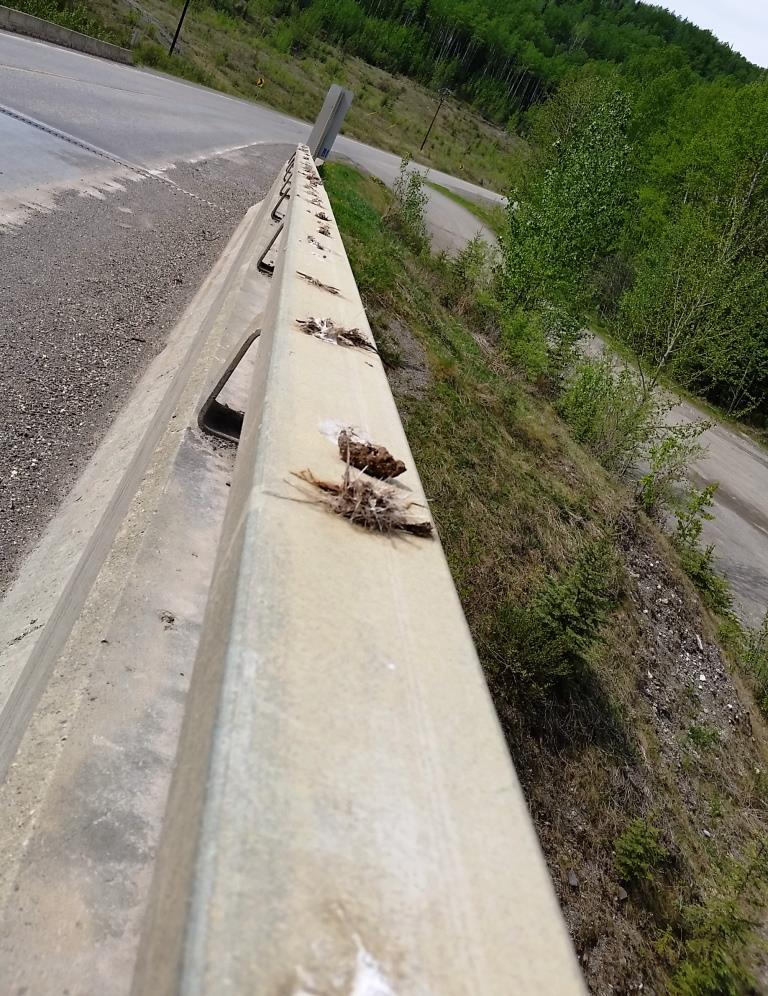
What we did see, when walking over one of the highway bridges close to the local boat launch, was a railing full of raven traces in the form of poop (yes, it's feces, but poop is more fun to write) and regurgitated pellets!

Most people are familiar with owl pellets or regurgitates. Owls tend to swallow their prey whole or in large chunks. Bone, fur, feathers, scales, skin, exoskeletons, and anything that the prey was eating (seeds and vegetation) are all swallowed. The gizzard of the owl compacts all of this hard to digest and indigestible material into a pellet, which the owl later regurgitates.


Owl pellets are fascinating, and form the base of a really fun educational activity: owl pellet dissection! It's a wonderful way to demonstrate the food web and predator-prey interactions, and predator diets. Owl pellets are also an invaluable source of dietary data for ornithologists studying the prey of target owl species. Owl pellets can also provide insight into the preservation of small mammal fauna from Cenozoic sediments: a paper by Terry (2004) examines what happens to the pellets of extant Great Horned Owls (Bubo virginianus) as they break down in a temperate forest environment. This another great example of how studies on modern ichnology (pellets are traces of an organism, so they are 100% in the realm of ichnology!) give us a better understanding of fossil ichnology.

Owls are not the only birds that regurgitate pellets: birds of prey, gulls, herons, cormorants, shorebirds, and corvids. Bird species that consume a great deal of indigestible material with their meal are likely to hack up pellets.

This morning I went to the bridge to see how many raven pellets I could collect for our institution's summer educational activities. We already have a Barn Owl pellet dissection activity, but Barn Owls are not native to northeastern British Columbia. The Common Raven, however, is ubiquitous in our region.

It was easy to see which side of the bridge the ravens preferred to perch on: the side that is closest to the boat launch. Our local ravens figured out that where there are trucks, there are people and the tasty things that people leave behind.

This Common Raven watched me from the boat launch the entire time I was rummaging around their bridge perch.

Clearly ravens spend a great deal of time on this railing.


I set to work choosing my samples. It was clear which deposits were pellets, and which ones were raven poo.


I did not arrange these deposits for the photo. The deposit on the far left has passed through the digestive tract and was deposited via the cloaca: you can see the white material (uric acid) and the small mounds underneath the uric acid. The deposit in the center is a nicely intact pellet. There is white material in the pellet, but it is solid, thin, and fragments of a once larger object. Our working hypothesis is that it is eggshell that this particular raven picked out of the trash. The deposit on the far right is full of fibrous vegetation and uric acid. It may have been a pellet that was later pooped on, or it was fecal in origin and has weathered a lot before I came across it.

I collected two intact pellets, and have passed them on to our Education Coordinator who will now heat sanitize the pellets. This site is easy to access, so we have the opportunity to collect more throughout the year. Once the pellets are sanitized, the kids participating in the Owl Pellet Dissection can compare the diet of a Barn Owl to that of their local Common Raven.

Wish me luck in finding more local bird pellet locations!


References

Terry, R. C. 2004. Owl pellet taphonomy: a preliminary study of the post-regurgitation taphonomic history of pellets in a temperate forest. Palaios 19(5):497-506.