Showing posts with label wildlife encounters. Show all posts

Thursday, January 4, 2018

Tracking Cretaceous Birds in South Korea: Bito Island

Happy New Year, Dear Readers!

I'm going to forgo the usual "Here are my goals for the New Year" post because...well, things are still up in the air, plan-wise. We still have no funding to continue the field documentation and excavation (a.k.a. research) of the Six Peaks Dinosaur Track Site (guest blog post on Real Scientists) near Hudson's Hope, British Columbia. This will be Year 2 of an uncertain field season. Right now, I'm just taking my work one day at a time, working on projects that I'm excited about. Some projects are research, while another is more literary in nature.

One of the projects I'm excited about is my science communication, and I must continue, Dear Reader, with my tale of Cretaceous bird tracks from South Korea!

We last left our ichnology heroes on September 13, 2017, at lunch at a Chinese restaurant after a morning of documenting tracks at Dr. Kim Kyung-soo's lab at Chinju University. We timed our lunch and travel to get from the University to Bito Island to hit the right part of the tide cycle, as our prospective field stops were all along the shoreline of the island. Doing field work in a tide-influenced area means you have to be aware of the local tide tables if you want to see outcrop. Our outcrops would be exposed during mid- to late afternoon.

The drive to Bito Island was lovely, with lots of coastal scenery (that does not photograph well at highway speeds). When we arrived at Bito Island around 2:45pm, Dr. Kim pointed out imagery of the Hare and the Tortoise, representing the Korean folktale of "The Hare's Liver." The Hare (representing the peasantry) had to be clever and quick to escape the Tortoise (representing nobility), who was tasked with fetching the liver of the Hare to cure the Dragon King. Here's a link to the story of "The Hare's Liver:" if you know of a better version, please let me know!

"The Hare's Liver." The Tortoise is likely happy because he thinks he's fulfilling his mission to retrieve the Hare's liver for the Dragon King, while the Hare is pleased that he's going to outwit the Tortoise and save his innards.
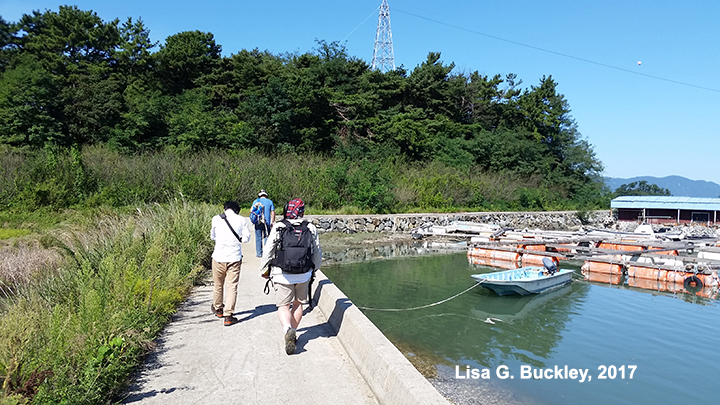
Our first stop was a possible reptilian track site. The area is a popular fishing spot, so there was good parking for the boat launches and anglers. We started our hike down to the first track site.
Strolling along one of the moorings for the small fishing boats on Bito Island.
The track site was a small exposure of finely-bedded (layered) silty sand that has some horizontal exposures. Here's Dr. Richard McCrea standing next to the track surface.

There are a great many similarities between doing fieldwork in South Korea and fieldwork in northeastern British Columbia. First, the bulk of the vertebrate fossil record for the Early Cretaceous in both areas is from the track record. There is skeletal material, but it is not common enough to tell an accurate story of life during the Early Cretaceous for South Korea and British Columbia. Second, both areas are heavily vegetated. We have to rely on either natural exposures along waterways and mountain tops, or those rocks exposed by the extensive industrial activity in both areas.

One thing we do not have in northeastern British Columbia is intertidal invertebrates occupying the track surfaces. Thankfully these snails were huddled in the cracks on the vertical part of the rock exposure and didn't hide the tracks.

Here is a close-up of the tracks exposed on the surface. They are very likely tracks of a large, Early Cretaceous turtle.

Our next stop was a larger track site that was a short car trip and a short hike away from Stop 1. It was a glorious day for a walk along the shoreline, and the scenery was beautiful.
The gorgeous coastal scenery on Bito Island.
I could look for bird tracks here all day.
Left to right: Drs. Richard McCrea, Martin Lockley, and Kim Kyung-soo, en route to the track site.
The track site is where the didactyl (two-toed) theropod tracks named Dromaeosauripus jinjuensis (Kim et al. 2012) were discovered (link to paper abstract).

We spent a little time sweeping off the small shoreline pebbles that covered the track surface.
Rich and Sujin standing behind the uncovered trackway of Dromaeosauripus jinjuensis.
Rich and our other grad student, Jason, at the Dromaeosauripus jinjuensis track site.
Here is a close-up of a section of the Dromaeosauripus jinjuensis trackway. Do you see the large theropod track stepping on the trackway?

Once we uncovered the Dromaeosauripus jinjuensis trackway, Rich got to work taking the pictures for a photogrammetry model.
Rich demonstrating photogrammetry in bright light conditions on the Dromaeosauripus jinjuensis trackway. Red arrows show the Dromaeosauripus jinjuensis tracks.
Site visits such as these are an important part of fossil heritage conservation. This trackway was described in 2012, but that doesn't mean that once it is published that it is forgotten about. This track site (and any other fossil site) will be examined every year to monitor its condition.

While the photogrammetry was taking place, I started hunting out my quarry: bird tracks! At this site, the smallest tracks we would see were those of Dromaeosauripus. We did see tracks of a small sauropod (think Brontosaurus for the trackmaker) on the same surface.
Sauropod manus (hand) and pes (foot) tracks, Bito Island. The arrow on the scale is 10 cm.
While I did not find any bird tracks at this track site, I did make a new friend. Meet (tentative identification) Scolopendra subspinipes, sometimes known as the Orange-legged Centipede.

I'm not the largest fan of encountering critters with more than six legs. I have been known to perform the Spider Dance at inopportune times. One such time was while using an outhouse in the field...admittedly not my most dignified moment. Thankfully I didn't find my new friend on my leg or in my backpack, although I did close all of the zips on my backpack after taking pictures of the centipede.

We were approaching 4:30pm when we went to the last field site for the day: a long stretch of shoreline on which large ornithopod tracks had been discovered. I immediately went into bird track mode and started with the rocks exposed near the edge of the forest.

I did find a suspicious-looking small trace, but there was not enough of it exposed for me to be sure that it was a vertebrate trace.

I also came across a medium-sized theropod track.

At this time the light was beginning to fade. Lighting plays a huge roll in seeing tracks in the field. The dimmer the light, the less likely you are to see small tracks. The best condition for seeing bird tracks in the field is a bright sunny day that casts shadows on low-relief surfaces. These were not ideal light conditions.
Dim light is not ideal for finding any track, let alone small, shallow bird tracks.
I started working my way down to the edge of the water around 6:30pm. I'll be honest: I was not expecting to find bird tracks this late in the day. I was still looking, but I knew my chances of recognizing bird tracks were slim. What caught my attention were all of the tiny hermit crabs. I knelt on to the wet, slippery rocks to try to get a picture of the hermit crabs...and my brain focused on a familiar pattern on the rock.

BIRD TRACKS!
I called people over, and we immediately started outlining the bird tracks that we could see using white chalk. Because this is a tidal-influenced area, Dr. Kim and his grad students began to salvage the track surface for removal back to the lab.

This part made me extremely nervous because the rock layer the bird tracks are on is very, but the surface came up in good condition. It turns out these were the first bird tracks to be found at this particular locality on the island. This was a good year for me finding bird tracks!

This was a full day! After we deposited the tracks in Dr. Kim's lab, we went to dinner at a sushi restaurant and ate more sushi in one sitting than I ever have in my entire life. We made it back to the Happy Owl Hotel by 11:00pm.
A very small part of the owl collection at The Happy Owl Hotel.
I downloaded all of my pictures and updated my field notes, and was definitely ready for bed at 11:30pm. The next day's adventure would prove to be just as busy, as we would visit the Jinju Innovation City track sites, and the Gajin-ri track site!

References

Kim JY, Lockley MG, Woo JO, Kim SH. 2012. Unusual didactyl traces from the Jinju Formation (Early Cretaceous, South Korea) indicate a new ichnospecies of Dromaeosauripus. Ichnos 19(1-2): 75-83.

Monday, December 4, 2017

Tracking Cretaceous Birds in South Korea: Chinju University

Hello Dear Readers!

I had an interruption in my planned blogging schedule with a long trip out of my office that included a keynote presentation at the Association of Professional Engineers and Geoscientists of British Columbia in Whistler B.C. on October 21, a couple of family visits, and presenting at the Afternoon of Palaeontology conference at the Philip J. Currie Museum in Wembly, A.B. I was also the host for the Real Scientists Twitter account for the week of November 12 (or as it should be officially changed to...Dinovember). THEN I had paper revisions and paper proof revisions to submit for a new ichnospecies of Ignotornis and the first occurrence of Ignotornis in Canada! In the parlance of the Internet, I haz a busy.

Now that I am back at my desk until the end of December, I can dust off Ye Olde Blog and continue with the tale of our ichnological adventure to South Korea! I'll be breaking our adventures of September 13th into two posts. This day was a combination of laboratory-based and field-based investigation, so there is A LOT to cover.

We left our mighty palaeontologists at the Happy Owl Hotel in Jinju.
Note: there are two spellings for the city. Jinju is the official name of the city, while Chinju is the European-style phonetic spelling that isn't being used much nowadays, but several official signs and building names still carry that spelling.

After our fantastic barbeque dinner (there are several styles of Korean barbeque and all of them are delicious) we were in bed (after updating notes) around 1:30 am.

We started September 13th bright and early when Dr. Kim drove us to his lab at Chinju University. There we met his graduate students Su-jin (who drove us from Daejeon to Jinju), and [CHECK NOTES]. We were given an introduction to all of the specimens that were available for study and those that are currently under investigation. Of course, I focused on the bird tracks, but there were so many specimens present that demonstrate the hugely diverse Early Cretaceous paleofauna of South Korea.

There was a bird track slab on the second floor of the Earth Sciences Department that was collected from Jinju Innovation City (more on that later). It preserved at least three bird trackways, and looked as though the ground the birds were walking on was pretty goopy - the toes do not have crisp, clean outlines that show digital pads, but they do show other details that might be missing from a non-goopy sediment, such as deeply impressed toes and webbing impressions.

Slab on the second floor of the Earth Sciences Department at Chinju (Jinju) University. 
The slab is on display for all of the students to see in the main hallway.
Since the track slab was on display in the main hallway, it also meant that I was on display while I was working. No one seemed too disturbed that I was lying on the display to get my measurements.
This part amused me somewhat. See the small gravel used as a decorative bedding to camouflage the supporting foam base? This may have been an outdoor display at some point because a cat had come into contact with the display and left some, um, commentary on what it thought of fossil bird tracks.

Apparently, you shouldn't send your bird track papers to cats to review.

This ranks a 1/10 in terms of animals interacting with fossil displays and fossil sites. The cat scat was easily removed with a plastic bag, and there were only two pieces. There was no smell of urine or evidence of fresh activity. If you want real horror stories of animals interacting with specimens, ask your local collections manager about moth or dermestid beetle infestations. Be kind to the poor souls and buy them a reviving beverage before requesting such a tale of misery and woe.

Step 1 of documenting a track slab such as this one was already done for me: all of the bird tracks on the slab were identified and had numbered stickers associated with them. All of the little white dots you see are number tags identifying a bird track.


This made Step 2 less time-consuming (but necessary) step to complete: outline ALL of the footprints with either a chalk or a soapstone pencil. This outlining step is crucial. First, it makes you look at the individual tracks. I mean, it makes you REALLY look at the tracks. You start to notice features in individual footprints that you might not otherwise see if you are just focusing on the number of tracks in a trackway.

Take a look at these lovely bird tracks.

Tracks 14, 15, and 16 are were made by the same bird, and by the same individual. There is still some overlying sediment that is filling in some of the toe impressions. Although there is some sediment filling in the backward-pointing toe (the hallux), we can see that is has a noticeable outside curve that is consistent in all the tracks. That's cool, and I'll be focusing on what this means for the trackmaker. 

Also, you can see that the step (also called the pace length in the literature) the bird took between track 14 and 15 is longer than the step between tracks 15 and 16. This is a really good example of something that frustrates people who don't really look at tracks: variation. 

Think about you walking from, say, your desk to the coffee/teapot. Are all of your steps equal in length? Did one foot catch a bit on the uneven carpet? Did you pass someone and move slightly off of your path to make sure you didn't shoulder-check them into the wall? There is absolutely no way that the step you take between track 14 and 15 is going to be exactly the same length as the step you take between track 15 and 16. Why? Because you are not a robot. And neither are the dinosaurs and birds that made these tracks. They are dynamic, complex living organisms that will make countless little adjustments as they walk. This is why I think it is important to spend time watching animals move in their natural habitats if you are going to study tracks. As soon as we stop viewing tracks as having been made by living animals, we've lost the purpose of studying fossil tracks: to learn more about the lives of extinct animals using records of their recorded behavior. [Steps off of soapbox.]

I don't have too many pictures of the rest of the team, as they were all down in the main laboratory, either taking photogrammetry images of track slabs (Rich) or making latex peels and plastic tracings of track slabs (Martin.) Rich was also mentoring the graduate students on how to take photogrammetry images. Photogrammetry is like any other computer tool we use in paleontology: garbage data in = garbage results out. In this case, the data are the digital photographs. If the photos are rushed and blurry, or if the settings on the camera change greatly between one photo and the next, or if the overlap of the photos isn't enough (we aim for at least 60% overlap for all of the images), then sure, you'll get a digital model, but you probably won't be able to collect much data from it.

We broke for lunch around 12:30 pm and went to a really good Chinese restaurant. I tried a soup that I was told had sea cucumber in it. If no one had told me I would never have known it was sea cucumber: it had the same taste and texture as portabella mushroom.

Over lunch, we planned our afternoon adventure. We were heading to Bitu Island to see some of the track sites in the field, including a site that has a dromaeosaur (a.k.a. the raptors from Jurassic Park) trackway! 

I was quite excited for our field adventure. All of the track sites we were going to see were on the shoreline, which - for my interests - means that there is a chance to see some modern shorebird tracks! I also enjoy shoreline prospecting: it is so different from the deep woods and mountain prospecting that we usually do in northeastern British Columbia.

Stay Tuned!

Thursday, February 4, 2016

Tracking the Wild in Your Neighborhood, Part 3: Of Mice and Birds

I have owls on the brain. My owl fascination (obsession?) is no secret. They are my favorite of the extant (living) theropods, followed hard on the hallux by diurnal raptors, vultures, and shorebirds.

Owls, traditionally known as harbingers of death and doom, are one of our Wild Neighbors: owls are often seen in city settings as long as there are trees. Parks, running trails, and cemeteries are great places to start looking for your Friendly Neighborhood Owl...

...OK, the friendly part is a lie. Don't let their adorable floofiness and their presence in your area fool you: owls are still wild animals. Mated pairs begin setting up their breeding territories in the early Spring, and owls take the word territory seriously. They will fiercely guard their territories. Also, while many owls are nocturnal (active at night), they still defend their territories during the day, much to the dismay of people who wander into those territories.

The most famous recent example is Owl Capone in Salem, Oregon: this Barred Owl was (and I'm going to guess we'll see Owl Capone again this year) was swooping silent but deadly onto joggers' heads and making off with their hats, leaving scratches in the process. There are now signs (made for the community courtesy of the Rachel Maddow Show) posted around Bush's Pasture Park, and they are all that is right with the world.


We may laugh at the idea of a hat-stealing owl, but keep in mind that having to constantly defend an area is stressful for owls. If you see an owl flying around your neighborhood in the early spring, keep a respectful distance. Don't hoot at them or chase them: this is the owl equivalent of a person running up to you and screaming "You want a piece of me?" in your face.

Also, keep your eyes on the ground! Owls are predators of rodents, birds, and insects. Owls are great at rodent control, and strike their rodent prey from above. Check out this BBC Earth video on filming a Barn Owl striking a target. It is simply amazing. My favorite part of the video is the shot from underneath.

"Oh, rats." The safe for work version of what a mouse's last thoughts would be on seeing this. Screen capture from BBC Earth video "The moment a hunting Barn Owl strikes its prey."
Owls hunt rodents year round, which means that you could see owl hunting traces in your neighborhood! They can hear rodents tunneling away under the snow, and will strike the snow to catch their frosty feast.

I have yet to see any owl hunting traces in person. The Internet is full of them, as well as the landing traces of other birds. While I keep hunting for my own owl trace, I do have some other landing traces of birds that may* have been going after rodents.

* It can be difficult to determine the exact timing of events when you're looking at more than one trace. There are clues you can use. Do the edges of the footprints look the same? Did the animals sink in about the same depth? This means the sediment didn't change much between Animal 1 and Animal 2 making their marks, and is more likely they were made at the same time. If one trace looks freshly made, and the other one has melted or frosty edges, they were likely not made at the same time.

Hunting Trace 1: The Magpie and the Mouse.

I took this photo outside of the University of Alberta Earth and Atmospheric Sciences building February 2, 2009.

I don't know for sure that the Black-billed Magpie was making a serious effort to go after this small rodent, but there is a bit of a trackway kerfluffle near the first rodent hop on the right of the image - the magpie was trying to make contact. Black-billed Magpies are omnivorous, and have no problem digging into meat when it is available. One of the difficult parts of ichnology is determining motive. Did these two events - the rodent hopping and the magpie landing - even happen at the same time, or did minutes pass? If they happened at the same time, was the magpie seriously looking for a rodent snack or was it being mischievous, as corvids are known to be. Was it just playing with the rodent? I don't know. Part of thinking about the different scenarios is what makes ichnology fun!

Part 2: The Bird and the Bouncy Mouse.

I took this image January 2, 2016.

I played with the contrast a bit to highlight the small tracks of the small rodent (presumably a mouse). The mouse trackway and the crater had the same type of preservation. The mouse track didn't walk over the crater (no footprints in the crater). The crater, while poorly defined, also had some clues. There were no footprints (other than mine), like those of a dog or a fox, leading up to it or leading away from it. This crater appears out of thin air. There seems to be a sweeping motion captured on the left hand side of the crater, and a hint of two wings.

Even with the clues, this is not enough for me to say with 100% certainty that either of these are bird hunting traces. It's promising, but it's not good enough. Lucky for us owls, hawks, and corvids are living right alongside us, so we just have to be patient when looking for trackways recording their behavior.

Trackways, modern and fossil, capture brief snapshots of the lives of these animals in time and space. The majority of animal trackways record what the animals spent the bulk of their time doing: moving from Point A to Point B. Birds of prey and corvids do most of their moving in the air, so when they do make contact with the ground, chances are it's for a pretty interesting reason!

So, I will be continuing my quest for the elusive Owl Hunting Trace. Keep an eye on your neighborhood skies for your local predatory birds, and an ear ready to identify local owls: you might be treated to a sneak-peek into their stealthy lives!

Saturday, January 16, 2016

Tracking the Wild in Your Neighborhood, Part 2: Fine Feathered Friends

There's one type of trace that I'm guaranteed to see during the winter: raven landing traces. The Common Raven is, well, common in northeastern British Columbia, and is a year-long resident. This is our equivalent to the Rock Dove (or pigeon) in more densely populated areas, or the Black-billed Magpie for my Edmonton, Alberta readers. The ravens here are a clever bunch: they recognize that pickup trucks without canopies are choice opportunities to look for garbage bags, and they are adept at removing both latched and screw top garbage can lids. They also are not shy about landing in the snow.

Cleared for landing!
Look for bird landing traces around bird feeding stations, dumpsters, grain silos, public parks, and garbage cans that people have forgotten to latch down.

This particular unkindness of ravens (which is an unfitting name for ravens, in my opinion) was quite happy to have discovered one such garbage can.

See the tail impression at the top of this image? Right in front of the tail impression are the foot impressions. This raven moved forward a bit right after touching down, and the snow to the left of the foot-body impression shows a wing sweep.

After landing, these ravens spent a great deal of time walking around their garbage treasure. Here we see the classic perching bird footprint shape in these footprints: a long backwards-facing digit (digit 1, or the hallux), the inner digit only lightly splayed away from the middle digit, and the outer digit largely splayed. This similar footprint shape is seen in many perching birds, from ravens to sparrows.

Another interesting feature in raven trackways is that they tend to drag their middle toes (digit III) when they walk.

Sometimes the Black-billed Magpies will join the ravens in their garbage-gutting, or will visit afterwards to pick over the scraps. Here's one Black-billed Magpie landing trace.

Landing traces of Black-billed Magpies tend to be a little bit smaller than those of the Common Raven. Magpie landing traces also come with a long tail drag, as seen above - directly related to their long tails!


The one trace for which I've been searching for over a decade is a predatory avian trace. This would be the impression left by a bird, such as an owl, hawk, or corvid, attempting to catch a small mammal. Our predatory birds are still active hunters in the areas in which they winter, so if you have a wooded area, park, or cemetery* nearby, check out the ground for landing strikes by hungry birds. I may have two such traces I can show you in my next post in the Tracking the Wild in Your Neighborhood series. Stay tuned!

*Yes, cemeteries. Cemeteries are quiet areas, often near or within wooded sections. Cemeteries can sometimes be the few remotely "wild" areas in a densely populated area. They also have the benefit of not being subject to the regular foot and vehicle traffic of a city. Cemeteries can be calm oases for urban wildlife.

Wednesday, January 6, 2016

Tracking the Wild in Your Neighborhood, Part 1: Cat or Dog?

Happy New Year!

One of my New Year's science-themed resolutions is to be a more regular contributor to my own blog. I'm going to aim for a more regular, more frequent schedule of posts. This may mean the posts are shorter, but hopefully this will get me into the habit of both writing science-based communication regularly and writing about what I do on a more consistent basis.

I don't have an "off" setting for my ichnology-eye. Going on regular walks around town in winter highlights all of the great, accessible vertebrate neoichnology (studying tracks and traces of modern animals) that is right outside of our own doors. Most people think that tracking animals involves heading into rural or wilderness areas, and that the city (or small community, in my case) is devoid of regular wildlife. A walk around your own neighborhood can reveal a great deal about what animals (other than humans) frequent the area.

My favorite way to introduce people to the wonders of urban ichnology is with our favorite furry friends, dogs and cats. Both members of the Order Carnivora, our feline and canine companions have similar-looking (though not exactly the same) feet, and can leave similar-looking footprints. This usually comes up large carnivore footprints are found near an urban setting. Here's a Daily Mail article on some spectacularly bad reporting on large carnivore tracks (sorry). Local speculations run wild (pun totally intended). Is it simply the print of a large dog, or is it something more dangerous sounding, like a mountain lion? In the case of the above link, the critter in question is likely a large, running canine, and probably not the super wolf hybrid monster speculated at by the interviewees. It's reports like this, and more level-headed reporting on local large carnivore tracks, that can be the start of the question "How do we tell a dog footprint from a cat footprint?"

I conducted a fun poll on Twitter in December. I posted a carnivore footprint and asked "Cat or Dog?"

Here is the image I posted:
Cat or Dog?
Here are the poll results:

67% of responders were correct: this is indeed the footprint of a cat!  People responding to the poll used all sorts of great observational evidence to support their identification of Cat or Dog. Cat voters noted the lack of claws, the round toe pads, and the wide splay of the toes to distinguish the footprint from that of a dog. I was also a stinker and did I did not include a scale bar on purpose so that people didn't think large = dog, small = cat: I'm going to use the most technical terminology possible and say that size sucks thrice-used tea bags when it comes to identifying footprints. (Note: I don't think I'm going to get "sucks thrice-used tea bags" past peer-review any time soon.)

Those observations were correct. There are also a few other clues that can be used to distinguish Fluffy's footprint from Fido's footprint. Here's a quick infographic I constructed comparing cat footprints to dog footprints, using photos from my neighborhood (cat) and outside of my vet's office (dog).

Cat (left) and Dog (right) footprints, scaled to approximately the same size.

Identifying footprints of cats and dogs can be easily converted into an ichnology-based educational exercise. Cats and dogs are fairly easy for kids to connect with. They likely have one or both as household pets, or they regularly see cats and dogs around their neighborhood. Footprints of cats and dogs are relatively easy to find. Educators with their own cats and/or dogs can make plaster replicas of their furry friend's footprints to use as in-class examples. A cooperative companion animal (my cat would be the antithesis of cooperative) could be brought in to give live demonstrations of footprints in a sandbox, clay, mud, and snow to look at how footprint shapes change (or stay the same) under different conditions. Also, being able to properly identify a canine footprint from a large cat footprint can go a long ways towards looking critically at wildlife-panic reporting, as seen in the link above.

Stay tuned for the next Tracking the Wild in Your Neighborhood post: Birds of a Feather Make Snow Impressions Together!

Saturday, August 29, 2015

Fieldwork Flail -The Ups and Downs of Being Out and About

Hello, Dear Readers!

Well, the thesis is off to the committee (eep!), so now I get to digitally dust off the blog and leave the academic hermitage that is writing thesis chapters! I've been figuratively chained to the office for most of the summer. While this was a self-imposed office banishment, having to stay indoors and write during the summer when every fiber of my being was screaming to be outdoors doing fieldwork wore on me. Needless to say, once the writing was done, I jumped at the opportunity to visit one of my favorite neoichnology sites before all the shorebirds abandoned us to the cold weather (thanks, birds). The site is a couple of hours drive from the museum and great for (long) day trip fieldwork.

What follows is a mixed bag of success and frustration: in short, it's the typical field story. 

I arranged with our summer field tech, Linda, to pick her up at 6am. I went to bed early, as I'd be up before the sun to put the finishing touches on my neoichnology field gear. Thanks to some horrid reaction to something I ate, I did not get to sleep until 2am. As I finally drifted off to sleep I thought "Oh, this trip is starting out well..."

The alarm blares off at 5am. I will be honest with you: I am not a morning person, even when I've had a decent night's sleep. "Good" is not paired with "morning" in my vocabulary. Our museum staff (morning people, the whole lot of them) take great delight in being all chipper around me when I first enter the building. The walking dead have more life in them than I do on waking. Several cups of tea infused me with what passes as life, I picked up Linda, we loaded the last of the gear into the field truck, and left town for a pleasantly uneventful drive to the site.

Oh, sorry. I slipped into telling fiction. Back to reality.

We were driving down the highway, which is pleasantly empty at this time of the morning. This means that I'm not ticking off the drivers who want to do 100-120km/hr by driving the speed limit (90km/hr). Given the driving habits of the region and the fact that we are smack dab in the middle of the BC wilderness, there are a lot of black tire marks on the highway. I didn't think anything of that new black mark on the road...until I was close enough to see that it had thickness. I slowed and swerved around whatever it was...

BANG!

My foot left the gas immediately. We slowed to a crawl. This let me know that a) my tire(s) were still attached to the truck, and b) the axles (if damaged) would last long enough to get us to a safe shoulder. We crept along the road until we found a turn-off to a gravel road, engaged the hazards, and stepped out to survey the damage.

The flattest of all tires.

Important Field Tip #1: Know how to change the tires on your field vehicle. Don't just assume that you know how to change a tire - actually practice on your field vehicle before you set off on your adventures. Everyone on your field crew needs to practice being the lead on changing a tire. Even though we were right on the highway, we had no cell service and the satellite phone was being twitchy, so there would be no calling BCAA.

Fortunately for me and Linda, while we had not been the leads on changing a tire, we knew enough from several assists how to do it. The most troublesome part of the process was lowering the bloody spare from under the vehicle because we couldn't find the thrice-damned attachment for the jack that fits into the decent mechanism. Which leads me to...

Important Field Tip #2: Keep all of your jack attachments in one area, even if they are small. It took longer than it should have to locate the proper attachment, which was helpfully located in the glove compartment. Once located, we were off to the races, so to speak. During the process we also encountered...

Important Field Tip #3: People are jerks. Don't trust that they will bother to stop, slow down, or even move their vehicle as they roar past you at 110km/hr on a relatively narrow highway. Out of the seven vehicles that drove past, not one even slowed down. This was all well and good - we didn't need help (and we didn't want the hassle of trying to tell someone that the damsels in distress actually could change a tire all by our little selves), but the gravel and dust being whipped at us from speeding trucks got old.

The tire change went smoothly. Once the tire was off...
we could see the extent of the damage. Whatever the tire had hit, it went right through. There would be no patching this tire. That tire wasn't just damaged: it was cancelled.
Linda shows us the extent of the damage.
That was Adventure #1. We decided that we deserved to stop at Tim Horton's before continuing on to the site. We also made a note of our location, because on the way back we planned to find the wretched thing in the road that thrashed the tire.

We made it to the parking area of the field site without any incident. Accessing the neoichnology site requires crossing a river. Usually the river is gentle and shallow enough at this location to cross without too much difficulty. However, recent rains had given the river a bit of vigor and depth. Each of us had a cumbersome load to pack across the river (plaster, mixing buckets, cameras, personal gear), and the local river bed flora add a nice element of slime to the bouldery river bed. Crossing would prove to be tricky.

We found a spot that looked promising, and started across. A combination of bulky gear, slimy boulders, and a slight misstep sent me flailing into the river.

SPLASH!

All I remember going in was thinking "S**t, the camera!" and holding that aloft with my right hand while my left hand let go of the bucket (which Linda retrieved before it floated off on its own adventure) and broke my fall. This area was deep enough that I didn't break my fall before going almost completely under the water - I think the top of my head was still dry - but the palm of my left hand took the full force of my fall as it hit boulders and gravel. Needless to say, there was a little bit of damage.
It's only a flesh wound...I hope.
I carry a first aid kit with me, but there was very little I could do at this point that couldn't wait until I reached civilization. Sure, I could have dug around in my hand to remove bits of embedded gravel, but nice cushiony blisters formed around the impact sites, so I knew where the offending material was located. What worried me more was the sharp ache deep in my first metacarpal - did I break or crack it? I could still move it, albeit with some discomfort, so I figured we had come too far to give up on the chance of shorebird traces.

We finally crossed the river, and I changed into more-or-less dry clothes. We had arrived!

This area is dominated by Canada Goose tracks, and the fine-grained sediment captured their trampling nicely.
Canada Goose trample surface.
With the Canada Goose tracks were smaller anseriform (duck) footprints: they have a different overall shape than Canada Goose tracks, so we knew they weren't young geese.

Duck, duck, (not) goose. Do you see the inward curving outer toes?
Did you see the webbing? Webbing is a useful feature when it preserves, but webbing is inconsistently preserved in bird tracks. If the sediment consistency is just right (firm yet damp, like a firm wet beach sand), webbing may not impress. A more reliable feature is the curvature of the lateral toes: members of the duck group (Anseriformes) with palmate webbing (a completely webbed three-toed foot) have digits II and IV (the outer two toes) that curve towards the middle digit (digit III). Sandpipers with semipalmate webbing (webbing that attaches only partly down the length of the toes) do not have inward curving side toes.

Part of neoichnology is hanging out in an area long enough to see the local wildlife. Ideally, you want to see the animal in question make the footprints. If that isn't an option, you need to know who is frequenting the area. If the tracks you are looking at are fresh, there's a better chance that the trackmakers you see are the owners of those footprints. These tracks were relatively fresh, so I knew that there was a good chance the trackmaker was either nearby or would revisit the site. All we had to do was wait.

While we were waiting, we checked out the track surface for more examples of the same type of footprint preserved in different ways. Here is a great example of how there is not one preservational scenario that will preserve all features all the time.
The webbing on these Canada Goose prints is very poorly preserved, but the hallux (digit I) on the left footprint is gorgeous! Digit I is another one of those birdy features that is inconsistently preserved, yet so many rely on the presence of the hallux impression as THE feature for saying with 100% certainty "Yes! We have a bird print!" I have a paper in press that discusses how the fossil and neoichnology data shows it's rarely that simple. Stay tuned!

We also found great samples of skin impressions for Canada Goose footprints. This print doesn't look like much at first glance - no webbing, no hallux, no "heel" pad (which isn't really a heel, but a fleshy pad where the toes and the end of the metatarsals connect)...
...but on closer inspection, it has great skin impressions!
A close-up look at the footprint shows that it preserves the creases, ridges, and pebbly texture on the bottom (plantar surface) of this Canada Goose's foot.

We also found evidence of our mammalian friends on the track surface: guess who?
If you guessed wolf, you would be correct!
Grey Wolf trackway overprinting the multiple trackways of Canada Goose. Bonus question: was this wolf walking or moving faster than a walk?
While we waited for the arrival of our small ducks (we could hear some quacking in the distance) we made a few plaster of Paris replicas of the different preservational variations of the Canada Goose and the as-of-yet unidentified small duck tracks.
Small duck trackway being cast.

The track surface with plaster replicas (white patches) drying.
Making replicas of modern tracks is a really simple process, and it's something that anyone of any age can do. We use a fiberglass-reinforced plaster of Paris (Hydrocal FGR-95). I also add additional fiberglass matting to the backs of the replicas, as many of my track casts are long and thin. Field neoichnology casting is a cumbersome process: you have to haul out plaster, mixing containers, fiberglass mat (or chop, but that's a pain in the butt to work with) and garbage bags. You also have to haul the awkwardly-shaped plaster casts out of the field. However, I think it's worth it for bird tracks. We're getting mixed results with digital photogrammetry on small bird footprints, and one of the reasons is that they are often wet, shiny, and partially underwater. All of this extra reflection confuses the computer program, which "prefers" even, consistent lighting for all of the images used in making the 3D digital replica. Also, plaster replicas are cheap to make, and I'm an ichnologist on a very strict budget.

This brings me to Important Field Tip #4: Pack it in, pack it out. We mix all of the plaster in a container placed inside a garbage bag, and any plaster drips and slops are collected after they harden. We don't want to leave a trace while we collect traces.

While we were waiting for the replicas to dry, we saw that our small ducks had arrived!
This is a horrid picture, but viewing these ducks through my binoculars let me know that they are Green-winged Teals in their non-breeding plumage. They are a small brown dappled duck, but one was kind enough to rearrange its wing feathers long enough to show me the green patch.

This was a good day for ducks, but where were my shorebirds? We scanned every centimeter of this shoreline, crossed over this waste-deep body of water to a second projection of land and scoured that for shorebird prints, and came up with almost nothing. We saw really faint impressions of Spotted Sandpiper footprints, but they were made in such wet mud that they had all but collapsed in on themselves, leaving nothing but faint lines where the toes impressions should be. We were about to call ourselves skunked in the shorebird category when we came across this:
FINALLY!
It turns out there were a pair of Spotted Sandpipers at this locality, but they were being extremely sneaky with us. We turned every corner just to see them flying away: none were comfortable with us in their territory, and they were more or less avoiding walking in areas that would keep an impression of a footprint for more than a few minutes. This was a huge change from last year, when two Spotted Sandpipers took a short nap while I was taking photos of them. On our way back to the field truck at the end of the day, we found out the little buggers had doubled back on us and were foraging in the areas we had already prospected. This brings me to my final Important Field Tip: you can't control your wild study taxa. Some days they cooperate, while on other days they flip you the feathery Bird.


This was a typical field excursion, full of wins (great duck and goose tracks) and fails (the Thrashing of the Tire and my new gravel piercings). Regardless of the frustrating parts, it was great to be back in the field!

Until next time,
SW

P.S. - My thumb turned out not to be broken (yay!) but it was swollen and sore for a few days. Here is a picture the day after I landed on it. Luckily the blisters were just impact blisters - there were no embedded gravel chunks to remove.