Showing posts with label paleontology. Show all posts

Friday, May 11, 2018

The Ivory Tower of Buying Fossils

It has been a couple of years since I've written about the commercial fossil trade and its erosive impacts (oh yes, I went there) on the science and public access of vertebrate paleontology heritage. Here's the usual scenario that inspires one of these posts:

There is media coverage of the high-profile sale of a dinosaur skeleton, and that skeleton is typically the skeleton of a theropod skeleton. There will be an opening line of "If you have Floppity Million dollars to spare, you could buy a dinosaur skeleton." Someone will be quoted as a paleontology expert. That expert will state that the skeleton is new to science, which justifies the million to multimillion-dollar price tag. There are some hazy references to the sellers and some quotes that portray how they were so excited to find such an amazing find. There is little consideration given to the future of the specimen once it is purchased.

And scene.

I was simultaneously frustrated and amused about The Guardian's "Rare dinosaur skeleton for sale - along with the rights to name species" piece. Amused because not only did it follow the tired formula of reporting on high-profile fossil sales, but it added the twist of buying the naming rights. Frustrated because, no matter how flippantly the naming of a fossil is described in the article, the realities are just not that simple. Let's get to the bare bones of the issue.

First, there are definite spins being played in this situation to make it appear above controversy. There is mention of charities that will receive a portion of the proceeds of the sale, but what's the amount? What percentage of that sale of 1.2 million euros is going to actually go to charities? 1 percent? 10 percent? 50 percent? Is this going to be a meaningful chunk of change, or is it the least possible buy-in for good optics?

The next spin tactic is the "fingers crossed it goes to a public display" pleading, in this case, quoted by "dinosaur expert" Eric Mickeler:

'Mickeler said he hoped the skeleton’s new owner would put it on public display.

"Dinosaur skeletons used to be bought by museums or collectors but recently there’s interest from a whole range of people. Thankfully in all the sales I have handled there’s never been one where the skeleton has ended up in a private place. Buyers like to share their pleasure, and there’s the size to consider," he said.'


I'm pleased that every sale this person has handled resulted in the specimen ending up in a public museum, but make no mistake: that is not guaranteed. This is why the commercial fossil trade is fraught with critique: there is no guaranteed stability for fossils that are purchased by private collectors.

Museums, in general, tend to be more stable than one person or a company. Museum archives are held in the public trust: this means that the fossils (or stuffed birds, or pickled spiders, or artifacts) are being cared for by specially-trained people for all of us. Museums and archives are caretakers of our common heritage. The archives are (ideally) a stable home that will care for a fossil specimen indefinitely. Two hundred years from now, we should be able to know exactly where that fossil is stored, and hear about the new discoveries that have been made because of that fossil over the years.

This is the other key part of a museum archive: scientists will be able to see that specimen ten or a hundred years from now to make new discoveries or to update science done by older technology. For example, our head curator, Dr. Richard McCrea, spent time at the Canadian Museum of Nature archives looking at the dinosaur footprint collections made by Charles Mortram Sternberg from the Hudson's Hope. C. M. Sternberg wrote up his finds in 1932. Eighty years later, Rich was able to see the exact footprints that C. M. Sternberg saw and apply new study techniques to those very specimens. That's the kind of stability a museum archive promises.

An individual human, or family, or even a business cannot promise the same long-term stability or access. The buyer - unless it is a museum - is under no obligation or code of ethics to keep the specimen in one place. The buyer could purchase the skeleton, get their name on it (more on that below), and then resell it. The buyer is under no obligation to disclose what they do with the specimen after they buy it. 

The buyer is also under no obligation to open their home/business to scientists wanting to study the specimen. They could deny access for personal or political reasons. For example: what if a scientist thinks "Hey, this newly named Bobosaurus might actually be an Allosaurus after all, so it doesn't need a new name." The buyer, if they have their name attached to the critter, might not want to see "their dinosaur name" be made defunct.

This brings me to the purchase of specimen naming rights. I'll quote the handler for this situation:

'[Mickeler] added: “The rule for all scientific discoveries that are confirmed to be new, the person who owns it can give it its scientific name. It can be the name of a company or a person. Then they just add an ‘-us’ on the end.”'

I do not know Prof. Mickeler: I have not heard their name through any of the other vertebrate paleontologists who I know. However, it's a comment like the one above that causes me to question their familiarity with how new specimens are named. I sincerely hope that Mickeler was misquoted because this statement ignores all of the conditions that must be met to name a new fossil specimen. I also do not know who the "unnamed paleontologists" are. I hope that they have a long, careful read of the Society of Vertebrate Paleontology's Code of Ethics. If they are members in good standing with the SVP, they should be familiar with Section 6:

Section 6. Commercial sale or trade - The barter, sale or purchase of scientifically significant vertebrate fossils is not condoned, unless it brings them into, or keeps them within, a public trust. Any other trade or commerce in scientifically significant vertebrate fossils is inconsistent with the foregoing, in that it deprives both the public and professionals of important specimens, which are part of our natural heritage.

First, one does not simply buy a fossil specimen and then announce in a press release "I NAME THEE BOBOSAURUS!" For a name to stick to a fossil (think Tyrannosaurus rex), that fossil first must be compared to all of the similar-sized and shaped fossils that are already named. If the bones are indeed different, then you can think about a new name.

Second, all of that comparison work has to be written up in a scientific paper. This paper can't just be published on my blog or in a newspaper. That scientific write-up has to be submitted to a scientific journal. That journal starts the process called peer-review, where the paper is then sent to specialists in that area of study. In this case, the paper would be sent to experts in large carnivorous dinosaurs. It is the job of those experts to pull that paper apart, identifying all of the areas that the paper is weak: faulty reasoning, leaps of logic, and opinion being stated as fact. The reviewers and the editor might agree there's not enough evidence to justify giving the specimen a new name. 

Third, more and more scientific journals are making it a requirement that specimens being published in their journal must be cared for in a public-trust archive, like a museum archive. There's a very good chance that studies of this specimen won't be able to be published unless the specimen finds its forever home in a museum. 

Fourth, naming new fossils is more than just sticking an "-us" on the end of your name. There is a whole instruction manual for naming new critters called the International Code for Zoological Nomenclature. Names have been made defunct just over not following the naming rules. For example, you can't name your new fossil "Brentisajerkosaurus iruleyoudroolensis" because there are rules against being a jerk to someone in a fossil name. [Apologies to Brent. I'm sure you're not a jerk.]

Fifth, there's no guarantee that your named specimen that you spent a floppity jillion dollars on isn't going to be renamed on you. As my friend and colleague Dr. Andrew Farke pointed out on Twitter, there's a lot of naming and renaming that is done on theropods (a.k.a. carnivorous dinosaurs) without needing to physically see the specimen. Just because you spent money on that name doesn't mean that name is going to be used forever.

Oh, and a funny bit about the science of naming things: if you give a new name to a specimen, and someone proves that the specimen is something that already has a name, your new name can never be used again. At best, your fancy expensive name will be given the title of "nomen dubium," which means that experts doubt the validity of the name. 

The Ivory Tower and The Dinosaur

One critique I hear, invariably whenever I write or speak about responsible fossil stewardship, is that I'm an Ivory Tower socialist elitist who wants to hoard all of the fossils and make sure that no one else gets to see them because of Reasons. I have an excellent long laugh at comments like these. We are advocating that fossils be kept in the public trust for the benefit of the largest number of people possible. The private sale of fossils, with large price tags, is such a succinct example of exclusion and elitism. Only a select few benefit from the sale of a fossil. You depend on the motives of the buyer as to whether that specimen will be available to the public. If we're going to label those actions that are elitist and exclusionary, that only benefit a select few as Ivory Tower, then I cannot think of a more perfect recipient of that label than the commercial fossil trade. When your actions support turning the specimens that are our common heritage into luxury collectibles, you have abandoned all illusion that the selling of fossils is altruistic, that it is for the common good, if you aim only to benefit the few. "

What are options other than selling a fossil specimen?

Use that money to fund research programs, museum operations, and archives upgrades. A 1.2 million euro donation to a museum's or scientist's work will ensure several years of discoveries are made. Science and discovery is not something that happens without support, and that support means money. Fieldwork to exciting locations costs money. Removing a new fossil from the ground costs money. Cleaning and restoring that fossil costs money. Visiting other museums to see if your fossil is new costs money. Putting that fossil on display costs money. This might sound like justification for selling one fossil for 1.2 million euros, but the difference is that a donation to a museum has the potential to make multiple such discoveries, not just the one. A research lab would be able to train multiple future paleontologists and share the many discoveries that you funded with the world. A donation is a better bang for your buck

Another method to "make money" off of a fossil specimen is to sell replicas. Fossil replicas are wonderful! They are lighter and less fragile than the original fossil. Fossil replicas can be displayed in a variety of ways and under a variety of conditions. Fossil replicas are the same size and shape of the original fossil so they will look just as impressive. The largest benefit is that replicas are replaceable: as long as the original specimen and the molds are being cared for in a long-term archive, you can make replacement replicas. Oh, and fossil replicas are a lot less expensive than the asking price for fossils being sold at auction, so there is more chance that museums - particularly small museums - can afford to put such replicas on display for their public. The revenues of replica sales can be recycled into the mechanisms that make the discovery of fossils possible: research and archives.

I do hope that the specimen ends up in a public collection, but the data to support such a hope is mixed. I do hope that the paleontologists involved have thought past the quick flash of their promotional idea to what such actions mean for the respect of fossil heritage as a whole.

For more of my thoughts on the commercial fossil trade, please see:


Saturday, March 3, 2018

Tracking Cretaceous Birds in South Korea: Goseong Public Library Talks

Hello, Dear Readers!

We've made it to September 16, 2017, when our Ichnology Heros are scheduled to give talks to the public at the Goseong Public Library! When we go to another country to do research, we always offer to give a local talk on the work we do in Canada, and how the local fossil record fits in with our work on a global scale.

Giving a talk in another country where the language is not your primary language is not that different (in my experience) than tailoring an academic talk to a public audience:

1. Keep the jargon to a minimum. There's always a way to explain even a highly technical test or feature using non-technical language.

2. You may understand your graphs, but remember: you've been staring at them for months or years. No blob of ambiguous data points on a graph with itty-bitty axes, no series of fifty graphs that only have really subtle differences. If you use graphs, make sure the meaning of the graph is crystal clear.

3. Pictures are worth a thousand words. If you can describe it, see if you can also show it. Outline hard to see details for your audience. If you're showing a picture of a single bone or a footprint, also show an image of the animal it came from (or the closest representative).

4. Remember - especially when your audience is in another country - that jokes/witticisms are often colloquial and have local or specialized meaning. it may fall flat. Also, "those jokes" (which are really just methods used to belittle groups who have less representation and/or power) about gender, race, jokes about sex, sexual innuendos, or sexual imagery, or jokes about political situations are in really poor taste, no matter your audience. They have no place in a talk communicating science to any audience. No one wants to see that nonsense.

5. If a translation is necessary, remember that this will (at least) double the time it takes to give your talk. Make sure you are not talking in huge paragraphs: your translator is going to have to remember what you've said and be forced to summarize your long rambling monologue to a more concise sentence or two.

We were told ahead of time that the audience would be a mix of children and adults, so I made sure to travel with my Bird Glamour makeup kit! I don't often have an opportunity to do a Bird Glamour for an extinct species of bird or avian theropod (although I did rock Anchiornis at the 2017 Society of Vertebrate Paleontology meeting during the auction/social event!) I was excited to do an ichnology-themed Bird Glamour.

This ichnology Bird Glamour was inspired by Ignotornis gajinensis, the bird trackways that have spoonbill-like "swooshes" preserved. These "swooshes" are similar in shape to the bill marks made on sediment by present-day spoonbills stirring up the sediment to catch fish and invertebrates.
Spoonbill with its namesake spoon-shaped bill.

I decided to go with the Black-faced Spoonbill for this Bird Glamour. We arrived at the Goseong Public Library after a nice lunch with the Library's curator, public programming coordinator, and some of the Library staff.
The poster advertising our public talks at the Goseong Public Library!
While the rest of the Ichnology Team had coffee and snacks with the curator, I applied my Black-faced Spoonbill look.

These looks can take anywhere from twenty minutes to an hour to create. Once I was done, Sujin asked if I could do her eyes up as an owl. Sujin chose a Long-eared Owl, and I was kindly given the use of the curator's office to apply Sujin's Long-eared Owl look.
Me (left) with Black-faced Spoonbill eyes and Sujin (right) with Long-eared Owl eyes. 
This was the first time I had given a public talk while wearing Bird Glamour. I admit to being a trifle nervous about it: people sometimes have a very specific stereotype image in mind when they think "scientist," and that image does not typically involve makeup, let alone bird-inspired makeup. Nevertheless, I opened my talk by introducing Bird Glamour and used the link between the Black-faced Spoonbill and Korea's fossil bird tracks to talk about the bird tracks of western Canada.
Dr. Martin Lockley talking about his track work in South Korea.
Dr. Richard McCrea talking about dinosaur tracks from western Canada.
The talks were very well-received: there were a lot of interesting questions from both the kids and adults in attendance. We went out for our last dinner in South Korea: bulgogi! After dinner, we went to Dr. Kim's lab for one last push to get as many tracks documented in our time remaining. We were at the lab until at least 11:00 pm local time.

Our flight from the Incheon Airport wasn't until the early afternoon, but we were scheduled to take a bus from Jinju to Incheon. The bus was scheduled to leave Jinju around 5:45 am. We were up, packed, and waiting in the hotel parking garage for our ride to the bus station at 5:10 am.

Things got...interesting. We saw some of the Jinju night-life as young people started returning home from what I assume was a fun Saturday night. Then a young woman staggers down the road. She is still in a partying mood and is very eager to give us cigarettes. She tells us in her limited English that she is from Russia, and that she doesn't speak [insert derogatory term here]. To directly quote my field notes from that morning "Charming that one of the few English words she knows is a slur. :| " While this interaction was taking place, I was scanning down the road to make sure that she was not distracting us so that an unseen companion could rob us. Before long Sujin arrived with an additional cab to take us and our luggage to the bus station. Rich gave his gift of cigarettes to our cab driver.

We arrived with plenty of time to get our boarding passes for the bus. These buses are glorious: truly comfortable seats with nice headrests and copious leg room. We slept until our rest stop about halfway between Jinju and Incheon Airport. We breakfasted on roasted chestnuts purchased at the concession. If you've never had roasted chestnuts, they have a soft texture that is slightly sweet.
Since all of the buses look the same, we made sure to remember in which space our bus was parked. 
We arrived at the airport with plenty of time to spare. This was good because it gave us a chance to repack our bags to make sure we didn't have power sources, like a solar battery charger, in our carry-on luggage. We found this out when Martin (who was flying out of Incheon first) was pulled out of line during his bag scanning to repack his bags. Oops. You can travel a million times and still miss an item or two.

Our flight back to Canada was uneventful, which is the best kind of flight! Usually, on a flight and while waiting in airports I type away on writing projects and papers. Sometimes I try to read if the jetlag isn't too powerful. I felt the jetlag start to hit me hard while we were waiting for our flight from Vancouver to Fort St. John. Jetlag gives me a very disconnected feeling: I feel as though I'm moving at a different tempo than that of the rest of the world. I also tend to feel as though all of my sensations have been muted.

Then, of course, there's the struggle to reclaim your original sleep schedule. This can take anywhere from a couple of days to over a week. My advice: don't try to do a hard reset on your sleep schedule. Day Three after we had arrived home, we forced ourselves into a "normal" day by doing a day trip into another community. We were out of the house at 9:00 am and in bed around 11:30 pm. The next thing we knew, we were waking up the next day at 3:45 pm. Just let the jet lag run its course.

That is the end of our tracking adventure in South Korea! Now we have several scientific papers to write on all of the data we collected! Hopefully, I'll be able to give you updates on those papers soon!

Saturday, February 17, 2018

Tracking Cretaceous Birds in South Korea: Goseong Dinosaur Tracks

Hello Dear Readers!

I'm excited to continue with our tale of Cretaceous tracks in South Korea! September 15 was our day to check out the coastal dinosaur track sites in Sangjogam County Park, a heritage site. This was a track site that Dr. Richard McCrea had visited back in 2000 on his first trip to South Korea. He said to me "I did not expect that I would ever get a chance to visit this site again."

A LOT had changed since Rich's visit in 2000. At that time the area was newly discovered and in the process of being documented. Let's just say, the progress made on the site was impressive!

After breakfasting and grabbing some Starbucks (science runs on caffeine all over the world), we drove to the parking area next to the coastline. We were immediately greeted by a great sauropod sculpture surveying the gorgeous shoreline.

"I am Lord/Lady of all I survey!" said every sauropod everywhere.
The entire area around the Goseong Dinosaur Museum was developed to celebrate the dinosaur track sites. The sidewalks also celebrate their fossil heritage.
Getting ready leave the walkway to stroll along the beach to see the sauropod tracks.
Of course, a sandy beach is a glorious place to look for present-day bird tracks. Today was a day for gull tracks.
One of these days, I'll be able to afford a decent lens for photographing birds. September 15 was not that day. Neither is today, actually.
This was the best picture I could get of one of the gulls roaming around the beach that morning. It's carrying a mussel in its beak, so the appearance of a black ring on the bill is artificial. I also didn't pack my binoculars that day, so my identification of this gull is "gull." The gulls did leave some nice trackways.
The sand is damp enough that the webbing impressions are preserved. We can clearly see the claw impressions and occasional toe impressions.
There was also some interesting behavior exhibited by the gull tracks. Check out this landing trace of a gull: you can see the long drag mark left by the hallux (backward-facing toe) running down the middle of the scuffed-looking footprint. I used this image for my weekly Twitter ichnology game #NameThatTrack.

Of course, I couldn't spend all day on the beach taking pictures of modern footprints (although this would be a worthy ichnology project.) We made our way over to the Goseong Track Site.

Goseong Dinosaur Track Site in Sangjogam County Park. Drs. Kim Kyung-soo (left) and Richard McCrea (right) taking initial observation notes.
The most obvious trackways on the site are sauropod trackways.
The circled areas are the sauropod tracks. Scalebar in the picture is 10 cm.
Close-up of the sauropod tracks with a 10 cm scale (and my feet) for scale.
While we were on the site, we found ourselves in the middle of a couple of school groups doing a geology-based field trip assignment and tour on the track site. We ended up being part of the tour, with the students watching us take photos and asking us questions. We also ended up signing autographs on their site brochures! That felt...odd. I mean, I was not involved with finding or developing the site, but I suppose they appreciated the chance to interact with dinosaur track scientists on the site.
Drs. Martin Lockley and Richard McCrea somewhere in the middle of the tour group!
There are several track types on the Goseong Track Site. Here is an ornithopod trackway, with the tracks outlined with dashed lines.

With coastal rock exposures, particularly those that are periodically covered by tides, we don't expect that tracks will "last" that long. Tides are powerful, running sand and shells over track surfaces. They also form tidal ecosystems: it's not uncommon to see dinosaur footprints doubling as tidepools. Given that tidal-influenced areas are generally high-energy, I was not expecting to see bird tracks at this site. I moved a little farther away from the shoreline to check out some fine-grained surfaces. I was not disappointed!
They are shallow, but there are small bird tracks!
It was an overcast day, so the light was fairly dim and there few shadows being cast on the track surface. These were great conditions for getting photogrammetry images of the sauropod and ornithopod trackways, but the dim light made seeing bird difficult. Like I've mentioned before, lighting is everything when it comes to recognizing tracks.

The Goseong Track Site was impressive for another reason: the level of resources and development that went into making the site accessible to the public. When I show these images, remember that only 17 years prior this area didn't have the track sites developed or a dinosaur museum built.

First, there are the extensive walkways built along the coastline so that people can look over the track surface. There are several kilometers of these walkways! At key points along the walkways are informative signs that direct visitors' attention to key geologic and paleontologic views.

Editorial Note: OK, friends, I need to go on a bit of a rant. Look at this sign. It gives out science information without talking down to the reader. Do you see any cheap, lazy Jurassic Park-themed lettering? Any sensationalized attempts to use giant waves in "storytelling"? You do not. I did not see ANY sign of the North American-style insulting "tourism marketing" in South Korea. This is because the organizations that made these signs actually respect the intelligence of the people who are visiting natural history sites. They don't assume that there is "too much science" in the information provided, or that the public needs to be "talked down to."  Each time I see a fossil heritage site that blatantly uses Jurassic Park imagery and/or sensationalized "stories" to interpret a site, I assume the organization that created those signs does not respect their visitors OR the fossil heritage they exploit. Respect for fossil heritage or those interested in natural history isn't even on the radar for those particular organisations: fossils are merely a thing to selfishly use, and the public are just their dupes with wallets. It makes me feel angry and ill. Oh, and the fact that, since Rich's 2000 visit, a museum and outdoor interpretive sites had been fully developed? It is extremely frustrating to see the slow progress of getting similar dinosaur track sites developed in North America. We've been in the Peace Region full-time since 2004 and we still struggle year-to-year to have fossil heritage conservation funded.

We hiked up to another track site that was not yet interpreted: one of the aspects of coastal geology is that it changes a lot, with new rock surfaces constantly being exposed. Rocky cliffs are also a tricky place to do ichnology, mostly because of the ever-present threat of those tracks using gravity to make face-time with you. Here are some bird tracks exposed on the underside of a rock exposure. We couldn't get a close-up view of them, but we could tell they were the ichnogenus Jindongornipes.
The preservation of these large bird tracks (Jindongornipes) is amazing! We can even see webbing impressions!
Rich attempting photogrammetry on the Jindongornipes tracks. It becomes more tricky when you can't get something for scale on to the track surface.
We continued our hike up from the coastline boardwalk to connect with the outdoor trails and displays of the Goseong Dinosaur Museum. Again we were treated to a glorious sight: great outdoor displays that did not shy away from interpreting science.
The boardwalk trail joins up to the Goseong Dinosaur Museum outdoor trails.
Um, friends? There's a Utahraptor watching you!
All of the outdoor dinosaur sculptures were time-appropriate to the age of the tracks exposed at the Goseong Dinosaur Track Site: Early Cretaceous in age, roughly 120-100 million years old. We did not see any Tyrannosaurus rex or Triceratops models, which are 66 million years old. This was another sign (to me) that the Goseong Dinosaur Museum wasn't relying on sensationalism (a.k.a. all cool dinosaurs are T. rex!) to interpret their fossil heritage.

The Goseong Dinosaur Museum also had some fun with their outdoor displays. I love this cartoon bird pointing out the names of the bird tracks.
We stopped for lunch with the Goseong Dinosaur Museum curator at the museum's cafe, and were treated to a wonderful beverage: quince tea that the curator made! We found out the recipe, but darn it! We can't seem to find quince anywhere in grocery stores. The hunt continues!

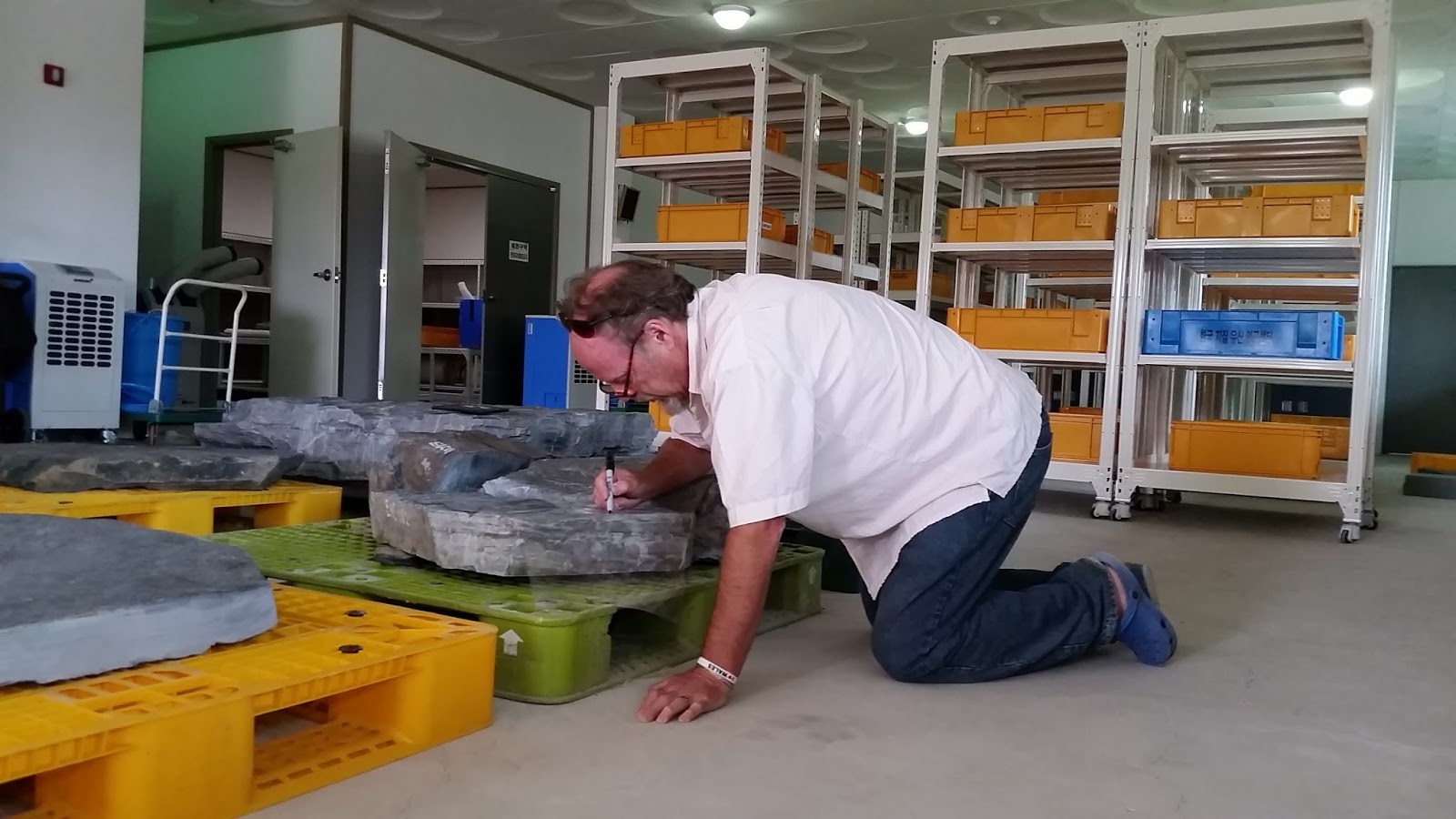
After lunch we spent some time in the collections facility of the Goseong Dinosaur Museum, collecting data, photogrammetry images, and track slab tracings.
Dr. Martin Lockley making a plastic sheet tracing of a bird track slab.
Sometimes you meet the local fauna when you work on tracks. Here's a wolf spider, who was not impressed when I disturbed its cozy hideout. It was ceremoniously moved outside.
One of the many bird track slabs in the Goseong Dinosaur Museum collections.

Drs. Martin Lockley (left) and Richard McCrea (right). If you like groaner-puns, these are the two to go into the field with.
We worked until evening, and then went out for dinner at a restaurant whose name roughly translates to "The Broken Bone Restaurant." It was a great dish of stewed meat on the bone, served with fried rice.
The Broken Bone Restaurant. 
It's no secret that I like spicy foods. Do you see the green chilis on the dish to the left? Up until this point, I had been munching on these peppers like they were candy. Tonight was the night that I found out there are two types of long green chilis: mild and spicy. I caused a great deal of amusement as I sat there, eyes streaming, face flushed, laughing at my luck of the draw. I found out that the smooth-skinned green chilis are the mild ones, and the green chilis with wrinkled skin near the stem are spicy. Live and learn!

The next day we were scheduled to give public talks on our work in Canada and South Korea at the Goseong Public Library! Tune in next week to find out how our talks went!

Thursday, January 4, 2018

Tracking Cretaceous Birds in South Korea: Bito Island

Happy New Year, Dear Readers!

I'm going to forgo the usual "Here are my goals for the New Year" post because...well, things are still up in the air, plan-wise. We still have no funding to continue the field documentation and excavation (a.k.a. research) of the Six Peaks Dinosaur Track Site (guest blog post on Real Scientists) near Hudson's Hope, British Columbia. This will be Year 2 of an uncertain field season. Right now, I'm just taking my work one day at a time, working on projects that I'm excited about. Some projects are research, while another is more literary in nature.

One of the projects I'm excited about is my science communication, and I must continue, Dear Reader, with my tale of Cretaceous bird tracks from South Korea!

We last left our ichnology heroes on September 13, 2017, at lunch at a Chinese restaurant after a morning of documenting tracks at Dr. Kim Kyung-soo's lab at Chinju University. We timed our lunch and travel to get from the University to Bito Island to hit the right part of the tide cycle, as our prospective field stops were all along the shoreline of the island. Doing field work in a tide-influenced area means you have to be aware of the local tide tables if you want to see outcrop. Our outcrops would be exposed during mid- to late afternoon.

The drive to Bito Island was lovely, with lots of coastal scenery (that does not photograph well at highway speeds). When we arrived at Bito Island around 2:45pm, Dr. Kim pointed out imagery of the Hare and the Tortoise, representing the Korean folktale of "The Hare's Liver." The Hare (representing the peasantry) had to be clever and quick to escape the Tortoise (representing nobility), who was tasked with fetching the liver of the Hare to cure the Dragon King. Here's a link to the story of "The Hare's Liver:" if you know of a better version, please let me know!

"The Hare's Liver." The Tortoise is likely happy because he thinks he's fulfilling his mission to retrieve the Hare's liver for the Dragon King, while the Hare is pleased that he's going to outwit the Tortoise and save his innards.
Our first stop was a possible reptilian track site. The area is a popular fishing spot, so there was good parking for the boat launches and anglers. We started our hike down to the first track site.
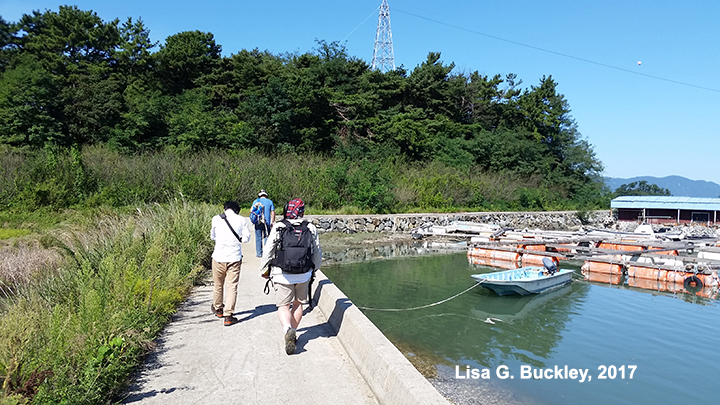
Strolling along one of the moorings for the small fishing boats on Bito Island.
The track site was a small exposure of finely-bedded (layered) silty sand that has some horizontal exposures. Here's Dr. Richard McCrea standing next to the track surface.

There are a great many similarities between doing fieldwork in South Korea and fieldwork in northeastern British Columbia. First, the bulk of the vertebrate fossil record for the Early Cretaceous in both areas is from the track record. There is skeletal material, but it is not common enough to tell an accurate story of life during the Early Cretaceous for South Korea and British Columbia. Second, both areas are heavily vegetated. We have to rely on either natural exposures along waterways and mountain tops, or those rocks exposed by the extensive industrial activity in both areas.

One thing we do not have in northeastern British Columbia is intertidal invertebrates occupying the track surfaces. Thankfully these snails were huddled in the cracks on the vertical part of the rock exposure and didn't hide the tracks.

Here is a close-up of the tracks exposed on the surface. They are very likely tracks of a large, Early Cretaceous turtle.

Our next stop was a larger track site that was a short car trip and a short hike away from Stop 1. It was a glorious day for a walk along the shoreline, and the scenery was beautiful.
The gorgeous coastal scenery on Bito Island.
I could look for bird tracks here all day.
Left to right: Drs. Richard McCrea, Martin Lockley, and Kim Kyung-soo, en route to the track site.
The track site is where the didactyl (two-toed) theropod tracks named Dromaeosauripus jinjuensis (Kim et al. 2012) were discovered (link to paper abstract).

We spent a little time sweeping off the small shoreline pebbles that covered the track surface.
Rich and Sujin standing behind the uncovered trackway of Dromaeosauripus jinjuensis.
Rich and our other grad student, Jason, at the Dromaeosauripus jinjuensis track site.
Here is a close-up of a section of the Dromaeosauripus jinjuensis trackway. Do you see the large theropod track stepping on the trackway?

Once we uncovered the Dromaeosauripus jinjuensis trackway, Rich got to work taking the pictures for a photogrammetry model.
Rich demonstrating photogrammetry in bright light conditions on the Dromaeosauripus jinjuensis trackway. Red arrows show the Dromaeosauripus jinjuensis tracks.
Site visits such as these are an important part of fossil heritage conservation. This trackway was described in 2012, but that doesn't mean that once it is published that it is forgotten about. This track site (and any other fossil site) will be examined every year to monitor its condition.

While the photogrammetry was taking place, I started hunting out my quarry: bird tracks! At this site, the smallest tracks we would see were those of Dromaeosauripus. We did see tracks of a small sauropod (think Brontosaurus for the trackmaker) on the same surface.
Sauropod manus (hand) and pes (foot) tracks, Bito Island. The arrow on the scale is 10 cm.
While I did not find any bird tracks at this track site, I did make a new friend. Meet (tentative identification) Scolopendra subspinipes, sometimes known as the Orange-legged Centipede.

I'm not the largest fan of encountering critters with more than six legs. I have been known to perform the Spider Dance at inopportune times. One such time was while using an outhouse in the field...admittedly not my most dignified moment. Thankfully I didn't find my new friend on my leg or in my backpack, although I did close all of the zips on my backpack after taking pictures of the centipede.

We were approaching 4:30pm when we went to the last field site for the day: a long stretch of shoreline on which large ornithopod tracks had been discovered. I immediately went into bird track mode and started with the rocks exposed near the edge of the forest.

I did find a suspicious-looking small trace, but there was not enough of it exposed for me to be sure that it was a vertebrate trace.

I also came across a medium-sized theropod track.

At this time the light was beginning to fade. Lighting plays a huge roll in seeing tracks in the field. The dimmer the light, the less likely you are to see small tracks. The best condition for seeing bird tracks in the field is a bright sunny day that casts shadows on low-relief surfaces. These were not ideal light conditions.
Dim light is not ideal for finding any track, let alone small, shallow bird tracks.
I started working my way down to the edge of the water around 6:30pm. I'll be honest: I was not expecting to find bird tracks this late in the day. I was still looking, but I knew my chances of recognizing bird tracks were slim. What caught my attention were all of the tiny hermit crabs. I knelt on to the wet, slippery rocks to try to get a picture of the hermit crabs...and my brain focused on a familiar pattern on the rock.

BIRD TRACKS!
I called people over, and we immediately started outlining the bird tracks that we could see using white chalk. Because this is a tidal-influenced area, Dr. Kim and his grad students began to salvage the track surface for removal back to the lab.

This part made me extremely nervous because the rock layer the bird tracks are on is very, but the surface came up in good condition. It turns out these were the first bird tracks to be found at this particular locality on the island. This was a good year for me finding bird tracks!

This was a full day! After we deposited the tracks in Dr. Kim's lab, we went to dinner at a sushi restaurant and ate more sushi in one sitting than I ever have in my entire life. We made it back to the Happy Owl Hotel by 11:00pm.
A very small part of the owl collection at The Happy Owl Hotel.
I downloaded all of my pictures and updated my field notes, and was definitely ready for bed at 11:30pm. The next day's adventure would prove to be just as busy, as we would visit the Jinju Innovation City track sites, and the Gajin-ri track site!

References

Kim JY, Lockley MG, Woo JO, Kim SH. 2012. Unusual didactyl traces from the Jinju Formation (Early Cretaceous, South Korea) indicate a new ichnospecies of Dromaeosauripus. Ichnos 19(1-2): 75-83.