Showing posts with label fossils. Show all posts

Saturday, February 17, 2018

Tracking Cretaceous Birds in South Korea: Goseong Dinosaur Tracks

Hello Dear Readers!

I'm excited to continue with our tale of Cretaceous tracks in South Korea! September 15 was our day to check out the coastal dinosaur track sites in Sangjogam County Park, a heritage site. This was a track site that Dr. Richard McCrea had visited back in 2000 on his first trip to South Korea. He said to me "I did not expect that I would ever get a chance to visit this site again."

A LOT had changed since Rich's visit in 2000. At that time the area was newly discovered and in the process of being documented. Let's just say, the progress made on the site was impressive!

After breakfasting and grabbing some Starbucks (science runs on caffeine all over the world), we drove to the parking area next to the coastline. We were immediately greeted by a great sauropod sculpture surveying the gorgeous shoreline.

"I am Lord/Lady of all I survey!" said every sauropod everywhere.
The entire area around the Goseong Dinosaur Museum was developed to celebrate the dinosaur track sites. The sidewalks also celebrate their fossil heritage.
Getting ready leave the walkway to stroll along the beach to see the sauropod tracks.
Of course, a sandy beach is a glorious place to look for present-day bird tracks. Today was a day for gull tracks.
One of these days, I'll be able to afford a decent lens for photographing birds. September 15 was not that day. Neither is today, actually.
This was the best picture I could get of one of the gulls roaming around the beach that morning. It's carrying a mussel in its beak, so the appearance of a black ring on the bill is artificial. I also didn't pack my binoculars that day, so my identification of this gull is "gull." The gulls did leave some nice trackways.
The sand is damp enough that the webbing impressions are preserved. We can clearly see the claw impressions and occasional toe impressions.
There was also some interesting behavior exhibited by the gull tracks. Check out this landing trace of a gull: you can see the long drag mark left by the hallux (backward-facing toe) running down the middle of the scuffed-looking footprint. I used this image for my weekly Twitter ichnology game #NameThatTrack.

Of course, I couldn't spend all day on the beach taking pictures of modern footprints (although this would be a worthy ichnology project.) We made our way over to the Goseong Track Site.

Goseong Dinosaur Track Site in Sangjogam County Park. Drs. Kim Kyung-soo (left) and Richard McCrea (right) taking initial observation notes.
The most obvious trackways on the site are sauropod trackways.
The circled areas are the sauropod tracks. Scalebar in the picture is 10 cm.
Close-up of the sauropod tracks with a 10 cm scale (and my feet) for scale.
While we were on the site, we found ourselves in the middle of a couple of school groups doing a geology-based field trip assignment and tour on the track site. We ended up being part of the tour, with the students watching us take photos and asking us questions. We also ended up signing autographs on their site brochures! That felt...odd. I mean, I was not involved with finding or developing the site, but I suppose they appreciated the chance to interact with dinosaur track scientists on the site.
Drs. Martin Lockley and Richard McCrea somewhere in the middle of the tour group!
There are several track types on the Goseong Track Site. Here is an ornithopod trackway, with the tracks outlined with dashed lines.

With coastal rock exposures, particularly those that are periodically covered by tides, we don't expect that tracks will "last" that long. Tides are powerful, running sand and shells over track surfaces. They also form tidal ecosystems: it's not uncommon to see dinosaur footprints doubling as tidepools. Given that tidal-influenced areas are generally high-energy, I was not expecting to see bird tracks at this site. I moved a little farther away from the shoreline to check out some fine-grained surfaces. I was not disappointed!
They are shallow, but there are small bird tracks!
It was an overcast day, so the light was fairly dim and there few shadows being cast on the track surface. These were great conditions for getting photogrammetry images of the sauropod and ornithopod trackways, but the dim light made seeing bird difficult. Like I've mentioned before, lighting is everything when it comes to recognizing tracks.

The Goseong Track Site was impressive for another reason: the level of resources and development that went into making the site accessible to the public. When I show these images, remember that only 17 years prior this area didn't have the track sites developed or a dinosaur museum built.

First, there are the extensive walkways built along the coastline so that people can look over the track surface. There are several kilometers of these walkways! At key points along the walkways are informative signs that direct visitors' attention to key geologic and paleontologic views.

Editorial Note: OK, friends, I need to go on a bit of a rant. Look at this sign. It gives out science information without talking down to the reader. Do you see any cheap, lazy Jurassic Park-themed lettering? Any sensationalized attempts to use giant waves in "storytelling"? You do not. I did not see ANY sign of the North American-style insulting "tourism marketing" in South Korea. This is because the organizations that made these signs actually respect the intelligence of the people who are visiting natural history sites. They don't assume that there is "too much science" in the information provided, or that the public needs to be "talked down to."  Each time I see a fossil heritage site that blatantly uses Jurassic Park imagery and/or sensationalized "stories" to interpret a site, I assume the organization that created those signs does not respect their visitors OR the fossil heritage they exploit. Respect for fossil heritage or those interested in natural history isn't even on the radar for those particular organisations: fossils are merely a thing to selfishly use, and the public are just their dupes with wallets. It makes me feel angry and ill. Oh, and the fact that, since Rich's 2000 visit, a museum and outdoor interpretive sites had been fully developed? It is extremely frustrating to see the slow progress of getting similar dinosaur track sites developed in North America. We've been in the Peace Region full-time since 2004 and we still struggle year-to-year to have fossil heritage conservation funded.

We hiked up to another track site that was not yet interpreted: one of the aspects of coastal geology is that it changes a lot, with new rock surfaces constantly being exposed. Rocky cliffs are also a tricky place to do ichnology, mostly because of the ever-present threat of those tracks using gravity to make face-time with you. Here are some bird tracks exposed on the underside of a rock exposure. We couldn't get a close-up view of them, but we could tell they were the ichnogenus Jindongornipes.
The preservation of these large bird tracks (Jindongornipes) is amazing! We can even see webbing impressions!
Rich attempting photogrammetry on the Jindongornipes tracks. It becomes more tricky when you can't get something for scale on to the track surface.
We continued our hike up from the coastline boardwalk to connect with the outdoor trails and displays of the Goseong Dinosaur Museum. Again we were treated to a glorious sight: great outdoor displays that did not shy away from interpreting science.
The boardwalk trail joins up to the Goseong Dinosaur Museum outdoor trails.
Um, friends? There's a Utahraptor watching you!
All of the outdoor dinosaur sculptures were time-appropriate to the age of the tracks exposed at the Goseong Dinosaur Track Site: Early Cretaceous in age, roughly 120-100 million years old. We did not see any Tyrannosaurus rex or Triceratops models, which are 66 million years old. This was another sign (to me) that the Goseong Dinosaur Museum wasn't relying on sensationalism (a.k.a. all cool dinosaurs are T. rex!) to interpret their fossil heritage.

The Goseong Dinosaur Museum also had some fun with their outdoor displays. I love this cartoon bird pointing out the names of the bird tracks.
We stopped for lunch with the Goseong Dinosaur Museum curator at the museum's cafe, and were treated to a wonderful beverage: quince tea that the curator made! We found out the recipe, but darn it! We can't seem to find quince anywhere in grocery stores. The hunt continues!

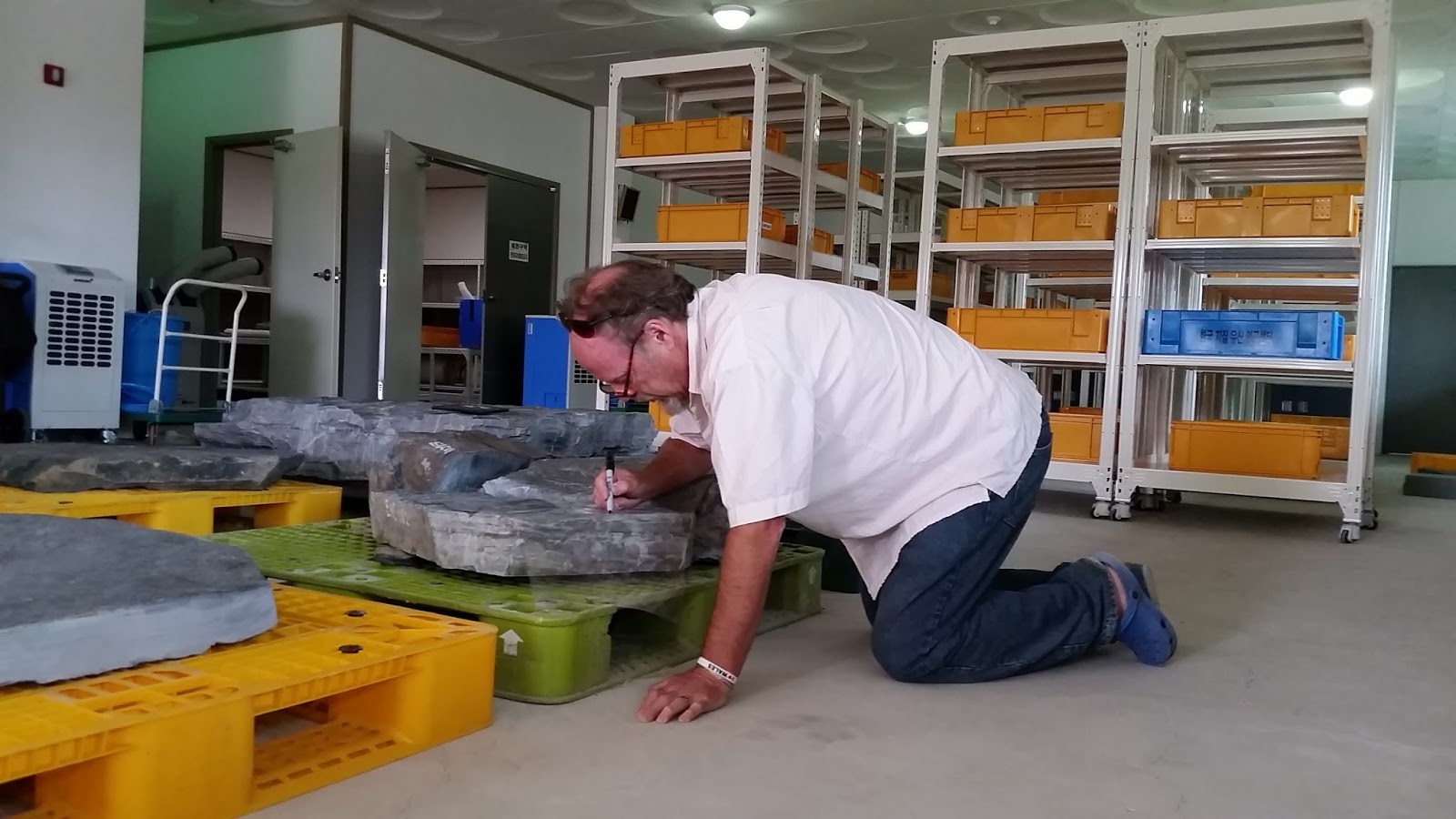
After lunch we spent some time in the collections facility of the Goseong Dinosaur Museum, collecting data, photogrammetry images, and track slab tracings.
Dr. Martin Lockley making a plastic sheet tracing of a bird track slab.
Sometimes you meet the local fauna when you work on tracks. Here's a wolf spider, who was not impressed when I disturbed its cozy hideout. It was ceremoniously moved outside.
One of the many bird track slabs in the Goseong Dinosaur Museum collections.

Drs. Martin Lockley (left) and Richard McCrea (right). If you like groaner-puns, these are the two to go into the field with.
We worked until evening, and then went out for dinner at a restaurant whose name roughly translates to "The Broken Bone Restaurant." It was a great dish of stewed meat on the bone, served with fried rice.
The Broken Bone Restaurant. 
It's no secret that I like spicy foods. Do you see the green chilis on the dish to the left? Up until this point, I had been munching on these peppers like they were candy. Tonight was the night that I found out there are two types of long green chilis: mild and spicy. I caused a great deal of amusement as I sat there, eyes streaming, face flushed, laughing at my luck of the draw. I found out that the smooth-skinned green chilis are the mild ones, and the green chilis with wrinkled skin near the stem are spicy. Live and learn!

The next day we were scheduled to give public talks on our work in Canada and South Korea at the Goseong Public Library! Tune in next week to find out how our talks went!

Monday, December 4, 2017

Tracking Cretaceous Birds in South Korea: Chinju University

Hello Dear Readers!

I had an interruption in my planned blogging schedule with a long trip out of my office that included a keynote presentation at the Association of Professional Engineers and Geoscientists of British Columbia in Whistler B.C. on October 21, a couple of family visits, and presenting at the Afternoon of Palaeontology conference at the Philip J. Currie Museum in Wembly, A.B. I was also the host for the Real Scientists Twitter account for the week of November 12 (or as it should be officially changed to...Dinovember). THEN I had paper revisions and paper proof revisions to submit for a new ichnospecies of Ignotornis and the first occurrence of Ignotornis in Canada! In the parlance of the Internet, I haz a busy.

Now that I am back at my desk until the end of December, I can dust off Ye Olde Blog and continue with the tale of our ichnological adventure to South Korea! I'll be breaking our adventures of September 13th into two posts. This day was a combination of laboratory-based and field-based investigation, so there is A LOT to cover.

We left our mighty palaeontologists at the Happy Owl Hotel in Jinju.
Note: there are two spellings for the city. Jinju is the official name of the city, while Chinju is the European-style phonetic spelling that isn't being used much nowadays, but several official signs and building names still carry that spelling.

After our fantastic barbeque dinner (there are several styles of Korean barbeque and all of them are delicious) we were in bed (after updating notes) around 1:30 am.

We started September 13th bright and early when Dr. Kim drove us to his lab at Chinju University. There we met his graduate students Su-jin (who drove us from Daejeon to Jinju), and [CHECK NOTES]. We were given an introduction to all of the specimens that were available for study and those that are currently under investigation. Of course, I focused on the bird tracks, but there were so many specimens present that demonstrate the hugely diverse Early Cretaceous paleofauna of South Korea.

There was a bird track slab on the second floor of the Earth Sciences Department that was collected from Jinju Innovation City (more on that later). It preserved at least three bird trackways, and looked as though the ground the birds were walking on was pretty goopy - the toes do not have crisp, clean outlines that show digital pads, but they do show other details that might be missing from a non-goopy sediment, such as deeply impressed toes and webbing impressions.

Slab on the second floor of the Earth Sciences Department at Chinju (Jinju) University. 
The slab is on display for all of the students to see in the main hallway.
Since the track slab was on display in the main hallway, it also meant that I was on display while I was working. No one seemed too disturbed that I was lying on the display to get my measurements.
This part amused me somewhat. See the small gravel used as a decorative bedding to camouflage the supporting foam base? This may have been an outdoor display at some point because a cat had come into contact with the display and left some, um, commentary on what it thought of fossil bird tracks.

Apparently, you shouldn't send your bird track papers to cats to review.

This ranks a 1/10 in terms of animals interacting with fossil displays and fossil sites. The cat scat was easily removed with a plastic bag, and there were only two pieces. There was no smell of urine or evidence of fresh activity. If you want real horror stories of animals interacting with specimens, ask your local collections manager about moth or dermestid beetle infestations. Be kind to the poor souls and buy them a reviving beverage before requesting such a tale of misery and woe.

Step 1 of documenting a track slab such as this one was already done for me: all of the bird tracks on the slab were identified and had numbered stickers associated with them. All of the little white dots you see are number tags identifying a bird track.


This made Step 2 less time-consuming (but necessary) step to complete: outline ALL of the footprints with either a chalk or a soapstone pencil. This outlining step is crucial. First, it makes you look at the individual tracks. I mean, it makes you REALLY look at the tracks. You start to notice features in individual footprints that you might not otherwise see if you are just focusing on the number of tracks in a trackway.

Take a look at these lovely bird tracks.

Tracks 14, 15, and 16 are were made by the same bird, and by the same individual. There is still some overlying sediment that is filling in some of the toe impressions. Although there is some sediment filling in the backward-pointing toe (the hallux), we can see that is has a noticeable outside curve that is consistent in all the tracks. That's cool, and I'll be focusing on what this means for the trackmaker. 

Also, you can see that the step (also called the pace length in the literature) the bird took between track 14 and 15 is longer than the step between tracks 15 and 16. This is a really good example of something that frustrates people who don't really look at tracks: variation. 

Think about you walking from, say, your desk to the coffee/teapot. Are all of your steps equal in length? Did one foot catch a bit on the uneven carpet? Did you pass someone and move slightly off of your path to make sure you didn't shoulder-check them into the wall? There is absolutely no way that the step you take between track 14 and 15 is going to be exactly the same length as the step you take between track 15 and 16. Why? Because you are not a robot. And neither are the dinosaurs and birds that made these tracks. They are dynamic, complex living organisms that will make countless little adjustments as they walk. This is why I think it is important to spend time watching animals move in their natural habitats if you are going to study tracks. As soon as we stop viewing tracks as having been made by living animals, we've lost the purpose of studying fossil tracks: to learn more about the lives of extinct animals using records of their recorded behavior. [Steps off of soapbox.]

I don't have too many pictures of the rest of the team, as they were all down in the main laboratory, either taking photogrammetry images of track slabs (Rich) or making latex peels and plastic tracings of track slabs (Martin.) Rich was also mentoring the graduate students on how to take photogrammetry images. Photogrammetry is like any other computer tool we use in paleontology: garbage data in = garbage results out. In this case, the data are the digital photographs. If the photos are rushed and blurry, or if the settings on the camera change greatly between one photo and the next, or if the overlap of the photos isn't enough (we aim for at least 60% overlap for all of the images), then sure, you'll get a digital model, but you probably won't be able to collect much data from it.

We broke for lunch around 12:30 pm and went to a really good Chinese restaurant. I tried a soup that I was told had sea cucumber in it. If no one had told me I would never have known it was sea cucumber: it had the same taste and texture as portabella mushroom.

Over lunch, we planned our afternoon adventure. We were heading to Bitu Island to see some of the track sites in the field, including a site that has a dromaeosaur (a.k.a. the raptors from Jurassic Park) trackway! 

I was quite excited for our field adventure. All of the track sites we were going to see were on the shoreline, which - for my interests - means that there is a chance to see some modern shorebird tracks! I also enjoy shoreline prospecting: it is so different from the deep woods and mountain prospecting that we usually do in northeastern British Columbia.

Stay Tuned!

Monday, August 7, 2017

The $0.00 Field Budget Season - Heavy Bird Tracks

Happy August (YIKES) Dear Readers!

Yes, August caught up with us. We've been as busy as a $0.00 field work budget season can allow us to be: this means no multi-week or multi-day expeditions to work on our many large-scale projects. I outlined a small list large projects we should be doing this summer in my last blog post. Spoilers: like all work of value, working to protect, preserve, and interpret fossil heritage has a price tag. Anyone who thinks you can do field work for free is lying to themselves and others.

We have a great member of our field crew, Dr. Charles Helm. To say that he is a passionate and avid outdoors person is an understatement. To say that he is one of our most dedicated and passionate volunteer is an understatement. Medical doctor by training, Charles has authored books, been an author on some of our scientific papers, and is now first-authoring his own papers on an ichnology site he has been surveying for years (stay tuned!)

We have a list of "Helm Sites" that we check out every field season. On August 01, after checking out a report of ankylosaur tracks from Conuma Coal's Wolverine Mine, we visited three other sites to confirm fossil tracks that Charles found and, of course, to look for more!

This expedition fell on a Tuesday, which is the day of the week I run #NameThatTrack on Twitter, the fun ichnology game!

Confession time, Dear Readers: I work on Cretaceous-age bird tracks, but until now I had never found a really clear Cretaceous bird track in the field. Don't get me wrong: I'm perfectly happy sciencing the heck out of Cretaceous bird tracks found by others. It's just that the irony of never having found a Cretaceous bird track was not lost on me.

All of that changed on August 1. Charles and Rich were checking out different parts of the outcrop, and I looked at what I obsessively look at: really fine-grained bedding surfaces of rock. My lack of personal Cretaceous bird track discoveries was not for lack of trying, my friends. I posted tweets of tracks we were coming across.

Lighting is EVERYTHING for tracks, and even more so for small tracks. Dim overcast light, or super bright straight-on light, will wash out shadows that highlight subtle surface relief. The lighting was not exactly on my side that day...but I finally got to post this tweet:


Based on the geology of the area, these tracks are Early Cretaceous in age (about 100 million years old), and are similar in age to bird tracks that we research in Alberta, the United States, and China. Here's a close-up of one of the tracks!
You can see (barely) one of the toes of a bird track right above the third black square from the left of the scale. This was horrid lighting for a picture.
Our only problem with the specimen was this:

At over two meters long and half a meter thick, this slab of rock must have weighed close to 400 kg (Note: at the time, we thought the whole slab was only 300 kg. Oh, were we wrong. So wrong.) There was no way Charles, Rich, and I could move it in its current state. But we needed to collect this specimen.

Fast forward to August 5. We were scheduled to be interviewed for a news broadcast on the work our Research Centre has been doing in the region since 2003. Rich asked the reporter, Kraig Krause, if he would be interested in including the recovery of the bird tracks in his segment. He was definitely on board, so we planned a morning tour of the research centre and then off to collect the bird track slab!

We arrived at the site around 12:30 pm. It was starting out to be a hot day, with no cloud cover in sight.

Step 1: Build a temporary bridge over the ditch. This part was simple. We weren't worried about the steep part leading down to the bridge: after all, there were four of us, and the slab would be much lighter. What could possibly go wrong?
(Note: I can feel every field person cringe at that statement. You never, ever ask that on an expedition.)
Dr. Richard McCrea (left) positioning the temporary bridge boards while Dr. Charles Helm (right) brings over more bridge material.
Step 2: Trim the track slab. We needed to remove at least half of the track slab thickness to make it portable. Here's the specimen before the trimming.

Removing some of the thickness from the slab was easy: there was already a fracture in the rock that we could exploit, and the bottom half of the slab separated with three chisels and maybe half a dozen hits with the crack hammer.
Success Part 1! Now we needed to drill holes to separate the non-track surface part of the slab from the birdy-goodness part of the specimen.
The next step was to remove the eroded (no track surface) part of the rock at the bottom of the picture. Rich and I took turns: one would drill holes along the bottom edge of the track surface while the other watched the track surface. Rotary hammers cause vibrations that could shake loose bits of track surface.
Dr. Rich McCrea adding punch holes to the non-track part of the slab, while Dr. Charles Helm selects more potential specimens for careful viewing later.
Kraig Krause getting some footage of the slab trimming process while Rich drills the punch holes.
Of course, when you're in the middle of doing a delicate job such as track slab trimming, you hope there isn't going to be a big "Oops!" that ends up on camera. Thankfully the trimming went smoothly, and the non-track part of the slab came off easily.
The piece off to the left was at least a good 30 kg that we didn't need to carry.
Step 3: Haul the specimen.
This was the Hard Part: hoisting the slab on to the wheelbarrow. First we wrapped it with a heavy tow strap to give ourselves more hand holds for potentially hand-hauling the block over the ditch bridge. Then we muscled the specimen on to one of the 2" by 8" boards so that the specimen would sit evenly across the wheelbarrow. Then...HEAVE! That specimen was heavier than we anticipated: it had to be close to 225 kg.
Kraig (top), Charles (middle), and Rich (bottom) preparing for the mighty lift while I brace the wheelbarrow.
Then Rich noticed an issue with the wheelbarrow: the cotter pin that keeps the wheel from slipping off of the axle was missing for the left wheel. The last thing we wanted to have happen was the wheel fall off while we were moving 250 kg of solid rock. Before we continued, Rich improvised an ersatz cotter pin out of a small awl.

Walking the track slab down to the bridge was a group effort: we made sure that the slab wasn't going to bounce or slide off as the wheelbarrow jostled over uneven terrain. Then we approached the ditch.

Because of how steep the bank of the ditch was, we had to slide the track slab off of the wheelbarrow to get it on to the bridge. We stood around the slab, not really relishing the thought of pushing it across the bridge and then putting it back on the wheelbarrow, when the thought hit us: we have a field truck and a tow strap.

New Plan: pull the track slab the rest of the way across the bridge and up the ditch slope on to the road, and then lift the slab into the back of the truck.

We hooked the tow strap up to the truck hitch...
Notice another field improvised pin?
...and then pulled the track slab gently on to the road.
Charles keeps an eye on the front of the truck while Kraig and I keep an eye on the track slab. The surface on which the tracks are found is facing up, of course. Success!
After the specimen was on the road, we positioned a 2" X 8" under the end that was closest to the truck crossways. This gave all four of us enough room to lift the front end up to tailgate level. Once the front end of the specimen was airborne, Rich left us to hold the front end up while he SLOWLY backed the end of the truck as close as possible. One great HEAVE and the specimen was resting on the tailgate!

Whew. The whole operation was finished by 2:30 pm.

Now that the track slab is back at the Research Centre, we get to do the fun part: examining the surface! This will involve turning off all of the overhead lights and shining a low angle light across the surface to create shadows from the small-scale surface details. This really makes small tracks POP. We'll also use the same technique at the field site: we're planning an overnight at the outcrop where we can examine all of the potential track surfaces with a flashlight in the evening. Once we do the low angle light examination, we'll have a better idea of what type of bird tracks these are.

Until then,

Strange Woman.

Thursday, September 1, 2016

Responsible Fossil Stewardship: You Might Not Get To Do Exactly What You Want With Fossils

One of the mostly pleasurable tasks on returning from a long field expedition away from the Internet is checking out the latest fossil news and posts. I say mostly because, every once in a while, I am alerted to such posts that reinforce all of the negative attributes that most palaeontologists I know try to remove from fossil heritage conservation: greed, selfishness, and short-sightedness.

I have to thank my husband for this hat tip. He was browsing fossil-related news and said "Oh, you'll love this. Check this out." It is a piece entitled "Exploring Canada's Socialist Dinosaur Paradise." I was immediately skeptical of the "socialist" part of the title. Last time I checked, Canada was a federal parliamentary representative democracy. This alerted me that, somewhere in this article, someone was going to complain that they weren't allowed to do something they wanted to do with fossils. I had hoped to be wrong. I had hoped that maybe it was just a bad case of the headline not matching the article. What I was NOT expecting was to read these complaints from the author themselves. The author is supposedly a science writer and spent time in the field with someone who takes their responsibility as a steward of Canada's fossil heritage seriously.

Please read the article for yourself, but the tl:dr message from the article was this: the author thought that not being able to do what they liked with dinosaur bone from Alberta was "absurdly socialist" and couldn't (or couldn't be bothered) to understand why these laws were in place. Rather than turn this revelation into a teachable moment that could have educated many on why fossils (and other heritage resources) are important to conserve and protect, they did the mature thing and got snarky.

Life is hard when you don't get to do exactly what you want, when you want, especially when you have to consider the long-term well-being of the most non-renewable resource on our planet: our heritage.

Let's hit the "highlights" of the article.

1. Researchers don't want bone fragments, so everyone should be able to fill their pockets.

This section from the article made me choke on my tea because it was clear that, even though the author went into the field with a trained palaeontologist, they didn't actually pay attention to the methods of prospecting.

"Paleontologists have little interest in the scattered fragments at the surface, which retain little information about where they came from and are unlikely to be connected back into a larger skeleton. They focus efforts instead on excavating bones still stuck in place on the hillside, where it might be part of a more complete animal hiding deeper within."

Do you want to know how palaeontologists actually know where to dig up the intact bones? They follow the bone fragments that have already weathered out from the skeleton to their source. Those bone fragments are every bit as important as the skeleton itself. The idea that palaeontology is all about collecting the most complete and eye-catching specimens is a rather Hollywood, Indiana Jones view of how fossil conservation works.

Museums regularly archive what they jokingly refer to as Underwhelming Specimens: those specimens that look kind of blah, but are actually treasure troves of data. Our own research center has its share of Underwhelming Specimens: bone fragments, pieces of leaves, smudges of Triassic fish. We archive them as diligently as we archive the complete specimens. We're not just filling cabinets with pretty fossils: we're collecting data. Heck, I'm not an expert at identifying all fossil bones (no one is): that thing I identified as a bone fragment might turn out to be a skull bone of a previously undescribed fish or reptile. There may be biochemical data that can be extracted from bone fragments that tell us about the dinosaur's ecosystem. I do not know exactly what data a future researcher or student will be able to collect from bone fragments, but I want them to have that opportunity. If we don't archive these Underwhelming Specimens, those opportunities won't exist. Saying that bone fragments are of little interest to palaeontologists - especially when that person is not an expert in what can be accomplished with bone fragments - is ignoring data, which is bad science and bad science reporting.

2. Canada's Heritage Laws/Policies: They're Speaking for the Fossils

The author states: "It’s nearly impossible to legally pick up a fossil and put it in your pocket in Alberta. The province has among the most restrictive regulations for fossil collecting in the world."

Let's take a closer look at Canada's heritage laws. Canada's fossil heritage laws are governed province by province: each province has jurisdiction over their fossil heritage. One aspect that is common for all the provinces is this: fossils from Crown Land (Canada's version of public land, for my American readers) and/or from provincial and national parks and protected areas are the property of the Government of Canada. The government gets to decide the who, what, where, why, and how of fossil conservation and fossil resource management. This is because - and I'm going to say this slowly so that everyone can follow -

FOSSILS
ARE
PART
OF
EVERY
PERSON'S
HERITAGE.

This is a very simple concept. No one person has the right to sell, destroy, or alter a piece of our country's (and our world's) heritage unless they plan to get permission from each and every person who calls Canada home. There is universally more leeway for fossils found on private land, but even so, it is recognized that, on private or public land, the fossils there are part of the country's heritage.

Had the author done their homework, they would have known that Alberta's fossil heritage laws are not even the most restrictive in Canada. This section is basically a "Here, let me Google that for you" for fossil heritage acts in Canada. I found it at 11pm by Googling "fossil collecting laws Canada".

I was going to provide a link to each of the province's relevant heritage acts, but I don't have to. The best resource comes from The Fossil Forum. This post highlights the heritage laws, province by province, and their policies on fossil collection. The link also provides the sources (and links!) for each of the excerpts of the provincial heritage acts. If you, like me, enjoy reading pages of heritage law, you're welcome. It's an interesting read.

Keeping track of provincial fossil heritage regulations is not just a hobby for me: the researcher staff at our facility have long been working with various provincial branches for clear, concise regulations as they relate to managing British Columbia's fossil heritage. Progress is being made. The most helpful statement for British Columbia's fossils that has been clarified is that fossils collected from Crown Lands are property of the Crown. We do not own ANY of the fossils curated in our archives. We do not want to own any fossils.

Fossil Stewardship versus Fossil Ownership

What disappointed me the most in this article was the lack of consideration of what it means to be a fossil steward, rather than a fossil owner. A person who owns a fossil has physical possession of that fossil for their lifetime (or as long as their interest and resources last). There is a small pool of people who derive any benefit from that owned fossil: immediate friends and family. There is no demand or expectation that the fossil owner will use their fossil collection for educational outreach. There is little continuity from one fossil-owning generation to the next. There is no guarantee that your children or grandchildren are going to be interested or able to care for your fossil collection once you are unable. There is no expectation that records of the who, what, where, when, why, and how of the fossil's past will be meticulously kept. In short, the personal ownership of fossils is finite and fraught with uncertainty.

A steward of fossil heritage knows that their time on this planet is finite and minuscule. You cannot escape the idea of your own mortality and impermanence when you look at a fossil that was a living animal 115 million years ago. That fossil existed long before you, and has the potential to exist long after you die. Caring for fossils is the realization that this collection must outlast not only your generation, but countless future generations. We merely hold vigil over The Dead, over our Past, and will do our very best to pass the source of that knowledge on the future generations. I cannot express both the honor and humbling weight of this responsibility.

Sadly, this responsibility of being a good fossil steward was neglected in the article that chose to complain about "socialism" just because the author could not take a piece of bone home with them.

3. Montana is not absurd because there, people can make money on dinosaurs.

Another thread I was waiting for when I saw "socialist" in the article title was how the commercial fossil trade system in the United States is better because people can do what they like with fossils found on private lands. The author did not disappoint:

"The rules are almost absurdly socialist, especially when compared to just south of the border in Montana, where commercial fossil hunting is both big money and big controversy. The idea that a chunk of rock in my pocket should still be subject to such intense government regulation seems a little silly."

Big controversy indeed. The issue of resolving commercial fossil collection with responsible and ethical fossil heritage management is ongoing, and frustrating as hell to those of us who are trying to champion for the best practices for managing our fossil heritage. I have written previously on the issues that academic palaeontologists have with the commercial system as it stands. Here are the links where I discuss

- the issue of Propoki case and the illegally exported Tarbosaurus
- the issue of the Montana Dueling Dinosaurs and the importance of fossil archive continutity
- the critique of the commercial fossil system, the predicable rebuttal, and ways I think we could move forward, along with ways to appreciate fossils that do not involve ownership

My personal opinion is that, as it stands, the commercial fossil trade, which promotes not only treating heritage resources as luxury items but the illegal fossil trade plaguing other countries, is broken and needs a complete overhaul. Unfortunately, the groups involved are not there yet, or ready to accept critique of the system as anything other than personal attacks. The current incarnation of the commercial fossil trade needs to be overhauled for the sake of not only one country's fossil heritage, but for the fossil and cultural heritage of all of the other countries that have been negatively impacted. This is not "silly".

4. What the Article Got Right
The article does state why these fossil heritage protection laws are in place: there is a black market for fossils, and people will go to extraordinary means to thwart those laws for selfish financial reasons:

"But paleontologists here...say the law works well to reduce conflict over bones, and to ensure that dinosaurs stay close to home where they can benefit science, public museums, and local tourism."

THIS is why we have these laws. The laws recognize that documenting and conserving our fossil heritage isn't just stamp collecting. It's ensuring that these resources will be present - in their home areas - for science, science education, and public outreach.

Here's an example from my home province of British Columbia. Prior to the overhaul of the previous fossil heritage resource management plans, the best collections and displays of British Columbia's fossils were not within the province. There was a long history of out-of-province and out-of-country institutions traveling to British Columbia, making research-level collections, and then leaving the province with the fossils. Small collections were kept here and there, but the best place for people to see British Columbia fossils was outside of British Columbia.

From a research and fossil conservation stance, this was fine: these institutions had the will to commit resources to British Columbia's fossils. I thank them heartily for this. However, from a public awareness stance, this fossil drain resulted in a net loss for British Columbia. There was no opportunity for British Columbians to develop a sense of cultural appreciation and pride in British Columbia's fossils because the fossils were not there to appreciate. People need to see to appreciate, and the fossils have to be in British Columbia to be seen by British Columbians. This is what the fossil heritage laws recognize.

This trend is slowly changing. We display fossils that we have collected in British Columbia. We offer fossil-related educational programming for children, as well as do many many public presentations to spread our excitement for British Columbia's fossil heritage to everyone we see. In fact, the next lecture tour we do will be on the work we did this summer on a great 115 million year old dinosaur track site near Hudson's Hope.

We will continue to work with British Columbia to not only establish clear fossil heritage protection laws, but also to enact management strategies that detail not only how to responsibly care for our fossil heritage, but to responsibly monitor its use for private collection, public outreach and education, and research. It's painstakingly long-term work, but British Columbia's fossil heritage is worth the effort and diligence. All fossil heritage is worth this level of effort. After all, we only get one shot to do this right.

Wednesday, September 9, 2015

I'm Lichen These Tracks!

(I'll see myself out. Oh, wait: this joke needs context.)

Our field season in northeast British Columbia is comparatively short. We usually confine the bulk of our field activities to July and August, with June and September-October reserved for shorter field excursions. The weather is twitchy in September: one day it may read 20C on the thermometer, and the next day there may be a dusting of snow on the lawn.  I am admittedly not a cold-weather person: when we recovered a slab containing an isolated tyrannosaurid track in late December, I received small patches of frost bite on three of my toes while wearing heavy boots and wool socks (to be fair, those boots were old). Any field work we can do after the end of August without turning into ichnocicles is bonus field work.

Yesterday we (me, Rich, and our field assistant Tammy and volunteer Linda) did a day-trip into a newly explored canyon with Early Cretaceous outcrop. We're not exactly sure where we are in terms of the rock layers (also known as the stratigraphic section) as all the mountain building activity has crumpled and folded the layers like Wile E. Coyote running head-first into a canyon wall. From the pictures brought back by our volunteer field crew, we could see that there were some interestingly small tracks on the near-vertical rock face. They were at standing height, which was a welcome surprise for us, since most of our vertical track exposures require ropes to access. That was the good news. The less than good news was that the tracks were coated with a layer of our old crusty friend, the Lichen.

Not for the last time.

Lichen, while a fascinating symbiotic organism, is a bit of a pain in the butt when it comes to ichnology. Lichen has its own topography, and it can obscure fine details on track surfaces. Lichen is also a pain to remove. Mechanical scraping is out of the question for tracks as it would scrape off all the cool details (skin impressions, behavioral traces), so we have our chemical method of removing lichen.

I talked about this method a bit in the post about Paxavipes babcockensis, the third Cretaceous bird footprint to be named from Canada. Here I'll show how to employ the techniques of Buckley and McCrea (2009) in field settings.

The morning started out foggy and frosty, with the thermometer reading 1C. Welcome to fieldwork in the Peace Region in September! The weather at this time of year is twitchy, so I layered up in long underwear. We knew it would warm up during the day, but this site is in the bottom of a steep-walled creek canyon and receives little sun, so no matter how warm it was going to be outside of the canyon, inside the canyon it would remain cool and damp.

I packed down the bleach treatment supplies. We needed:
  • A spray bottle of bleach solution, diluted to about 25% strength,
  • Several pre-cut pads of cotton cheesecloth,
  • Plastic cling wrap,
  • Black Gorilla Tape - yes, this stuff is amazeballs for sticking to cold rock surfaces,
  • Gloves, eye protection
  • A stiff-ish brush, but NOT a wire brush. A whisk broom worked well, as well as a sturdy synthetic sponge,
  • Garbage receptacle (a 5 gal. bucket for carrying all the equipment served as this).
When I say steep-walled canyon, I mean STEEP. The slope was nothing more than large loose boulders held in place by moss. Moss makes for a cushy soft hike, but it is not considered a reliable industrial adhesive, so we had to be very careful. Every step down had to be tested before trusting my weight on the seemingly secure surface. Field Work Tip: don't EVER be in a rush to get anywhere. That's how accidents happen. Fortunately we made it to the bottom of the canyon incident-free.

Unfortunately I can't show any images of the traces at this moment. They are going to be part of a paper that I'm working on with several coauthors, and many journals have strict rules on talking about what you're going to publish before you publish it. Hopefully I'll be able to talk about it until your eyes bleed. Soon.


First, I gave the track surface to be treated a good brushing with the stiff brush. This was to remove any extra clinging dirt, and to rough up the lichen surface so that the bleach treatment could soak in.

There could be all manner of interesting traces under this lichen and we wouldn't see them!

Next, we soaked the cheesecloth pads in the bleach solution (wearing our safety gear!) and pressed them on to the surface.

Field technician Tammy adding bleach to cheesecloth.

Volunteer Linda telling the cheesecloth to stick, darnit!


After the soaked cheesecloth was applied, we covered the entire works with plastic cling film.

A picture of my test patch. I always do a test patch along with the actual treatment. This patch is the one I check every half hour to see if the treatment has worked, rather than disturbing the actual treatment.

You know how cling film only sticks to things you don't want it to stick to (itself) and refuses to stick to anything else? That's where the Gorilla Tape comes in. All of the edges and seams of the cling film were firmly taped to the wall. This keeps the bleach solution from drying out before it has a chance to work, and keeps the soaked pads firmly pressed against the lichen. The tape and plastic also keep the treatment from oozing down the slope.

Taped. Time to play the waiting game.

Now we had nothing to do but wait. We had applied the treatment by 12:30pm, and I checked it every half hour. Once the lichen was soft enough to remove with a firm scrubbing with the sponge (2:15pm) we gave the surface a vigorous scrubbing and washing. Once the surface dried, Rich took 3D photogrammetry images, and then we did a latex peel of the surface.

We always do a physical replica to accompany the digital replica for important, novel, and published specimens. Digital replicas are great for sharing, and for taking large-scale tracksites back to the lab on your hard drive, but a digital replica will only be as good as the technology at the time it is created. Physical replicas (when done correctly) are exact replicas, and won't be lost to the Blue Screen O' Death or a hard drive failure. Collections managers are paid to be paranoid.

We had limited daylight, so we applied a nice thick coat of museum-grade latex (sweet or low-ammonia latex) to the surface. Don't let its appearance fool you: it may look like cream cheese frosting, but it smells like cat urine.

Who wants to lick the spoon? No?
Now we are waiting for the latex to cure. Latex takes a long time to cure in cool damp conditions. Recover it too quickly and it will still be a goopy mess. Recover it too late and it will freeze and fall apart. Silicone would face the same issues: it doesn't cure well (or at all) in the cold, and the cure is inhibited if there is a hint of sulfur in the rocks (which there is).

In the end, we'll have a great additional specimen to the paper, a nice new replica to curate in the fossil archives, and another bonus fieldwork day accomplished. Not bad for September!

Strange Woman.

Buckley LG, McCrea RT. 2009. The sodium hypochlorite solution for the removal of lichen from vertebrate track surfaces. Ichnos 16(3):230-234.


Saturday, April 25, 2015

We Need Help to Fund Summer Dinosaur Track Research!

Hello Dear Readers!

Regardless of the snow that is on the ground as I type, this is the time of year our planning kicks into high gear for this summer's field season. We have an exciting new dinosaur ichnology project (for new readers, ichnology is tracks, traces, and other "signs" left by dinosaurs other than their body parts), thanks to the sharp-eyed residents of the Peace Region who reported the site to us, and the guarantee that we can operate this year.

"Wait, Strange Woman - didn't you say you were office bound this summer in your last post?"

Indeed I am, friends. However, that doesn't mean I'm not hard at work ensuring the field season can happen for my Research Team. As a Museum Of Unusual Size (MOUS), we struggle every year to not only convince the Powers That Be that our institution (the Peace Region Palaeontology Research Centre) is a worthy project for conserving, archiving, researching, and interpreting British Columbia's fossil heritage, we have to justify WHY research should be funded. We have no access to research funding through provincial or federal means. We always approach the natural resource companies operating in the region for potential partnerships, and are usually given the same rebuff: "Our head office decides funding levels based on population size. You live in a small population center. You will get a small amount." Trying to convince them that this project is regional and provincial in scale does not make an impression.

This year we're trying something different. Two days ago I launched an Indiegogo campaign to crowd fund the research for our Williston Lake Tracksite (link to the "Research Dinosaur Tracks in Northeast BC, Canada!" campaign site here.)

There's good background information on the campaign page, but I'll also provide a summary here.

The new Williston Lake Tracksite is a large, flat exposure of the Gething Formation (Early Cretaceous, approximately 115 million years old). Dinosaurs in BC - and specifically dinosaur footprints - have a long, but little known history in the province. Tthe cultural history of many British Columbia residents of European descent (there may be First Nations historical recognition for the tracks - still hunting out info) has long assumed that "there are no dinosaurs in BC, they're found in Alberta" - I heard this so often growing up in BC that I wanted to scream. However, dinosaur prints were first found in northeast BC by geologist F. H. McLearn in 1922-23. Paleontologist Charles M. Sternberg led the first paleontology expedition to the Peace Region in 1930.

C. M. Sternberg named many new ichnotaxa (footprint types) from the Peace River Canyon Gething Formation sites in 1932 and on. This was the first extensively published description of Cretaceous tracks as a footprint community (ichnofauna). Several ichnotaxa were named:

Amblydactylus gethingi - here's a footprint and handprint pair from a different tracksite, not the original Sternberg locality.  Amblydactylus is thought to be made by a dinosaur related to Iguanodon.

Medium-sized herbivorous dinosaur print Gypsichnites pacensis (image not Sternberg's original site):

The small theropod footprint Irenichnites gracilis. This specimen is not from the original Sternberg localities:

Medium-sized theropod footprint Columbosauripus ungulatus (image not from Sternberg's sites):

Large-sized (and likely allosaurid) theropod prints Irenesauripus (from Sternberg 1932):

Last, but certainly not least, the ankylosaur footprints of Tetrapodosaurus borealis (image not from the Sternberg localities, but from our Flatbed Creek Trackway Tour site):

Later, Currie (1981) named what was, at the time, the oldest bird footprints known, and the second
bird footprints named from North America: Aquatilavipes swiboldae.
From Currie (1981).

There are two things I'm sure you have noticed by now:
1. The Peace River Canyon tracksites are important. Several type specimens come from there, and they are an important part of not only British Columbia's history, but the history of paleontology. The Province of British Columbia agreed, and in 1930 the Peace River Canyon site was designated as a Provincial Heritage Resource. Cool, right?
2. Most of the images are not from the original Peace River Canyon localities. Why? The Peace River Canyon localities, a Provincial Heritage Resource, are now flooded under the "Dinosaur Lake" reservoir of the Peace Canyon Dam. Despite a huge salvage effort by the Provincial Museum of Alberta (now the Royal Alberta Museum), led by paleontologist Dr. Philip Currie between 1976-1979 that recovered over 90 footprints, mapped 1000 prints, and in total documented 1700 prints, the sites and the in-place tracks were lost to future science, science outreach, and tourism opportunities.

This new site, the Williston Lake Tracksite, is the first large-scale track-bearing surface from the Gething Formation that has been seen since the flooding of the Peace River Canyon. We have this fantastic opportunity to continue Sternberg's and Currie's work.

First, we simply need to documenting the site. It won't really be simple: there's A LOT of site to be cleared (in yellow):

We need to map all of the footprints in place as they appear on the surface. We need to take latex and silicone molds of significant footprints and trackways. We also need to 3D-digitize the ENTIRE site.
We can take an entire tracksite back to the lab with us in 3D-digital replica format. Image from McCrea et al. (2014b).

Why do we need to do this?

We need to know a) what track types are there, b) what proportion each track type is in this slice of the paleo-ecosystem, and c) update or revise Sternberg's footprint identifications (as needed) with our advanced understanding of how footprints work - Sternberg did a great job in 1932, but our understanding of footprints has increased and changed a lot since then, and since the original Sternberg sites are inaccessible, we have this golden opportunity to research a site that is as close to what Sternberg saw as possible.

We can't miss this scientific opportunity. This is why we need your help. Some of the tracks are exposed, and we know from experience that the longer tracks are exposed, the more likely they are to be damaged by weathering (slow) and human selfishness (fast). We need to get in, uncover, document, and securely cover the site this summer. To do this safely and efficiently we need to replace our old equipment (truck, all-terrain vehicle) and pick up a new item: a secure cargo trailer in which we can store gear (we've had all of our sites robbed) and store specimens. We also need to feed our crew of staff and volunteers.

Once this site is documented, we hope that it can one day be used as a science-based tourism initiative. Our research this summer will be the basis for all of the exciting stories we'll discover about Early Cretaceous dinosaurs. We want to bring the Peace River Canyon tracks from their watery obscurity, if only by proxy, and tell their story to the world.

You can help us tell that story. The most important way you can help is to share the "Research Dinosaur Tracks in Northeast BC, Canada!" site with anyone interested in history, heritage, dinosaurs, and science education. If you have the means, we would greatly appreciate any contributions.

I know we can do this.


References

Currie PJ. 1981. Bird footprints from the Gething Formation (Aptian, Lower Cretaceous) of northeastern British Columbia, Canada. Journal of Vertebrate Paleontology 1(3-4):257-264.

McCrea RT, Buckley LG, Plint AG, Currie PJ, Haggart JW, Helm CW, Pemberton SG. 2014a. A review of vertebrate track-bearing formations from the Mesozoic and earliest Cenozoic of western Canada, with a description of a new theropod ichnospecies and reassignment of an avian ichnospecies. New Mexico Museum of Natural History Bulletin 62: 5-94.

McCrea RT, Buckley LG, Farlow JO, Lockley MG, Currie PJ, et al. 2014b. A ‘Terror of Tyrannosaurs’: The First Trackways of Tyrannosaurids and Evidence of Gregariousness and Pathology in Tyrannosauridae. PLoS ONE 9(7): e103613. doi:10.1371/journal.pone.0103613

Sternberg CM. 1932. Dinosaur tracks from Peace River, British Columbia. National Museum of Canada Bulletin 68:59-85