Showing posts with label sushi. Show all posts

Thursday, January 4, 2018

Tracking Cretaceous Birds in South Korea: Bito Island

Happy New Year, Dear Readers!

I'm going to forgo the usual "Here are my goals for the New Year" post because...well, things are still up in the air, plan-wise. We still have no funding to continue the field documentation and excavation (a.k.a. research) of the Six Peaks Dinosaur Track Site (guest blog post on Real Scientists) near Hudson's Hope, British Columbia. This will be Year 2 of an uncertain field season. Right now, I'm just taking my work one day at a time, working on projects that I'm excited about. Some projects are research, while another is more literary in nature.

One of the projects I'm excited about is my science communication, and I must continue, Dear Reader, with my tale of Cretaceous bird tracks from South Korea!

We last left our ichnology heroes on September 13, 2017, at lunch at a Chinese restaurant after a morning of documenting tracks at Dr. Kim Kyung-soo's lab at Chinju University. We timed our lunch and travel to get from the University to Bito Island to hit the right part of the tide cycle, as our prospective field stops were all along the shoreline of the island. Doing field work in a tide-influenced area means you have to be aware of the local tide tables if you want to see outcrop. Our outcrops would be exposed during mid- to late afternoon.

The drive to Bito Island was lovely, with lots of coastal scenery (that does not photograph well at highway speeds). When we arrived at Bito Island around 2:45pm, Dr. Kim pointed out imagery of the Hare and the Tortoise, representing the Korean folktale of "The Hare's Liver." The Hare (representing the peasantry) had to be clever and quick to escape the Tortoise (representing nobility), who was tasked with fetching the liver of the Hare to cure the Dragon King. Here's a link to the story of "The Hare's Liver:" if you know of a better version, please let me know!

"The Hare's Liver." The Tortoise is likely happy because he thinks he's fulfilling his mission to retrieve the Hare's liver for the Dragon King, while the Hare is pleased that he's going to outwit the Tortoise and save his innards.
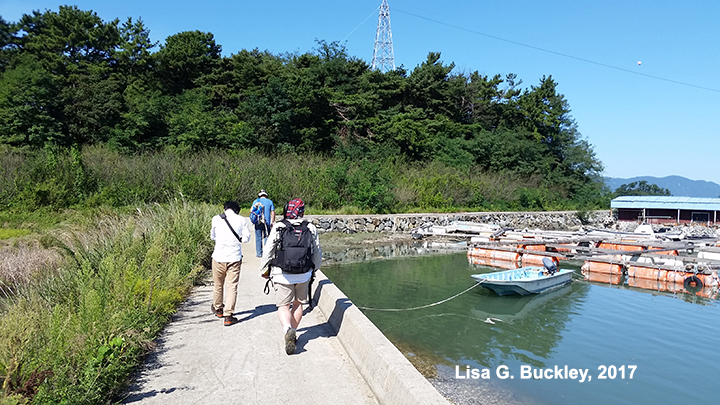
Our first stop was a possible reptilian track site. The area is a popular fishing spot, so there was good parking for the boat launches and anglers. We started our hike down to the first track site.
Strolling along one of the moorings for the small fishing boats on Bito Island.
The track site was a small exposure of finely-bedded (layered) silty sand that has some horizontal exposures. Here's Dr. Richard McCrea standing next to the track surface.

There are a great many similarities between doing fieldwork in South Korea and fieldwork in northeastern British Columbia. First, the bulk of the vertebrate fossil record for the Early Cretaceous in both areas is from the track record. There is skeletal material, but it is not common enough to tell an accurate story of life during the Early Cretaceous for South Korea and British Columbia. Second, both areas are heavily vegetated. We have to rely on either natural exposures along waterways and mountain tops, or those rocks exposed by the extensive industrial activity in both areas.

One thing we do not have in northeastern British Columbia is intertidal invertebrates occupying the track surfaces. Thankfully these snails were huddled in the cracks on the vertical part of the rock exposure and didn't hide the tracks.

Here is a close-up of the tracks exposed on the surface. They are very likely tracks of a large, Early Cretaceous turtle.

Our next stop was a larger track site that was a short car trip and a short hike away from Stop 1. It was a glorious day for a walk along the shoreline, and the scenery was beautiful.
The gorgeous coastal scenery on Bito Island.
I could look for bird tracks here all day.
Left to right: Drs. Richard McCrea, Martin Lockley, and Kim Kyung-soo, en route to the track site.
The track site is where the didactyl (two-toed) theropod tracks named Dromaeosauripus jinjuensis (Kim et al. 2012) were discovered (link to paper abstract).

We spent a little time sweeping off the small shoreline pebbles that covered the track surface.
Rich and Sujin standing behind the uncovered trackway of Dromaeosauripus jinjuensis.
Rich and our other grad student, Jason, at the Dromaeosauripus jinjuensis track site.
Here is a close-up of a section of the Dromaeosauripus jinjuensis trackway. Do you see the large theropod track stepping on the trackway?

Once we uncovered the Dromaeosauripus jinjuensis trackway, Rich got to work taking the pictures for a photogrammetry model.
Rich demonstrating photogrammetry in bright light conditions on the Dromaeosauripus jinjuensis trackway. Red arrows show the Dromaeosauripus jinjuensis tracks.
Site visits such as these are an important part of fossil heritage conservation. This trackway was described in 2012, but that doesn't mean that once it is published that it is forgotten about. This track site (and any other fossil site) will be examined every year to monitor its condition.

While the photogrammetry was taking place, I started hunting out my quarry: bird tracks! At this site, the smallest tracks we would see were those of Dromaeosauripus. We did see tracks of a small sauropod (think Brontosaurus for the trackmaker) on the same surface.
Sauropod manus (hand) and pes (foot) tracks, Bito Island. The arrow on the scale is 10 cm.
While I did not find any bird tracks at this track site, I did make a new friend. Meet (tentative identification) Scolopendra subspinipes, sometimes known as the Orange-legged Centipede.

I'm not the largest fan of encountering critters with more than six legs. I have been known to perform the Spider Dance at inopportune times. One such time was while using an outhouse in the field...admittedly not my most dignified moment. Thankfully I didn't find my new friend on my leg or in my backpack, although I did close all of the zips on my backpack after taking pictures of the centipede.

We were approaching 4:30pm when we went to the last field site for the day: a long stretch of shoreline on which large ornithopod tracks had been discovered. I immediately went into bird track mode and started with the rocks exposed near the edge of the forest.

I did find a suspicious-looking small trace, but there was not enough of it exposed for me to be sure that it was a vertebrate trace.

I also came across a medium-sized theropod track.

At this time the light was beginning to fade. Lighting plays a huge roll in seeing tracks in the field. The dimmer the light, the less likely you are to see small tracks. The best condition for seeing bird tracks in the field is a bright sunny day that casts shadows on low-relief surfaces. These were not ideal light conditions.
Dim light is not ideal for finding any track, let alone small, shallow bird tracks.
I started working my way down to the edge of the water around 6:30pm. I'll be honest: I was not expecting to find bird tracks this late in the day. I was still looking, but I knew my chances of recognizing bird tracks were slim. What caught my attention were all of the tiny hermit crabs. I knelt on to the wet, slippery rocks to try to get a picture of the hermit crabs...and my brain focused on a familiar pattern on the rock.

BIRD TRACKS!
I called people over, and we immediately started outlining the bird tracks that we could see using white chalk. Because this is a tidal-influenced area, Dr. Kim and his grad students began to salvage the track surface for removal back to the lab.

This part made me extremely nervous because the rock layer the bird tracks are on is very, but the surface came up in good condition. It turns out these were the first bird tracks to be found at this particular locality on the island. This was a good year for me finding bird tracks!

This was a full day! After we deposited the tracks in Dr. Kim's lab, we went to dinner at a sushi restaurant and ate more sushi in one sitting than I ever have in my entire life. We made it back to the Happy Owl Hotel by 11:00pm.
A very small part of the owl collection at The Happy Owl Hotel.
I downloaded all of my pictures and updated my field notes, and was definitely ready for bed at 11:30pm. The next day's adventure would prove to be just as busy, as we would visit the Jinju Innovation City track sites, and the Gajin-ri track site!

References

Kim JY, Lockley MG, Woo JO, Kim SH. 2012. Unusual didactyl traces from the Jinju Formation (Early Cretaceous, South Korea) indicate a new ichnospecies of Dromaeosauripus. Ichnos 19(1-2): 75-83.

Saturday, December 29, 2012

Eye Taste Something A Bit Odd.

Happy Holidays, Dear Readers! I hope everyone is recovering from the Bacchanalia of holiday cheer and an (over) abundance of food. I ate more gingerbread cookies than I care to admit. 

While I am organizing my notes on my recent ichnology fieldwork and conference in China and while I am both taking and editing pictures of theropod teeth with the frenzy of an obsessed woman, I thought I would include a food-related adventure from China. [NOTE: Technically I am re-taking these photos. Somehow my entire folder of 300+ images became corrupt, and I can no longer access the images I had already edited. A back-up, you say? I wish I had thought of it sooner. I will never put my trust solely in one external hard drive again. The hurt is still too fresh. Will I learn to love again?]

Fieldwork and conference travel in other countries often involves a crash-course in foreign cuisine. You have absolutely no choice but to dig in unless you have a satchel full of granola bars, which would become tedious after two meals. Also, if you are an invited guest, your hosts will have gone to great effort to feed you. And do they ever feed you! We did field work in multiple regions, and at every dinner we were treated to special regional dishes. One of the first phrases I had to learn in Mandarin was "I'm full!"  

I love international travel, and one of the reasons is the opportunity to experience different foods the way they are actually cooked, rather than the North American version of that particular cuisine. I usually do not hesitate to try something that is new to me or that "looks different." I was prepared for a completely different food experience, but I don't think that anything could have prepared me for THIS particular experience.

WARNING: For those of you with a squeamish stomach, I recommend not reading this post. Certain parts of invertebrate and vertebrate anatomy are consumed that would not normally be consumed, at least in westernized North America. Thanks for stopping by, though. I'll have something a bit less bizarre on the China trip in the New Year. For those of you who have not traveled to China and are leery about the cuisine, please do not worry. This Fear Factor-esque story is not indicative of the cuisine we experienced in China. I enjoyed 99.9% of what I ate while in China.

This foodie adventure takes place after a successful week of field work in various regions and a spectacular conference in Chongqing, China. We spent a few days in Beijing with our host Lida, who did a great job showing us around the city. He also showed us all of the great restaurants at which to eat. The food was fantastic. We sampled countless vegetarian dishes, several regional seafood dishes, beef, pork, and various steamed buns. I have a new appreciation for the multiple ways that tofu can be cooked and actually taste good. We even went to a specialty vegetarian restaurant where the tofu was prepared to look, feel, and taste exactly like fish. 

Lida, like me, is a fan of sushi. Lida and his wife took us to one of his favorite sushi restaurants in Beijing and ordered us the V.I.P. menu. If you've never had one of these types of sushi meals, this means that (with a few exceptions) the sushi chef decides what you will be eating that evening. We were in luck, because we were treated to extremely fresh tuna sashimi. Each part of the fish produces a slightly different texture and flavor of sashimi, and we get to sample each of the parts.

Meanwhile, Lida ordered one of his favorite dishes: octopus tentacles. The tentacles are so fresh that they are still moving. The tentacles are not technically alive, but the nerve impulses are still firing, which means the tentacles wriggle and writhe on the plate like some vermiform nightmare.

How bad could it be? Just watch!


That is me talking in the background. The pauses you hear indicate when I am trying not to gag. Everyone has food preferences and aversions. My food aversions include gelatin-based or items with a gelatin-like consistency, and things shaped like worms. Gummi-worms are near the top of the list, or at least they were until I sampled octopus. Octopus, right then and there, moved to the top of my list.

I did not judge octopus on its plate-appeal alone. I listened to the voice in my head that said "Woman up!" and tried a tentacle. This is not an experience I will be looking to repeat. First, I like octopi as whole, living animals. Octopi are intelligent invertebrates, and if a large invertebrate came at me with a cleaver to dine upon my freshly severed limbs, I'd be a bit miffed.

Pronouncing this correctly will not save me from his wrath. http://www.thelovecraftsman.com/2011/03/youtube-video-tells-you-how-to.html

I also did not enjoy the texture. It was too chewy. And, believe me, I chewed like there was no tomorrow for fear of feeling the tentacle move. I wasn't fast enough.

We moved on to dishes that included more tuna sashimi, tempura, shellfish, and soup. Everything was delicious. I temporarily forgot the excitement of the tentacles, assuming that was the odd food highlight of the evening.

I could not have been more wrong.

The chef wheeled the frozen head of the tuna on which we had been feasting in to the dining room on a carving trolley.

"Fish heads, fish heads, roly-poly fish heads. Fish heads, fish heads, eat them up, Yum!"

The chef started carving the head in front of us, removing the choice cuts of meat from the head and serving them to us immediately. I learned that many people consider the meat on the head to be the most flavorful part of a fish. I can't disagree: the sashimi was excellent.

Now we come to the part of the story where my brain divides into two entities: Practical Woman and Timid Woman. What prompted this mental fission was that the chef, while carving up the fish head, took great pains to extract the eye intact. This back-and-forth happened completely in my head: how much of this played out in my facial expressions I cannot say. Hopefully I looked as if I was intrigued by the chef's carving skills.

"You do know what this means, don't you?" Practical Woman said. "He wouldn't be so careful with that eye if it was not going to be used."

"Be quiet, you!" Timid Woman squeaked. "Maybe this is to show us how fresh this fish is."

P.W. insists "I tell you that eye is destined for your plate. And really, how bad could it be? It's just as edible as most other parts of a fish."

"It's a GIANT EYE. Need I say more? How can they expect us to eat a frozen eye that measures in at about a cup?" T.W. had a false sense of security at this point.

"Oh really? Did you not see the giant cleaver? You are going to know what eye tastes like."

Here is what we saw:

From right to left: tuna head, sashimi, A CUP OF EYE.
The chef then took the frozen eye and started finely chopping it into snow cone consistency, or the consistency of ice in a blended drink. Once the surface area of the eye chunks was increased, the pieces started to thaw. I could see gelatinous strands of liquid clinging to the knife. I felt my stomach lurch and try to exit my body in protest.

The chef then carefully scooped the shaved ice (or, in this case eye-ce) into four large shot glasses. The glasses are about 2/3 full at this point. He topped each glass with a serving of white wine, and oh-so-carefully used a toothpick to place a single flake of gold leaf on the top of the floating eye-ce. He handed us each a glass. And then he stood there, waiting.

"This has to be a joke!" T.W. mentally gasps. "There is a hidden camera somewhere. I can't do this!"

"Don't be silly, and don't be rude. You will drink this special creation. You are a guest." P.W. admonishes. "Oh, and the longer you hesitate, that frozen eye-ice is just going to become more slimy." Sometimes I think P.W. takes great pleasure in providing uncomfortable observations. 
  
That was it. I was a guest and a representative of my country: I had to do my duty as a gracious Canadian visitor and drink that eye.
  
I had only enough culinary fortitude to do this in one gulp. Yes, I felt the gooey melting eye pieces in my mouth, and there was a faint fish flavor, but down it went, gold flake and all.

I DID IT!!! I ATE (well, drank) AN EYE!!!

We had a great deal of fun teasing each other about this later, and, as Lida said "You'll never forget this meal!" If I had to choose between the two bizarre (to me) food items of that evening, I would pick the eye over the octopus tentacles. I didn't have to chew the eye, and the eye didn't come from an animal that was still alive. The eye also didn't move (and didn't come from an animal that was still alive when it was removed). That being said, I am not going to seek out eye for my next dinner party.

I'm sure that this isn't the strangest food item people have sampled in the name of international research. I'd love to hear some stories!

I think it's time for lunch!

Happy New Year!

Strange Woman.