Showing posts with label ethics. Show all posts

Thursday, September 1, 2016

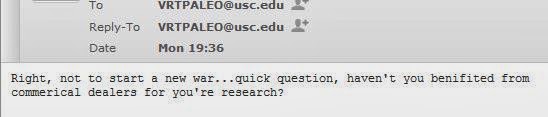
Responsible Fossil Stewardship: You Might Not Get To Do Exactly What You Want With Fossils

One of the mostly pleasurable tasks on returning from a long field expedition away from the Internet is checking out the latest fossil news and posts. I say mostly because, every once in a while, I am alerted to such posts that reinforce all of the negative attributes that most palaeontologists I know try to remove from fossil heritage conservation: greed, selfishness, and short-sightedness.

I have to thank my husband for this hat tip. He was browsing fossil-related news and said "Oh, you'll love this. Check this out." It is a piece entitled "Exploring Canada's Socialist Dinosaur Paradise." I was immediately skeptical of the "socialist" part of the title. Last time I checked, Canada was a federal parliamentary representative democracy. This alerted me that, somewhere in this article, someone was going to complain that they weren't allowed to do something they wanted to do with fossils. I had hoped to be wrong. I had hoped that maybe it was just a bad case of the headline not matching the article. What I was NOT expecting was to read these complaints from the author themselves. The author is supposedly a science writer and spent time in the field with someone who takes their responsibility as a steward of Canada's fossil heritage seriously.

Please read the article for yourself, but the tl:dr message from the article was this: the author thought that not being able to do what they liked with dinosaur bone from Alberta was "absurdly socialist" and couldn't (or couldn't be bothered) to understand why these laws were in place. Rather than turn this revelation into a teachable moment that could have educated many on why fossils (and other heritage resources) are important to conserve and protect, they did the mature thing and got snarky.

Life is hard when you don't get to do exactly what you want, when you want, especially when you have to consider the long-term well-being of the most non-renewable resource on our planet: our heritage.

Let's hit the "highlights" of the article.

1. Researchers don't want bone fragments, so everyone should be able to fill their pockets.

This section from the article made me choke on my tea because it was clear that, even though the author went into the field with a trained palaeontologist, they didn't actually pay attention to the methods of prospecting.

"Paleontologists have little interest in the scattered fragments at the surface, which retain little information about where they came from and are unlikely to be connected back into a larger skeleton. They focus efforts instead on excavating bones still stuck in place on the hillside, where it might be part of a more complete animal hiding deeper within."

Do you want to know how palaeontologists actually know where to dig up the intact bones? They follow the bone fragments that have already weathered out from the skeleton to their source. Those bone fragments are every bit as important as the skeleton itself. The idea that palaeontology is all about collecting the most complete and eye-catching specimens is a rather Hollywood, Indiana Jones view of how fossil conservation works.

Museums regularly archive what they jokingly refer to as Underwhelming Specimens: those specimens that look kind of blah, but are actually treasure troves of data. Our own research center has its share of Underwhelming Specimens: bone fragments, pieces of leaves, smudges of Triassic fish. We archive them as diligently as we archive the complete specimens. We're not just filling cabinets with pretty fossils: we're collecting data. Heck, I'm not an expert at identifying all fossil bones (no one is): that thing I identified as a bone fragment might turn out to be a skull bone of a previously undescribed fish or reptile. There may be biochemical data that can be extracted from bone fragments that tell us about the dinosaur's ecosystem. I do not know exactly what data a future researcher or student will be able to collect from bone fragments, but I want them to have that opportunity. If we don't archive these Underwhelming Specimens, those opportunities won't exist. Saying that bone fragments are of little interest to palaeontologists - especially when that person is not an expert in what can be accomplished with bone fragments - is ignoring data, which is bad science and bad science reporting.

2. Canada's Heritage Laws/Policies: They're Speaking for the Fossils

The author states: "It’s nearly impossible to legally pick up a fossil and put it in your pocket in Alberta. The province has among the most restrictive regulations for fossil collecting in the world."

Let's take a closer look at Canada's heritage laws. Canada's fossil heritage laws are governed province by province: each province has jurisdiction over their fossil heritage. One aspect that is common for all the provinces is this: fossils from Crown Land (Canada's version of public land, for my American readers) and/or from provincial and national parks and protected areas are the property of the Government of Canada. The government gets to decide the who, what, where, why, and how of fossil conservation and fossil resource management. This is because - and I'm going to say this slowly so that everyone can follow -

FOSSILS
ARE
PART
OF
EVERY
PERSON'S
HERITAGE.

This is a very simple concept. No one person has the right to sell, destroy, or alter a piece of our country's (and our world's) heritage unless they plan to get permission from each and every person who calls Canada home. There is universally more leeway for fossils found on private land, but even so, it is recognized that, on private or public land, the fossils there are part of the country's heritage.

Had the author done their homework, they would have known that Alberta's fossil heritage laws are not even the most restrictive in Canada. This section is basically a "Here, let me Google that for you" for fossil heritage acts in Canada. I found it at 11pm by Googling "fossil collecting laws Canada".

I was going to provide a link to each of the province's relevant heritage acts, but I don't have to. The best resource comes from The Fossil Forum. This post highlights the heritage laws, province by province, and their policies on fossil collection. The link also provides the sources (and links!) for each of the excerpts of the provincial heritage acts. If you, like me, enjoy reading pages of heritage law, you're welcome. It's an interesting read.

Keeping track of provincial fossil heritage regulations is not just a hobby for me: the researcher staff at our facility have long been working with various provincial branches for clear, concise regulations as they relate to managing British Columbia's fossil heritage. Progress is being made. The most helpful statement for British Columbia's fossils that has been clarified is that fossils collected from Crown Lands are property of the Crown. We do not own ANY of the fossils curated in our archives. We do not want to own any fossils.

Fossil Stewardship versus Fossil Ownership

What disappointed me the most in this article was the lack of consideration of what it means to be a fossil steward, rather than a fossil owner. A person who owns a fossil has physical possession of that fossil for their lifetime (or as long as their interest and resources last). There is a small pool of people who derive any benefit from that owned fossil: immediate friends and family. There is no demand or expectation that the fossil owner will use their fossil collection for educational outreach. There is little continuity from one fossil-owning generation to the next. There is no guarantee that your children or grandchildren are going to be interested or able to care for your fossil collection once you are unable. There is no expectation that records of the who, what, where, when, why, and how of the fossil's past will be meticulously kept. In short, the personal ownership of fossils is finite and fraught with uncertainty.

A steward of fossil heritage knows that their time on this planet is finite and minuscule. You cannot escape the idea of your own mortality and impermanence when you look at a fossil that was a living animal 115 million years ago. That fossil existed long before you, and has the potential to exist long after you die. Caring for fossils is the realization that this collection must outlast not only your generation, but countless future generations. We merely hold vigil over The Dead, over our Past, and will do our very best to pass the source of that knowledge on the future generations. I cannot express both the honor and humbling weight of this responsibility.

Sadly, this responsibility of being a good fossil steward was neglected in the article that chose to complain about "socialism" just because the author could not take a piece of bone home with them.

3. Montana is not absurd because there, people can make money on dinosaurs.

Another thread I was waiting for when I saw "socialist" in the article title was how the commercial fossil trade system in the United States is better because people can do what they like with fossils found on private lands. The author did not disappoint:

"The rules are almost absurdly socialist, especially when compared to just south of the border in Montana, where commercial fossil hunting is both big money and big controversy. The idea that a chunk of rock in my pocket should still be subject to such intense government regulation seems a little silly."

Big controversy indeed. The issue of resolving commercial fossil collection with responsible and ethical fossil heritage management is ongoing, and frustrating as hell to those of us who are trying to champion for the best practices for managing our fossil heritage. I have written previously on the issues that academic palaeontologists have with the commercial system as it stands. Here are the links where I discuss

- the issue of Propoki case and the illegally exported Tarbosaurus
- the issue of the Montana Dueling Dinosaurs and the importance of fossil archive continutity
- the critique of the commercial fossil system, the predicable rebuttal, and ways I think we could move forward, along with ways to appreciate fossils that do not involve ownership

My personal opinion is that, as it stands, the commercial fossil trade, which promotes not only treating heritage resources as luxury items but the illegal fossil trade plaguing other countries, is broken and needs a complete overhaul. Unfortunately, the groups involved are not there yet, or ready to accept critique of the system as anything other than personal attacks. The current incarnation of the commercial fossil trade needs to be overhauled for the sake of not only one country's fossil heritage, but for the fossil and cultural heritage of all of the other countries that have been negatively impacted. This is not "silly".

4. What the Article Got Right
The article does state why these fossil heritage protection laws are in place: there is a black market for fossils, and people will go to extraordinary means to thwart those laws for selfish financial reasons:

"But paleontologists here...say the law works well to reduce conflict over bones, and to ensure that dinosaurs stay close to home where they can benefit science, public museums, and local tourism."

THIS is why we have these laws. The laws recognize that documenting and conserving our fossil heritage isn't just stamp collecting. It's ensuring that these resources will be present - in their home areas - for science, science education, and public outreach.

Here's an example from my home province of British Columbia. Prior to the overhaul of the previous fossil heritage resource management plans, the best collections and displays of British Columbia's fossils were not within the province. There was a long history of out-of-province and out-of-country institutions traveling to British Columbia, making research-level collections, and then leaving the province with the fossils. Small collections were kept here and there, but the best place for people to see British Columbia fossils was outside of British Columbia.

From a research and fossil conservation stance, this was fine: these institutions had the will to commit resources to British Columbia's fossils. I thank them heartily for this. However, from a public awareness stance, this fossil drain resulted in a net loss for British Columbia. There was no opportunity for British Columbians to develop a sense of cultural appreciation and pride in British Columbia's fossils because the fossils were not there to appreciate. People need to see to appreciate, and the fossils have to be in British Columbia to be seen by British Columbians. This is what the fossil heritage laws recognize.

This trend is slowly changing. We display fossils that we have collected in British Columbia. We offer fossil-related educational programming for children, as well as do many many public presentations to spread our excitement for British Columbia's fossil heritage to everyone we see. In fact, the next lecture tour we do will be on the work we did this summer on a great 115 million year old dinosaur track site near Hudson's Hope.

We will continue to work with British Columbia to not only establish clear fossil heritage protection laws, but also to enact management strategies that detail not only how to responsibly care for our fossil heritage, but to responsibly monitor its use for private collection, public outreach and education, and research. It's painstakingly long-term work, but British Columbia's fossil heritage is worth the effort and diligence. All fossil heritage is worth this level of effort. After all, we only get one shot to do this right.

Thursday, March 31, 2016

Fool Me At All, Shame On You Always: How Not To Do April Fools' Day

April Fools' Day is tomorrow, and I am waiting with mild trepedation over what faux science gags I am going to see on the Internet. What I was not prepared for was to have someone actively try to recruit me to deceive the public in a pretty rotten way.

Let's be clear right from the start, Dear Reader: I love a good prank. I've been on the receiving end of many a gag courtesy of my colleagues. The most recent prank was having my office filled with toy spiders - we refer to it as The Spidering...this happened over a year ago, and I'm still finding spiders. We have a rather cute, so obviously over the top so as not to be taken seriously video that we're going to post tomorrow that is 100% fun, and in no way would ever be confused with real science. What we do not do, nay, what we REFUSE to do is to actively deceive the public with regards to fossil discoveries, fossil heritage appreciation, and fossil conservation.

Enter my phone conversation from Tuesday afternoon.

I'm out of town, picking up some supplies for the up-coming field season. My cellphone interrupts my browsing. It's a phone number from British Columbia. NOTE: As technologically slow as I am, I am pretty good at Googling phone numbers - I know exactly which organization made this call.

I will refer to the person on the other end as Skippy. Skippy was all excited to tell me of their great idea. There is a project that is going ahead somewhere in British Columbia (not in my neck of the woods), and those involved thought that a great way to get publicity would be to announce a fake dinosaur skeleton discovery as a result of said project. This plan was considered a good idea because, well, April Fools' Day. Skippy continued: they even wanted to get the public involved in submitting names for their new fake dinosaur find. Skippy was wondering if they could use our institution's name to lend their April Fools' prank credibility.

Dear Readers, guess how I responded. I think I was quite polite under the circumstances.

The first words out of my mouth were "Absolutely not!" I went on to say a version of this:

There is already a culture of mistrust in the general public towards science and scientists. The public is also deeply interested in fossil discoveries and news, and trusts that when such news is announced, it's for real. Faking a fossil discovery in British Columbia, using the name of a well-respected institution such as ours, would only serve to fuel such public distrust of scientists. There is no way that we could in good conscience take part in such a scheme.

I ended the conversation with Skippy by saying "And I had better not see our names anywhere near anything that you publicize." Skippy's response was "You won't be included," wording that makes me think that they are actually still planning to go ahead with this Scicomm Wrong.

Half-assed publicity stunts such as these give me nothing but anger and frustration. This is nothing more than manipulating people's natural curiosity about dinosaurs and fossils for a project that will do absolutely nothing to further their appreciation of their province's fossil heritage. There is no way that this can be spun as a scicomm opportunity: had our name been associated with this scheme, we would have lied to the public - April Fools' Day or no - and given them a reason to get excited about dinosaurs in British Columbia. People trust us, whether they consciously recognize that trust or no, to give them trustworthy and factual information about the fossil heritage in British Columbia.

I will not apologize for this: I respect and greatly appreciate the public's natural interest in their fossil heritage. For as long we are at the helm of our institution, we will never abuse that interest for the sake of tacky publicity.

British Columbia is only just starting to develop a cultural appreciation and respect for the province's fossil heritage. The idea that the public has a sense of ownership and pride over their province's heritage is not yet at the levels we see in Alberta, where fossils have been part of the cultural identity for decades. Being an institution operating in British Columbia and actively promoting a culture of pride and responsibility for fossil heritage resources is a serious business for us. We also rely on the goodwill of the public to be supportive of fossil heritage protection and conservation. We will not lightly throw that hard-earned trust away for the sake of a "joke".

Unfortunately for many of us scientists engaging in science communication about our respective fields, we are bombarded with examples of credible-looking fake-umentaries presented by organizations that are trusted by the public as providers of accurate information, all for the sake of publicity. Pick your favorite cryptozoology hunter show - my favorite examples are anything involving Bigfoot, which I have written about previously. Newsweek recently put out a special issue on Bigfoot. National Geographic has also jumped into the realm of presenting Bigfoot "research". Discovery Channel's Megalodon fakery. Discovery Channel's Mermaids fakery. These are all communication brands that have the trust of the public, and that trust is manipulated each and every time a fake-umentary or sensationalized show is presented as fact.

Public Service Science Announcement (PSScA): there is indeed such as thing as bad publicity, especially when it deliberately exploits people's science curiosity for the sake of clicks or views.

So, Dear Readers, I will be online this April Fools' Day, making sure that I keep track of this newest plan to exploit the public's love of fossils. I hope the group involved has had a sober second thought and will abandon this plan. Stay tuned.

Tuesday, February 3, 2015

Fortune Cookie Advice - For Real

Since this advice works as well in the coffee house, tea shop, or cafeteria as in the pub, here's my post full of nuggety accumulated experience advice that I posted on the Prehistoric Pub, dealing with the pitfalls and the advice to (hopefully) avoid them in academia (with a paleo slant, of course).

-----------------

I'm picking up a shift at the Prehistoric Pub today. Faces come and go, but if they are the faces of students starting out in paleontology, there is a look they all have in common at one point or another: that look when you jump into the deep end and realized at the last moment that you aren't as strong a swimmer as you thought. The look of feeling in over your head, feeling overwhelmed.

That feeling that makes you sit down and mumble to your confidant "I don't know if I can do this."

If that describes you or someone you know, have a seat at the bar. I've got some advice that I've accumulated from time, some experience of learning from dumb-ass mistakes, and some experience of learning from events that you simply can't control, and hopefully a way out of the seductive mind-traps that we all fall into.

Wine? Beer? Soda? Mineral water? Hot chocolate? The virtual bar is well-stocked.
I can only speak from my experiences, and the experiences of what I observed in student colleagues, colleagues, advisers, and mentors. All of my advice comes to you through my personal filter. 

Do what you love, and you will work harder than you have ever worked in your life.

If I could find the person who first said "Do what you love and you'll never work a day in your life", I'd give them a metaphorical smack on the back of their head. (This quote gets attributed to Confucius, at least according to goodreads.) More accurately, I'd give this metaphorical smack to those who use this quote to say that doing what you love is easy, while doing what you don't like is difficult.

I love paleontology. The exploration, the discovery, analyzing data, writing up the papers, telling the stories of the past of our planet to kids, the public, and colleagues - it's an honor to be part of the system that opens the doors to understanding our past.

If it feels like a difficult system to be a part of, it is. It takes a lot of time, a lot of training, and a lot of discipline to get into a position where you can start unraveling the mystery of the history. In short, it takes a heck of a lot of hard, hard work.

I was at a conference, standing around and chatting with colleagues in between talks. A prospective student who was interested in joining a certain lab had joined the conversation. Student started asking questions. These questions started to piss me off:

Student: "I know So-and-So-Grad-Student in this lab, so that will make it easier for me to get in, right"?
Us: "That's not how you get into a lab. You have to contact the PI and see if they are taking students. Even if they are, you have to submit your proposal and application like everyone else."

Student (persisting): "You people are clearly succeeding. What are your tricks?"
Me (rather irritated at this point, and yes, I swore): "Tricks? There are no tricks. This is hard-ass work, and I'm a tenacious bitch. That's why I've made it this far."

The others who were with me started giving the now shocked Student, um, softer good advise (for lack of a better word), but I was annoyed by this line of thinking. Clearly hard work was not first and foremost in this Student's mind. They persisted on believing there was a gimmick, a trick, a sham that made all of this seem so easy.

My wish is that I never make this look easy. I don't ever want to fool people into thinking it is easy. There is no innate brilliance that makes paleontology easier for some and harder for others. It. Is. Not. Easy. This shit is hard - hard to do, hard to keep the energy and ambition up to do it. Loving what you do gives you something to focus on when you're submitting yet another grant application, when you're rewriting that paper that got rejected again, when you're told by your funding agency that they support museums but don't support research. Maybe you've made a mistake that is now going to cause you seemingly endless hours of work to correct. Maybe you're trying out something new, and there is no clear path to follow. That happens. That love for your path is your carrot, the hard work is the stick. You can't have one without the other. Loving what you do doesn't make the bullshit easier to deal with - it just gives you a target at which to look past the BS. Do what you love, and you will work harder than you ever have in your life because you will want to make it work.

Who are you?

This next story makes me sad. The Student character represents several individual students I've seen through teaching labs, running volunteer programs, and being in labs.

I know this Student is bound and determined to pursue paleontology as a career, and I have not even spoken to them yet. How can I tell? Student has come to class wearing an Indiana Jones fedora, hiking boots, canvas pants, and a pocketed photographer's vest. They announce in grand tones that they are going to study dinosaurs, and scoff at using mammal bones in osteology labs. It's bones, after all. Student knows bones, because dinosaurs. Student receives soul-crushing 20% (or lower) on the bone lab, and, fighting back tears of disappointment, comes to the lab instructor all confused. HOW?

Here's a confession. I was that student. On my first comparative anatomy bone lab I crashed and burned, Chicxulub-style. I may not have had the fedora or the vest, but I was convinced that years of being a dinosaur fanatic was enough to prepare me for what it takes to be a scientist. Hell no.

Why does this scenario make me sad? I saw the same familiar pattern repeated in each new set of undergraduates. They are so determined to assume the mantle of paleontologist that they take an idealized, TV-promoted distillate of what a scientist appears to be and lose themselves in that ideal because that is all they know about the people who do paleontology. They only know what they have seen in the media, in books, in movies. These students have no sense no real sense of who the people they idolize are, and no sense of who they themselves are as individuals. Cosplay is all fun and games until someone loses their identity.

Make sure you develop who you are, inside and outside of the scientist realm. If you don't yet know, that's OK. It's a constant work in progress. An easy way to do that is start by a fill in the blanks exercise. "I am a scientist who feels/does/thinks _________." What's in your blank? Is it art? Jazz dance? Bar tending? Archery (guilty)? Martial arts (guilty)? Are you a bird fanatic (guilty)? Do you have causes you are passionate about? Great! You do not have to give up who you are or the non-paleontology (or science) things that excite you to be a paleontologist. They are part of your identity. Being comfortable in your own skin, quirks and all, will go a long way to helping you identify who you are as a scientist. Scientists are people, and people have varied interests. Be a person...

Do Unto Others...

...unless that person is a jerk. Do. Not. Be. A. Jerk.

All paleontologists are people. Some people act like jerks. Therefore, some paleontologists are going to act like jerks. You will encounter jerks. I'm sorry. It sucks to be on the receiving end of such behavior, especially if others brush it off as "Oh, that's just So-and-So. Pay it no mind."

There is no rule that someone has to be who you would classify as a good person to be a good scientist. There are no end of stories of people who have done good work, even brilliant work, and have been people you would not want to go to the pub with, be in the lab alone with, or share research ideas with. Some people are just jerks. It might be that they don't know they're jerks. It might be that they just don't care. Regardless, the outcome is that they hurt colleagues and students, building resentment and distrust in a community which is so much more than a sum of its parts.

Some people, intentionally or otherwise, try to emulate their jerk-heroes, or buy into the destructive culture of a particular lab setting. Here's a personal example: I interned at a (non-paleo) lab in my youth. My supervisors were two men in their mid-late 30s. The room in which they conducted my orientation was decorated with female porn centerfolds. It was also the room in which my temporary desk was placed.

I did not feel like I belonged in that lab. It felt like the supervisors were symbolically telling me this was a no-girls allowed space. It gave me a sick, disgusting feeling when they would look at their centerfolds while talking to me. I was horridly uncomfortable. I was also scared. I was scared to tell anyone because I thought I would get in trouble for making a fuss. I was scared that, by not playing along with this lab environment, I was not cut out to be in science. I was scared of not being accepted by the boys' club culture of the lab. Not only did I make it through the one day introductory orientation, I chose that lab to work in to prove that it didn't get to me, to prove that I belonged. I didn't want to rock the boat and call this out for what it was: inappropriate and unacceptable in a professional setting.  I thought speaking out was a weakness. I was so wrong. It is never weak to call out BS. Always stick up for yourself. Always stick up for people who are not in a position (or don't feel they can) stick up for themselves. Don't contribute to a culture you would not want to be on the receiving end of.

Here's some advice that needs to be emphasized a heck of a lot more than it is now: the ends no longer justify the means in science. The culture of accepting crappy behavior from someone just because they do exciting work is dying a long-deserved death. There are now enough people in paleontology that you don't have to suffer a jerk when you encounter one. And, in the event that you do encounter a jerk, there are people and resources there to help you. Don't keep it silent.

You do not need to belittle others, downplay their work, be jealous of them, steal their work or credit, or marginalize them to do good science. If you feel the need to do that to be in science, to be in paleontology, sit yourself down for a second and ask "Why am I doing this?" If "being the best" is your goal instead of "doing your best", it's deep self-reflection time. Take-home message: if you wouldn't want to be on the receiving end of your actions, your actions are inappropriate. If someone tells you your actions are inappropriate, you owe it to yourself and the people you work with to consider that they might be correct.

...Oh, and if you are called on jerk-like behavior, DO NOT try to justify it as "Oh, I was just so excited and eager" and other lame-ass excuses. When people say that to you, they are saying that their obnoxious behavior towards you is justified because of science. No. Science does not need people who try to use students to access your data for a paper that they have not told you about, but are going to try to publish first (for an extremely specific example). Science does not need the person who is so desperate to be noticed (or is a show-off) that they belittle someone during the Q & A of their talk. As Andy Farke said, to quote the great ones, "be excellent to each other."

Who are you racing against?

Have you ever had one of those days when you feel as though you are "behind"? You're publication list is woefully small compared to that of a lab colleague. You were rejected for that NSF/NSERC grant, while your lab colleague's was successful. Here is my favorite: did you start your program before those people who are now Ph.D.s?

Welcome to the race. Except that it isn't a real race. Oh sure, there is competition for research money, for publication spaces, for talks, for jobs. Even so, one of the biggest morale killers is feeling and behaving as though you are competing against someone. (That feeling could also tempt you down the Jerk Path.)

I get it. It's likely the most common mind-trap I fall into. I've looked at people younger and better funded than me and have thought "I don't stand a chance against this. How can I possibly compare?" The honest answer is that I can't compare. No one can compare, because every person's situation is unique to them and them alone. The only person in your race is you. You have to find your own academic pace so that you can complete a marathon, not a sprint. Don't feel that you have to burn yourself out: there is a culture in academia that accepts stress and pushing oneself to the breaking point as some sick badge of honor, and it's dangerous. There are enough challenges in academia without approaching it with the attitude of being "better" than someone, or trying to "win". Also, do not buy into the notion, if you find that academia isn't for you, that you are a failure. I call shenanigans on that idea. You are going to feel loss and disappointment over a plan that did not work out. You have to rethink the idea of failure. If A doesn't work out, then that means you should try X. A plan not working is an opportunity (albeit a bloody frustrating one) to try something different. You have failed no one.

You are not alone in feeling the way you are. You are surrounded by people at all stages of their academic careers who have felt this way at one time or another. There are people who will give you advice. Some of it will be good. Some of it won't be good for you. You get to choose what advice you follow.

Remember the way you feel now. One day a student or a colleague is going to come to you and say "I don't think I can do this.

Wednesday, January 21, 2015

Advice for Students Feeling...Well, You Know the Feeling.

Hello Dear Readers,

Every once in a while the Strange Woman comes up with a nugget or two of wisdom. These nuggets are dug from under a layer of dirt made of a combination of learning from my own silly mistakes, observing experiences of others, and from enduring those situations that are sometimes out of our control.

All of this has given me strong opinions on the approach and conduct of people in vertebrate paleontology, although I imagine this has applicability to any STEM field. I'm fairly open about sharing what I think with others when they ask. A friend recently told me "You're advice is awesome! It's really helped me. It should be in fortune cookies!" All of my fortune cookie baking attempts have been sad, but what I decided to do was to put some of this advice in blog form. I share some embarrassing stories, one rather painful creepy story, and a couple of frustrating experiences. These stand out in my mind when someone asks me "How do you think I should do X?" Needless to say, I'm going to steer people away from being the future subject of someone's creepy/frustrating/embarrassing story.

Check out my post at the Prehistoric Pub: Fortune Cookie Advice...For Real!

SW

Thursday, October 30, 2014

How To Appreciate Fossils Without Ruining It For Science

[UPDATE 25-11-2015: The hadrosaur bone listed by ThinkGeek has been removed. At the time of the writing of this post on 30-10-2014 the issue was pending.]

[Big thanks to @BlackMudpuppy for both the post and title idea! Go check out his comic!]

I had so many posts planned before this particular topic. Tyrannosaur trackways. North America's earliest known bird footprints. You know, real science-y stuff that I have been directly working on since the start of the summer. Instead, my muse must be directed towards the ever contentious issue of the commercial fossil trade.

I wanted my next post on the commercial fossil trade to focus on the positive role that a fossil shop in France played in reuniting the skull and feet of Deinocheirus (which had been illegally removed, or poached, from Mongolia) with the rest of the specimen. Happy ending stories can and do happen, but unfortunately they are outweighed by the stories of greed and lack of forethought.

ThinkGeek, a popular online store that boasts an impressive array of geek-targeted wares (from home decor to cubicle toys) recently posted a product: people can buy real dinosaur bone. Go see for yourself. This is one of the few times I recommend reading the comments section. I'll wait here with my tea.

As you read in the comments section, a few paleontologists and fossil enthusiasts have voiced their concerns over the ethics of treating fossils, an irreplaceable, non-renewable (in our lifetime) natural history heritage resource, as a "product". In response to a comment left by paleontologist Jim Kirkland, a ThinkGeek representative stated this:


There are issues glaring out at us from this paragraph:
1. Who exactly verified these fossils? Contrary to what this statement would have you believe, there is no third party oversight body or committee that verifies fossils for legal or ethical issues before sale. No paleontologist has come forth to state that they checked over these fossils and that they are OK to sell. There is also no way to know if the dealer/supplier is conducting their work legally or ethically. Unfortunately, ThinkGeek to date has not supplied the information on their dealer, which does not allow the fossil consumer to decide if they are making an ethical purchase.
2. If they are so weathered and out of context, how do they know this is hadrosaur bone? If there are identifying features on these bones that allow us to know they are hadrosaurid, that's science. That material is important to some researcher somewhere. There are a couple of scenarios: that the material is just being guessed at as hadrosaur based on size, or that there is associated material that is complete enough to identify as belonging to a hadrosaur. If the latter is the case, what is the fate of that more complete material?
3. Appeals to emotion as logic. What we see here is a marketing ploy: the way to appreciation and inspiration is direct ownership. There is the appeal to emotion hidden not so subtly in here as well of "Won't someone please think of the children?" These are the tired tactics of commercial fossil supporters, and that is the main point I want this post to address.

Now that the background reading is out of the way, let's focus on ethical fossil love.

How to Ethically Love Fossils

You are a fossil enthusiast, and you want to develop a closer and deeper connection with the life of the past. You also want to make sure that your interests are not directly or inadvertently supporting shady doings (e.g. poaching and illegal fossil export, accidentally removing scientific access by buying a fossil, etc.) You are in luck. There are so many ways in which the Fossil Lover can support science, science education, and a sustainable use of fossil heritage resources!

1. Donate your time to your nearest natural history museum! Museum activities such as educational outreach, fossil archiving, fossil preparation, and even fieldwork thrive when there is a strong, dedicated volunteer base. Volunteers made field discoveries, lab discoveries, and inspire countless children with their enthusiasm and dedication. This is a great way to become part of the story of the fossils you love!

2. (If you are financially able) Donate funds to your nearest museum! In these times of budget cuts and downsizing (particularly focused on research and collections of museums) museums are expected to rely more heavily on external donations. These donations pave the way for renovations and research chairs (guaranteed funding for paleontology research), which are necessary to bring the story of fossils to life. Imagine this: a new dinosaur is discovered because you funded an endowed research chair, or funded an ongoing field project. You have the power to enable these advancements.

3. Support public outreach events: attend talks at your local museum! Fossils are a great gateway to exposing people to science and nature. Fossils are not just a remote part of our past from which we are disconnected: the story of fossils is our story. I recommend checking out the outreach work of Dr. Scott Sampson (yes, Dr. Scott from Dinosaur Train): he makes fantastic connections between fossils and science outreach. The more information you gather, the better you can promote your own love of our past life!

4. Purchase fossil replicas instead of fossil heritage resources! There are several places where museum-quality replicas of your favorite dinosaurs and other prehistoric creatures can be purchased. Fossil replicas are great: they are renewable, they are durable, and they are much less expensive than an original fossil. Here is a small (and not complete!) list of companies who sell fossil replicas of dinosaurs, and their replica work can be viewed in natural history museums worldwide. [DISCLOSURE NOTE: some companies also sell original fossil material. I want to encourage and promote the sale of fossil replicas whenever I can.]

Gaston Designs - We have two of their ankylosaur skeletons (Gastonia and Animantarx) in our display gallery.
Triebold Paleontology, Inc. - A large selection of replicas of dinosaurs, marine reptiles, flying reptiles, and more.
Black Hills Institute - A cast of their Acrocanthosaurus is in our display gallery, menacing the Gaston Designs ankylosaurs.

There is also a growing trend of 3D digital sharing, where, if a person has the right equipment, can download a 3D image file and print off their very own fossil replica. As more museums are able to secure the funds to digitize and publicly upload their collections (this takes a great many staff hours and equipment upgrades, and is a slow process - I'm in the process of getting just 2D images of our collections online, and even that takes time), and as the technology becomes more accessible, I see 3D digital fossil replicas being an ethical alternative to purchasing original fossil material. Check out these sites for downloadable 3D digital replicas and information:

africanfossils.org - featuring artifacts and fossils from West Africa
Digital Morphology - information on their scanning work and digital files of several animals
University of Arkansas Center for Advanced Spatial Technologies

5. Are you a private land owner who has fossils on their land? Contact your local schools and work with classrooms to help them create their own teaching collections. Better still, involve a paleontologist from a nearby museum - that K-12 driven display could be a great collaborative project that is displayed in a museum, or become part of a student's museum studies project.

6. For private land owners: if you charge museums to prospect on your land, please be aware that museums cannot afford the same access fees or the "market value" of vertebrate fossils that commercial businesses can afford.

7. Are you a K-12 educator? There are many ways in which to inspire children in paleontology that do not involve the purchase of a single fossil. Contact your local museum, or your closest university: there are many researchers and student-researchers who are passionate about science education, and who would love to work with you to develop a natural history-themed curriculum.

8. Are you a heavy equipment or technology company? You can make a huge impact by donating equipment time and your own expertise to field, display, and archiving projects! Much of our helicopter time and crane operator time has been donated, and we would not have been able to complete many projects without such in-kind donations.

9. Are you often out of doors on public lands? Be aware of what fossil heritage resources are around you, and keep a sharp eye out for poachers and vandals. Report any suspicious activity to the local state/provincial public land authorities. The same goes for fossil discoveries on public lands: report these right away to the land management authorities. Many people make the well-meaning but ill-advised mistake of trying to remove new discoveries to protect them. This ends up damaging the fossils and surrounding data. It's hard to say "I'm sorry" to 110 million year old information.

This is just a small handful of ways in which you can express your appreciation for fossils without having to purchase them. It is my great wish to see appreciation and respect for fossils not expressed in terms of ownership of fossil heritage resources. One does not have to own a thing in order to love it, and the ethical alternatives to fossil ownership have the potential to provide meaningful, lasting connections to the life of the past. How you will influence the future of paleontology remains to be seen, but the best way to start is to get involved. That chapter of Earth's history is waiting to be written.

(This post and the information contained within would not have been possible without great info and links from Andrew Farke, John Steward, and yes, even ThinkGeek. Without their sale of vertebrate fossils online and their tissue paper thin reasoning behind said sales, the inspiration for this post would have come in the unforeseeable future.)

UPDATE 01-11-14:

Lee Hall at the blog Extinct Los Angeles posted his letter to ThinkGeek regarding the subject. Lee details exactly why selling fossils is a dangerous precedent to set for science education, and his post also contains links to other great places to purchase research quality fossil replicas.

Also, my comment on the ThinkGeek site was quoted by The Mary Sue in their coverage of ThinkGeek's fossil faux pas. (As of this update, the comment section is open.)

As of now, ThinkGeek has put the sale of these items on hold. Here is the statement on their website:

"Many of you have concerns about these dinosaur bone fragments and we want to take a moment to address that. We agree that harvesting fossils from federal and public land is not only wrong, it's illegal. The vendor that supplies us with these specimens has confirmed that they have been obtained from privately leased lands and out of situ.

An independent scientist has also examined our specimens, and has determined that there is no scientific value that can be gained from the fossils in their current state, which confirms what a large number of you have also stated.

Here's what is going to happen next: We've put the sale of the fossils on hold for now because next week there is an annual gathering of paleontologists and we are expecting that they will publish a letter on the topic of selling fossils. We will abide by their decision. For now, thank you for your thoughts and passion, and please be sure to respect each other in the comments."


Who is the paleontologist, and is ThinkGeek quoting their assessment accurately? I'll explain why I ask this question. Many paleontologists are shown material once it has been removed from the surrounding rock. If a paleontologist has not had the opportunity to investigate the source locality for this bone, they are missing a great chunk of the information: location, rock formation, the relationship of that fossil to other fossils (other dinosaur bone, plants, pollen, invertebrates). Fossils removed from the rock without having the site examined are therefore considered "less scientifically valuable" than those fossils that are investigated while still in the ground. Note: this is not a loop-hole to start ripping fossils out of the ground in order to sell them. This is a reminder that, by simply removing fossils from their source without a thorough examination of the source is the equivalent of ignoring or destroying data.

ThinkGeek does not have to wait for the annual Society of Vertebrate Paleontology meeting to know the stance of members of the paleontology community: there are official Society statements that have been made in regards to the sale of high-profile specimens, such as T. rex. The issue with these statements is the "scientifically significant" wording. Scientifically significant does not always mean complete and showy, which is what many people think when they hear "significant". Also, unless the site and the source of the material is assessed by a trained professional (not just the individual pieces), how is anyone to know the significance?

ThinkGeek, you have the opportunity to do the ethically sound thing: sell casts of fossils. I am sure any one of these companies would be happy to work with you.

Sunday, July 20, 2014

Idols and Idolatry

Who is your idol?

I found myself asking this question to myself in the wake of the public scrutiny of the behavior of theoretical physicist Richard Feynman (I recommend reading Janet Stemwedel's in-depth examination of the situation). In short, he made important contributions to his field and is considered a brilliant scientist, but his actions towards the women he associated with professionally were extremely disrespectful, and arguably harmful to the goal of inclusion and fair treatment of women in science. Many in the field look to Feynman as a role-model or idol, and have responded harshly to the critiques.

The World English Dictionary defines idol as
"1. a material object, esp a carved image, that is worshipped as a god,
2. Christianity, Judaism any being (other than the one God) to which divine honor is paid,
3. a person who is revered, admired, or highly loved."

Dictionary.com has a different version of definition 3 for idol: "any person or thing regarded with blind admiration, adoration, or devotion. Madame Curie had been her childhood idol."

Both versions of the definition for idol carry with them an unrealistic burden to apply to any one person, and that burden comes with a heavy responsibility. Theoretical physics is not the only academic field in which idols exist. Every field has people who are treated as idols. There are idols in paleontology.

I had a couple of idols growing up, and I was fortunate in that I admired scientists who are also good people before knowing anything about their non-research conduct: they are ethical, fair-minded, and generous people. My early admiration of these scientists stood the test of time and my maturity. I still admire them, even though I have grown enough to realize that, although they are great scientists and great people, they will never be above scrutiny or critique. No one is.

Idols and role-models can be a potentially positive influence for young people looking to enter the sciences. They can inspire the younger generation to study. If their role-models write or appear for the public, they introduce young people to science concepts they might not otherwise encounter until their post-secondary education. Role-models inspire students to explore, to challenge old ways of thinking, and make the sciences so engaging that the students can see themselves participating.

There is a fine, fuzzy line between a role-model and hero worship, between a mentor and an idol. Idolatry can lead to mimicry, and while mimicry is supposedly a type of compliment, there are many examples in nature of toxic organisms being mimicked. It may be a heavy-handed analogy, but in the case of students, they may not immediately realize that the person they model themselves after is displaying behaviors that do more to erode the cooperative and inclusive goals of the scientific community than to uphold them.

I have come to find the idea of promoting someone to idol status disturbing. While we can cite examples of scientists who repeatedly demonstrate positive academic and community ethics, we should not promote the idea that any one should strive to "be like" another researcher. When a person is idolized, it is too easy to dismiss their less than noble actions for fear of tarnishing the shiny image, and those who critique the idol are portrayed as destructive. I have heard many say (and have stated this myself in my naive days) that it doesn't matter who the scientist is as a person as long as their academic work is sound, and that all that matters in the end is the product. I may have believed this once upon a time, but now I firmly believe this statement is a pile of steaming horse-apples.

Stemwedel hits the rock squarely with the Estwing:

'Do we have a scientist who is regularly cruel to his graduate student trainees, or who spreads malicious rumors about his scientific colleagues? That kind of behavior has the potential to damage the networks of trust and cooperation upon which the scientific knowledge-building endeavor depends, which means it probably can’t be dismissed as a mere “foible.”'

I realize that a scientist can be what I would colloquially describe as a jerk, a sleaze, or as dancing down the slippery slope of ethically dubious behavior and have also produced notable work. For example, I can't refuse to cite someone's paper just because I think how they treat their graduate students is despicable. However, their scientific contributions do not excuse or lessen the negative impact of their behavior on their community. They have set the stage for the conduct of future students on a shaky foundation. This should not be ignored.

How a scientist behaves towards their colleagues and subordinates professionally and personally is as important to the science community as their body of work, if for no other reason than they are maintaining the trail that the next academic generation will follow. All of the good within the community that currently exists is because of the attitudes fostered by our predecessors that we, knowingly or unknowingly, have internalized and are projecting as normal. The same applies to the negative actions that happen within our community. Whether we like it or not, whether we want the responsibility or not, our actions in and out of the field/lab are demonstrating what is normal for our field. We are demonstrating what we accept as acceptable behavior. It becomes our responsibility as soon as we start interacting with students.

It is also our duty to publicly criticizing behavior that we would not want to see demonstrated in our future students, regardless of the work conducted by the person/people. We have the responsibility to denounce the behaviors that sow mistrust, uncertainty, and even fear in the scientific community, and work harder to prevent them. If we do not want to see our future students 1) treat their peers or subordinates without personal respect, 2) treat underrepresented groups as inferior, 3) sabotage, undermine, or otherwise inhibit the work of their peers or subordinates, we have to model the type of behaviors that we want to see passed on to the next generation of students. We cannot excuse bad behavior as "part of the package" of doing research just because "it's always been done this way." If we receive criticism for our behavior, we have the responsibility to listen, examine, and change to foster a positive community.

In the end, the only people who are responsible for the climate we foster in our scientific community are ourselves. Sooner or later, someone is going to look up to you: who do you want them to see? More specifically, if you were on the receiving end of your actions towards your peers and subordinates, would you feel welcome in your scientific community?

Wednesday, June 11, 2014

Fossils on Fire: How We Evacuated A Museum.

Hello, Dear Readers!

It's been a busy two weeks for the Strange  Woman: the international assessors from the Global Geoparks Network have completed their on-site visit, and I now have a few spare moments to attend to both personal and professional activities.

It did not really occur to me how closely entwined are my personal and professional lives until this weekend, when I was telling the story of having to evacuate the PRPRC collections facility because of a forest fire that was encroaching on the town of Tumbler Ridge, and how this event will forever be associated with my marriage to my colleague and partner-in-paleo crime.

On a personal note, one of the most frequent questions I receive when I tell people that I work professionally with my husband in the same facility is "I could never do that - my husband would drive me insane! How do you stand it?" It's simple, really: he's my best friend. We think enough alike that we know how each other thinks and automatically have the other's back on important issues, yet have different approaches to these issues to cover multiple bases and explore new ideas together.


Along with celebrating the good times and fantastic results of our joint efforts, we are also there for one another during the soul-suckingly frustrating times. We may get the double hit of a budget cut, but since we know exactly what the other is going through, we can both plan, sympathize, and move forward together out of the fire. No matter what, we always have each other.


Our wedding was on July 1st, and even though it was a small event, there was still enough planning involved that we were quite busy up until the day; however, as the old saying goes, where there's smoke, there's fire. My family had arrived a couple of days before to help with the set-up and, of course, attend, and one of their first comments was that they were very disconcerted by the smoke rising above the ridge roughly north east of town. At the end of June, after a series of dry days and lightning strikes, a wildfire had started on Highway 52, and was growing larger daily. We were growing less concerned about our wedding and more concerned about the fledgling fossil collections of the PRPRC - what would we do if the official order was given to evacuate?

Not one of our choices was logistically simple. Our first option was to leave everything and bolt, taking only our personal belongings. We had had enough warning of the impending fire to cut and run with only personal items. However, that would entail leaving behind the fruits of our and those of several volunteers' efforts behind to suffer the whims of the weather and fire: we would be leaving behind the fossils. Rich and I didn't even discuss Option 1: these were some of the first and best representatives of Mesozoic vertebrates from British Columbia, and we both knew that the other felt it was our duty to do whatever we could to protect this part of our fossil heritage. This collection is bigger than ourselves.

Option 2 was to move everything out of the museum to a secure location. Unfortunately, this was logistically impossible. We could not arrange the freight in time, and the cost was more than our fledgling organization could bear (it still is more than we could afford if another evacuation were to happen.) At this point the collections had already accumulated several hundred specimens of Triassic vertebrates, not to mention dinosaur track-bearing rock slabs weighing several hundred kilograms each. The secure location part was not readily available: there was a muster station for evacuees set up in the nearby town of Chetwynd, but we wanted to avoid that area. Stress makes some people to odd things, and we wanted to keep stress as far away from the collections as humanly possible.

Option 3 was really our only option: to perform specimen triage, and identify those specimens that could be safely transported in our truck and educational van. All the computer towers and paper records would also be moved. In the event the evacuation warning became an order, we would load up the vehicles and leave the remaining specimens to chance.

If you work at a museum, imagine going through your collections and performing such a triage. What do you take, if you know your repository faces destruction? All the electronic and paper records, of course. Any type material would be the first to be packed, and if it were too large, any replicas or molds of said material. Other specimens that had been published would also be a priority. But what of the non-published specimens? What would be your criteria for selection? What becomes important?


Our wedding day was hot, and that is not a bad joke: the temperature was above 25C, and the forest was aromatic with dry needles. Most brides don't want rain on their wedding day, but this bride would have welcomed a torrential downpour if it had meant not having to worry about evacuating BC's fossils. There was no rain. After a small reception at the Dinosaur Discovery Gallery, we spent our wedding night wrapping and tagging specimens for the anticipated move. We were at the museum until 3am.

July 2 we had reserved for showing my family some of the hiking trails in the area, and we were able to visit most of them. My family were very aware of what we were facing in terms of the possible evacuation, and decided to leave a day early on July 3 so that we could focus on the museum. We spent the night of July 2 at the museum, putting the finishing touches on packing.

My family left just after 2pm on July 3, and Rich and I took this opportunity to catch up on some sleep. We were physically and emotionally exhausted. On waking around 7pm, we went outside to see the progress of the smoke over the mountain. I now know how characters in zombie movies feel when they wake from a coma and see the world around them rendered silent and abandoned. We made a couple phone calls and found that the evacuation order had been given not long before we had woken up. It was time.

I dropped Rich off at the museum to begin the official packing while I went back to our apartment for a quick personal pack. The very first item that was packed was my cat Maiahttp://birdsinmud.blogspot.ca/2012/12/its-3amdont-step-on-hairball.html: she was none too pleased at being unceremoniously bundled into her carrier and tossed into the cab of the truck. Next I packed our important paper documents (previously secured in one case as soon as we saw the smoke.) Then I packed a change of clothes for both of us, and, because they were still sitting out, our wedding clothes and gifts. I took about 15 minutes.

During the personal packing, I tracked down our Summer Education Coordinator, who was here without a vehicle. I picked her up at her apartment, along with a small, grey and white bob-tailed kitten that had been in the apartment next to hers. The kitten's owners could not get back into town, so we took the kitten with us. I have no idea what the name of the kitten was, but we called him Evac.

We went to the museum and began loading specimens. Both cats shared a space in the truck's cab, much to the endless dismay of a yowling Maia. We spent many hours loading specimens and documents: we had found that we had more room than previously thought for the move, and decided to stay, packing specimens into the vehicles until we were told in no uncertain terms that it was time to go. As we packed between 8pm and 11pm, we were visited a few times by the emergency response team. They were very curious about when we were planning to get out of town, and each time they stopped their insistence increased. We understood: they had a job to do and didn't want to have to worry about our safety while doing it, but I think they also understood that we had a job to do as well. During the loading of the specimens, we received concerned phone calls. The first question was "Are you guys OK?" The next question was "What is going to happen to the fossils?"

The final specimens that would fit - all the track slabs were left behind, but their latex molds were stowed on the top layer of material in the back of the van - were loaded just as fine, while ash particles began to fall around us. We broke out the field walkie-talkies and divided ourselves between the vehicles - Robin (our E. C.) and I were in the truck (with the two rather agitated cats), and Rich was in the van. We drove to our friend's house in Fort St. John via Chetwynd and Hudson's Hope, as the direct route was now inaccessible due to the fires. This white-knuckle drive took about four hours. Four hours of wondering if the remainder of our collections would survive. This fretting was accompanied by yowling from the back seat from Maia, repeated escape attempts from his temporary cardboard box carrier by Evac, and listening to the radio for updates.

Once we arrived in Fort St. John, we relaxed a bit. The fossils were secured, and we had nothing to do but wait. So we waited. We watched local TV to keep abreast of the updates, watched bad movies, played a round or two of golf, and ate pizza. We still jokingly call it the Evacuation Party. Maia was tormented by Evac, who wanted nothing more than to play with this other cat. Maia wanted to play as well, but only on her terms.

We were in Fort St. John until July 7. The evacuation order had been downgraded to an alert on July 6 after 4pm. The winds had shifted so that the town was no longer in danger, and 17mm of rain had fallen. The fossils could go home. Our Evacuation Party/honeymoon was over.

Collections management isn't just about keeping track of the history and location of a specimen: it also involves the health and safety of that collection, and having to consider everything that could possibly threaten that security. I often joke with VIPs that I'm paid to think of the worst things that could possibly happen to the fossils under my care, and to then come up with ways to avoid those scenarios. They laugh and I laugh, but it is a serious matter. Museums in the zone of the Ring of Fire must contend with earthquakes and possible tsunamis. Collections managers secret away valuable specimens in vaults and basement rooms during times of war or political uncertainty. Hurricanes, floods, and tornadoes are a reality for collections managers in tropical and flat locales. In our part of the world there are only three things that threaten the safety of our collections: forest fires, deliberate acts of vandalism, and loss/reduction of funding.

This began as a story about how closely my personal and professional lives are tied, but it really is a story about how seriously all collections managers, archivists, and curators take their duty of caring for our natural heritage. I am not the only curator with a story like this. It's not just a job: it's a mission to do the best we can by our ancient charges. Keeping vigil over The Dead is such a huge responsibility that it becomes an intimate part of all of our lives.

Saturday, May 24, 2014

Fossil Commercialism and the Threat to Paleontology, Part 3: The Outreach

I recently did some consulting work on an i09.com article with Mika McKinnon entitled "Fossil Poaching and the Black Market in Dinosaur Bones". This is an article that was inspired by a discussion thread of "What Mysterious Creature Left These 190-Million-Year-Old Footprints?" on the issues surrounding the commercial fossil trade and private ownership of fossils among myself, artiofab, and someone who regretted not buying a trilobite trackway.

Please take a moment to read the "Fossil Poaching and the Black Market in Dinosaur Bones" article. It's full of juicy links to other media that highlight the issues with which academic paleontologists are concerned in regards to fossil heritage conservation.

The article does what very few discussion threads (or the media) address when tackling this quagmire of an issue: it suggests possible solutions that are neither "All selling and private ownership is evil!" nor "Have a Fossil Sellapalloza or you hate children's dreams!" It's a middle of the road approach that I think would benefit all parties in the long run (except those parties conducting illegal activities or exploiting impoverished areas by encouraging illegal activities.) I've summarized them below:

1. Develop a system to provide proof of legal collection.
- Did that specimen come from China? Likely illegally collected and exported. Is that tyrannosaur Mongolian in origin? That specimen was poached. Perhaps it is just me, but I can't imagine wanting to own anything that was illegally collected.
2. Have a review body of scientists clear items for sale.
- I like this suggestion, because it has the added benefit of the review body also being able to put sellers in touch with institutions that could archive the specimen, and working with them to develop a fair price or donation.
3. Regulated pricing of heritage items.
- Resources are involved when collecting fossils and preparing them, but having some sort of price cap (cost of collecting and preparing the specimen, plus a percentage?) would not only give museums a chance to realistically purchase a specimen for the public trust, but may help to discourage the illegal trade.
4 & 6. Register fossils in a private archives.
- As I've stated in a previous post, I would love to develop a Citizen Archives Program. The Citizen Archivist would be an official branch of our museum. They would be trained in the proper archiving techniques, and all specimens would officially be part of the museum's archives. Archives would be reviewed regularly to ensure that proper practices (e.g. no selling off or trading archived fossils, etc.), and there would be an agreement as to where the fossils went after the cessation of activity of the Archivist.
5. Remove fossils from the luxury market.
- How the hell did it become the "thing" to have a fossil in your home as a piece of art? I understand that fossils are fantastically fascinating and awe-inspiring, but that doesn't mean that they should be treated like art purchased from a gallery. People once wore dead birds on hats as a fashionable accessory: the "Plume Boom" in the early 1900s saw hundreds of millions of birds killed worldwide for the millinery trade. I would love the idea of owning "rare" fossils (the poor theropods seem to bear the brunt of fashion, extant or extinct) to become as fashionable as me wearing this to my next conference:

Umm..ma'am. I hate to intrude, but you have an ex-bird on your head. Image source: www.diaryofavintagegirl.com
I've also been contributing to the comments section of the article, clarifying issues and, in one case, trying to steer a comment back on track. I'm hoping that people will test-discuss some possible solutions, and I will discuss some of these solutions in future posts. If you have any ideas, please contribute to the discussion!

Tuesday, March 25, 2014

Fossil Commercialism and the Threat to Paleontology - Who Will Accept the Challenge?

I wonder if, in my lifetime, I'll see a resolution to the issue of the commercial fossil trade.

Hello, Dear Readers!

This post is going to be part summary, part rant. This is not the first time I have commented on the commercial fossil trade, and it will likely not be my last. Deep down I still believe there is a magical combination of words that will finally enlighten those who support the commercialization of fossils and they will get it. They will finally get why treating the only record we have of our planet's history like organic Pokemon cards does nothing to promote science education and knowledge. They will finally understand there is more to fossils than their current market (illegal or otherwise) value. I need to believe that people truly want to understand that our irreplaceable heritage is worth protecting.

I'm not the only one who believes this. Please read this thorough commentary published recently in Palaeontologica Electronica:

Shimada, Kenshu, Currie, Philip J., Scott, Eric, and Sumida, Stuart S. 2014. The greatest challenge to 21st century paleontology: When commercialization of fossils threatens the science. Palaeontologia Electronica Vol. 17, Issue 1; 1E: 4 p;palaeo-electronica.org/content/2014/691-great-threat-in-21st-century

The article was shared on the vertpaleo listserver less than 24 hours ago, and already the predictable sniping is underway:

For so many reasons.
Some researchers have brought up useful points, especially those in Europe who have good working relationships with their commercial collectors (I would be very interested to read a detailed commentary from my European colleagues on their experiences with commercial fossil collectors). However, the bulk of the comments follow the theme of the one above. This theme of commentary that is absolutely NOT helpful.

Here's the amusing part. The article was shared by the editor of Palaeontologica Electronic on PaleoNet. In anticipation of the name-calling, pseudoreasoning, and general unprofessional behavior of some of the commercial fossil trade supporters on various public forums, he wrote this (I'll write it out below, as the link doesn't seem to display the entire contents, and this link is difficult on the eyes):

"NOTE: I am not looking for brief "comments" on Shimada et al. Instead, I want detailed and well thought out statements that will contribute to a dialog on these critical topics. Please do not be hesitant to clearly stake out a position. I do, however, reserve the right to reject any contribution that I regard as impolite."

To all those who support the current state of fossil commercialism: here is your opportunity to convince us that the commercial fossil trade is beneficial. Many paleontologists have rationally and logically stated their concerns with the current commercialized system. Present a cohesive argument that details why the benefits of the current commercialized system outweigh the damage to fossil heritage resources.

I'll offer some friendly advice. Avoid the appeals to emotion and tradition. Don't paint yourselves as the downtrodden, demonized victims of the academic elite. No one will take that argument seriously because it offers neither factual content nor practical solutions. Frame your argument in terms of the fossils themselves rather than personal issues. How does the current system of commercialism benefit fossils? What is your evidence? Can you honestly see any problems with the current system, and if so, what are they? What practical changes can you envision that will allow for a greater collaboration between commercialism and conservation (I offer some suggestions here)?

In short: go productive or stay home.

Challenge accepted?

Strange Woman

Sunday, March 16, 2014

Reviewing: A Thankless Job?

Hello, Dear Readers!

Excuse me for a moment while I brush the digital dust off of the blog. Ignore the cyber-spiders and the e-webs. There. That is much more presentable.

There has been a lot going on in my life since January, and much of it is not positive. I'm not going to elaborate on that here and now: those issues are still fresh and mutating, and I can't predict the outcome. I can postulate several likely outcomes, but which one will it be?

I'll focus instead on the productive side of my life. I made it a mission to continue with the paper writing storm we started in 2013. There have been delays, hurdles, and (of course) the unexpected, but 2014 is starting to bear the fruits of the academic trees we planted in 2013. First, a large ichnology publication on which I am second author is out, summarizing the work that has been done on vertebrate ichnology in western Canada over the last decade (the bulk of which includes discoveries and research by us and our volunteer team in the Peace Region.) Next, I am waiting for proofs for the published version of my M.Sc. thesis on Coelophysis dentition (this was the last update on that endeavor.) There are three collaborative papers that will be heading to press in March. All in all, not a bad academic start to 2014.

I have also been reviewing papers. If you have read my previous posts, you know that I take my role as Reviewer seriously and feel that, despite some flaws (check out the Nature's Peer Review Debate here), the peer-review system is the best means we have by which to produce and disseminate scientifically accurate information.

It takes time and effort to provide a thoughtful and constructive review of a paper. Most authors, who have also been on the Reviewer end of the process, recognize this. Most scientific papers contain an "Acknowledgements" section. There are items which should appear in the Acknowledgements section (e.g., grants, direct contributors who are not authors, etc.) It can look like the Academy Awards acceptance speech for scientists. If the current form of the paper would not exist without the input or efforts of other parties, you thank those parties. For example, in both the university and the published version of my M.Sc. thesis, I give shout-outs to the curators, collections managers, and technical staff who assisted me in accessing the specimens. I thank the people with whom I discussed the project at great length. I thank my committee. In the published version I thank all of these, and I also thank the reviewers.

Scientists, being human, sometimes take the opportunity to interject a little of their personality (humor, snark, noncompliments) into their published work (examples here and here).  For the big ichnology review, we really wanted to change the heading of the Acknowledgements section to "Ichnoledgements," but apparently that was taking a joke too far. Fair enough. In a scientific paper about dogs, one would not be able to change the experiment methodology heading to "Mutterials and Methods."

I flipped through one of the papers that I had recently reviewed. I find it interesting to see how the authors incorporate my revision suggestions. As a reviewer, I know that my comments may be accepted in full or completely rejected in a letter to the journal editor (with justification as to why they are rejected). In the end, it is up to the author to decide which suggested revisions to incorporate or ignore; however, the journal editor can also insist on or add amendments to the reviewer comments. [NOTE: Don't want to incur the wrath of your editors/reviewers? Show how you incorporated their suggestions!]

One thing that caught my gaze was the Acknowledgements section. Not one reviewer was named or thanked.

Interesting.

There is cranky, and then there is owl-strength cranky. Link to image.
While there is no rule that states "Thou shalt thank thy reviewers or forever burn in a pit of reality TV programming," you learn by reading (recent) paper after paper after paper after paper (etcetera, etcetera) that there are recurring themes in the Acknowledgements section. One of these is thanking the reviewers.

"Hold up, Shaman," you may ask, "why be annoyed? Aren't scientists expected to review papers? And don't you get your papers reviewed in turn?" (The extremely polite version of an actual comment received by a colleague not thanked by the authors for their review: the original comment contained the words "whining" and "self-centered.")

This cat is disappointed with your patronizing dismissal of my colleague's critique. Image link.
There are logical reasons for thanking your reviewers, especially if they are not anonymous:
  • Naming your reviewers gives the final version of your paper historical transparency: everyone who reads the paper knows who had some influence on its content.This is exactly why thanking those who have directly influenced your paper is not just gratuitous thanks: great or small, they are also responsible for the final published content. Readers of that paper should know the names of the hands stirring the pot.
  • Professional courtesy and respect: researchers are not sitting for hours with tense anticipation at their computer, eagerly awaiting the "BING" of an incoming email with a review request. They are writing papers, teaching and advising students, grading, serving on communities, and, somehow, having a personal life. Yes, we are expected to review, and yes, we expect ourselves to review. However, if a researcher has too much going on in the timeframe of the review request, they can decline. When a fellow researcher accepts a request to review your paper, they are taking time in their already packed professional lives to ensure your paper is ready to publish. That deserves acknowledgement.
  • Naming reviewers lets your colleagues know who is functionally available to review papers on certain topics. This can be a good resource for less experienced authors who might not yet know who all the experts in their specialization who also are available to review manuscripts.
There are reasons why reviewers might not be named:
  • Some journals may remove the names of the reviewers on their final formatting. This may be done to preserve a feel of complete objectivity during the review process, but in my opinion the benefits of naming reviewers outweigh the costs, especially in a field as relatively small as vertebrate paleontology. When in doubt, be transparent.
  • The review is really, really bad. I'm not talking about a review that is critical and results in the rejection of the paper, but a truly piss-poor job done by the reviewer. There are some reviews that are negative without providing any feedback, insulting, or vindictive. Comments such as "This is wrong" without any follow-up information is an example of a completely useless review. Sadly, many of these stories seem to correlate with anonymous reviewers, but not all do. I feel that if a review is truly not helpful, there is little point in thanking said reviewer. They are not doing science any service.
  • The reviewers are anonymous. I have mixed feelings about this. I thank my anonymous reviewers. Others do not. Reviewers may have valid reasons for remaining anonymous. Perhaps they know the authors well (a good chance in vertebrate paleontology) and want to write as objectively as possible. Perhaps they do not agree with the authors' conclusions, but do not want to risk offending a well-established colleague (something students may feel). 
As a personal example, I did consider an anonymous review for one paper only because I thought it was poorly presented and that the interpretations of the results were incomplete. There is always a chance the authors will take the review personally rather than as a critique on what was needed to bring the paper up to code.
Yes, in this analogy the paper is a house. Image link.
In the end I waived anonymity. There was nothing I put in the review that I wouldn't have said in person to the authors were they sitting in front of me as I read the paper. That was my choice, and I can't say that my choices are right for everyone. Each reviewer has to decide what they do with the option of anonymity: every situation is slightly different.

A final word (for this post) on thanking reviewers: I believe this is just the polite thing to do. Just because reviewing papers is an expected part of our jobs doesn't mean that we do not deserve to be thanked for doing our jobs. I thank the police when I have to call them. I thank my doctor and pharmacist. I thank waitstaff and the people who make my coffee. I thank my employees and volunteers. I thank my advisers and colleagues. They are doing their jobs, and I was raised to thank the people who help me. Everyone who does something for you is a person, and people like to be acknowledged for their hard work. It's the simplest way to let that person know that you appreciate their efforts.

Thank You.

SAS.