Showing posts with label footprints. Show all posts

Tuesday, February 6, 2018

Tracking Cretaceous Birds in South Korea: Gajin-ri Site

Hello, Dear Readers! I'm back! Well, sort of back. I have been down and out with that nasty flu that is going around. It's a bad one. Friends, if you happen to catch it, please please please take the time to get the rest you need to recover. I've taken the time off that I need, and darn if I don't feel the least bit guilty about it.

We last left our intrepid ichnology adventurers enjoying a lunch of mul-naengmyeon. Here our party split up. Martin went back to Dr. Kim Kyung-soo's lab at Chinju University with Sujin to continue collecting data, making latex peels, and tracings of track slabs on to plastic sheets. Rich and I accompanied Dr. Kim to the Fossil Heritage Hall of the Gyeongsangnam-do Institute of Science Education. We were here to see the famous Early Cretaceous Gajin-ri track site. This site was written up scientifically by Kim Jeong-yul and coauthors in 2012 (Dr. Kim Kyung-soo was one of the authors), and it is famous for two main reasons. One, there are SO MANY BIRD TRACKS, with an estimated 600 bird tracks per square meter!
Figure 3 from Kim et al. (2012). Each one of those marks is an individual bird footprint. This is glorious.
Second, the Gajin-ri site is where Ignotornis gajinensis was found! This is a bird track type has the classic Ignotornis look - three forward-pointing toes with webbing in-between them, one long reversed toe (hallux) - but it also has bill scrape marks!
Tracks of Ignotornis gajinensis, with the bill scrape marks. I like to call them swooshes!
These bill scrape marks are very close in shape to those of modern-day spoonbills. Spoonbills get their name from their spoon-shaped bill, which they use to search for food by swooshing their bills through the water and the underwater sediment, stirring up fish and invertebrates.

I love this image of a Eurasian Spoonbill for two reasons: a great view of the bill, and its showing off its foot.
This site is one of many sites in the Republic of Korea that has been designated a Natural Monument (No. 395), but an entire center was built over the site to offer top-notch science outreach and education. I need to show you how wonderful this center is: this is what I dream of happening in northeastern British Columbia.

First, here's entrance sign. Do you see the bird tracks on the sign?
There are three different bird track types on this sign, including the iconic Ignotornis gajinensis and the bill swooshes!
 Once we were in the Center, we immediately saw a sign for Ignotornis gajinensis!

We were eager to see the track surface, which the Center set up so that visitors can walk around the entire exposed surface at an upper and a lower level.

The lower level allows visitors to get up close and personal with the track surface.
There are several track types on this surface, displaying a whole track ecosystem from the Early Cretaceous Period. Here is one of the sauropod trackways.
Sauropod trackway walking towards me.
Small (left) and large (right) sauropod trackways.
You'll notice how dark the pictures are. It seems counter-intuitive that a dark room is the best way to see dinosaur and bird footprints, but it really is. Bright, direct lights wash out all of the details, while a dark room with a low angle light shining over the surface makes the details pop.

Here is the trackway of a small non-avian theropod, walking among the trackways of sauropods and birds.
Birds, theropods, and sauropods, oh my!
If you look at the upper left-hand corner of the above picture, you'll see my shoes. We got to crawl all over the track surface, but I sure as heck wasn't going to drag my rough shoes - with abrasive grit and dirt stuck in the treads - over a fine-grained track surface. It was socks for us!

Since some of the tracks on the middle part of the surface are hard to see, a series of cameras that project a close-up image of the Ignotornis gajinensis tracks on a huge projection screen. It also shows a projection of anyone working on the tracks, putting research on display. In this case, people got to see our socked feet.
The socked foot of Dr. Richard McCrea next to the trackway (and bill swooshes!) of Ignotornis gajinensis. Dr. Kim and I had a bit of a chuckle over this picture.
Not only was there was a track surface live cam, there was a gorgeous mural depicting the Early Cretaceous paleoenvironment, showing the shoreline of the lake complete with sauropods and flocks of birds!
Spoonbill and sandpiper-like birds fly over the future Gajin-ri track site 117 million years ago.
I didn't want to see Ignotornis gajinensis just because it is a famous bird track type: I have research reasons for wanting to see the real deal. I had an idea that I wanted to test: if we didn't have the glorious bill swoops, would we be able to tell Ignotornis gajinenesis apart from Ignotornis mcconnelli? Before visiting this site and seeing the tracks firsthand, I had to rely on measurements and photographs from publications. Now, data and pictures are good, but there's a lot of information that gets washed out in two-dimensional photos. It didn't take me long to abandon the idea that Ignotornis gajinensis and Ignotornis mcconnelli were the same track shape: there are just too many small differences that separate them.

The untrained eye might think I'm pointing out sauropod tracks, but we all know I'm pointing out a really long bird trackway!
We also saw lots of tracks of a track type called Koreanaornis. These are small, three-toed tracks that sometimes - but not all the time - have a small reversed digit impression. These tracks show many individuals skittering all over a wet sandy surface, much like we would see sandpipers at the beach doing today.
A flock of Koreanaornis track makers, likely running all over the lakeshore, looking for food.
We also saw the other fossil interpretive displays. My favorite one (of course) was the interpretive display for Ignotornis gajinensis. This is a good time to point out another similarity between the work our colleagues in South Korea and the work we do in the Peace Region: the scientists design the interpretive displays! Dr. Kim designed this awesome display.
Scientists like Dr. Kim Kyung-soo make awesome science interpretive displays.
Scientists are great at communicating their science to the public.
Check out those awesome spoonbills!
From left to right: Drs. Kim Kyung-soo, Lisa Buckley (me), and Richard McCrea. 
After taking many pictures, and many photogrammetry pictures, and seeing many, many specimens, we drove back to Chinju University to pick up Martin for dinner. Of course, I had to take pictures of these lovely shed exoskeletons of cicadas attached to a quince tree.


We went to a restaurant that only serves two dishes: two variations of stewed ribs. Let me tell you: when a restaurant focuses on one specialty, they do it up right. These ribs were delicious!
I cannot begin to describe the mouth-watering aroma that came from this dish. I have not had better ribs.
That was the end of a very busy day! The next day (September 15) we were scheduled to visit the field sites and collections of the Goseong Dinosaur Museum! Stay tuned!

References

Kim JY, Lockley MG, Seo SJ, Kim KS, Kim SH, Baek KS. 2012.  A paradise of Mesozoic birds: the world's richest and most diverse Cretaceous bird track assemblage from the Early Cretaceous Haman Formation of the Gajin Tracksite, Jinju, Korea. Ichnos 19(1-2): 28-42.

Saturday, January 20, 2018

Tracking Cretaceous Birds in South Korea: Chinju Innovation City and Sangcheong-gun

Hello, Dear Readers!

When we last left our heroes, they were finishing up a long day (September 13) of laboratory and field work in Chinju (Jinju) University and Bito Island, respectively. September 14 would also prove to be an exciting field- and museum- day, full of bird tracks! Don't worry: I won't forget the non-avian dinosaur and pterosaur tracks!

Once again I'm forced to break our day into the field component and the museum component because there is just so much to talk about. This week's September 14 post will cover our field activities, and the next post will cover the spectacular Gajin Track Site.

We start off our day with a 7:30am wake-up and met Sujin for breakfast at a local Starbucks around 8:30am. After breakfast, we met Dr. Kim Kyung-soo at the hotel and drove to one of the in-progress construction sites of Jinju Innovation City. Remember in my last post, when I said that one of the similarities between studying tracks in British Columbia and South Korea is that many discoveries were (and continue to be) made as a result of industrial activity? Jinju Innovation City is a perfect example of industry significantly contributing to paleontology discoveries.

Excavations are uncovering track surface after track surface, and with a mandate to preserve national heritage, paleontologists in South Korea have to not only archive these large track-bearing blocks, but they also have to collect them! In the spirit of "necessity is the mother of invention," Dr. Kim designed a novel method for removing and transporting track blocks weighing several hundred kilograms...in one piece. Oh yes: and every picture in which you see a "KS" label on a track specimen? That specimen was collected and documented by Dr. Kim Kyung-soo.
People with visible faces: Drs. Kim Kyung-soo (left), Martin Lockley (center) and Richard McCrea (right) examining one of Dr. Kim's amazing track cradles for a large specimen ready to be removed to collections.
When we have the resources, we are going to bring Dr. Kim and his team over to visit track sites in British Columbia: I would love to see his track slab cradle technique in action!

Not all of the track-bearing surfaces are removed. One of the great approaches we witnessed in South Korea (take note, North America) is that people recognize - and act on - the value of preserving track localities as interpretive sites to educate the public. At this one construction site, two interpretive buildings are under construction for small interpretive centers.


I am just going to add an editorial note: this is the Republic of Korea. The country has a population of in a land area of 51,446,201 (with a density of 507 people per square kilometer) in a 100,210 square kilometers. Land, and space on which to develop, is valuable, and yet the Republic of Korea STILL finds ways to preserve and showcase their fossil heritage with respect. Now look to Canada. We have a population of 35,151,728 people spread over 9,984,670 square kilometers (population density of 3.92 people per square kilometer, albeit concentrated near the border with the United States.) So how come there is so much reticence towards protective buildings such as this one installed over important fossil sites? Take your time.

The track surface is covered to protect it during construction, so we pulled back the layers of tarps and thick felt-like cushioning to visit the surface.
Vertebrate ichnologists LOVE seeing surfaces like this...these are great surfaces for tracks!
We swept off portions of the track site to reveal some tracks with exquisite detail. The track type that has fascinated me (let's be honest: they all fascinate me) are trackways of pterosaurs. Yup: tracks of flying reptiles! When they weren't soaring through the air, pterosaurs walked on surfaces as quadrupeds, leaving wing finger impressions! HOW COOL IS THAT?!?
A pterosaur handprint! Guess what the loooong digit impression is from? (Psst: it's the wing digit!)
Editorial Note: You may want to Google pterosaurs. I don't blame you: they are fascinating archosaurs! However, you may encounter two websites in your search. One is called "ReptileEvolution.com" and the other is called "Pterosaur Heresies," both of which are run by the same person. Both of these sites are full of interesting artwork, but the information they provide on "radical" new ideas about pterosaurs is not supported by information from the fossils. Neither site should be a go-to site for accurate, data-supported information. Read the Tetrapod Zoology blog post on the issue.

One part of Dr. Richard McCrea's work is to refine photogrammetry techniques, particularly with small, low-relief tracks. This little pterosaur handprint is a perfect test subject!
Dr. Richard McCrea takes photogrammetry images for creating a 3D digital model of small tracks.
With a surface that preserved detail like pterosaur tracks, I was very hopeful for bird tracks. I was not disappointed! We didn't have a lot of time at the site, so this is the only definite track I could see, but where there's one, there's likely more!
This isn't the best picture (the room was under construction and unlit) but it is very birdie!
We drove to Sangcheong-gun (Sangcheong County) to check out a track site that was relatively close to the highway. It was a HOT day: the track surface was almost burning hot. It was a great contrast to the raindrop impressions we saw.
Oh yes, that's a bird track in the center of all of those rain drop casts.
This was a lovely track surface for fine details. The bird tracks were exquisite. The bird track in the center of the image above has slight digital pads and a lovely hint of a webbing impression!
You know you have a nice track surface when fine soft tissue details, like skin impressions and webbing impressions, are visible!
There's a lot we can tell about this trackmaker by looking at its footprint. One, this is a small bird (footprint length about 2.5 cm). Two, it doesn't have a well-impressed hallux (or reversed toe), so we know it didn't look or behave like a small crane or egret. Three, this bird only has a little bit of webbing between the middle and outer digit: this isn't a webbed bird like a duck. Four, this bird meandered, stopped, and started again, all over the track surface. This bird, if we were to take a time machine back to the Early Cretaceous, would have looked and behaved a lot like one of our present-day sandpipers. This was another track site exposed by industrial activity (construction of a highway), although our time machine shows us a peaceful scene of a very quiet, silty bank next to a small lake or slow-moving stream.

Also, we would have had to watch out for being stepped on by sauropods! Another thing we know from the tracks is that the sauropod came through first, and then the birds walked on the surface. We know this because the bird trackway actually walks around the sauropod track! How cool is that?

We then drove to a small cafe where we would eat what would be my favorite meal in Korea: naengmyeon, cold noodle soup! (Note: this is only one of many recipes I found online.) Most of the soups we tried in Korea had two versions, a regular version and a spicy version (I went spicy!) This is now a soup I make regularly for dinner, or at least the closest version I can make living in a remote area with limited shopping options.

Stay tuned for our visit to the Gajin-ri track!

Thursday, January 4, 2018

Tracking Cretaceous Birds in South Korea: Bito Island

Happy New Year, Dear Readers!

I'm going to forgo the usual "Here are my goals for the New Year" post because...well, things are still up in the air, plan-wise. We still have no funding to continue the field documentation and excavation (a.k.a. research) of the Six Peaks Dinosaur Track Site (guest blog post on Real Scientists) near Hudson's Hope, British Columbia. This will be Year 2 of an uncertain field season. Right now, I'm just taking my work one day at a time, working on projects that I'm excited about. Some projects are research, while another is more literary in nature.

One of the projects I'm excited about is my science communication, and I must continue, Dear Reader, with my tale of Cretaceous bird tracks from South Korea!

We last left our ichnology heroes on September 13, 2017, at lunch at a Chinese restaurant after a morning of documenting tracks at Dr. Kim Kyung-soo's lab at Chinju University. We timed our lunch and travel to get from the University to Bito Island to hit the right part of the tide cycle, as our prospective field stops were all along the shoreline of the island. Doing field work in a tide-influenced area means you have to be aware of the local tide tables if you want to see outcrop. Our outcrops would be exposed during mid- to late afternoon.

The drive to Bito Island was lovely, with lots of coastal scenery (that does not photograph well at highway speeds). When we arrived at Bito Island around 2:45pm, Dr. Kim pointed out imagery of the Hare and the Tortoise, representing the Korean folktale of "The Hare's Liver." The Hare (representing the peasantry) had to be clever and quick to escape the Tortoise (representing nobility), who was tasked with fetching the liver of the Hare to cure the Dragon King. Here's a link to the story of "The Hare's Liver:" if you know of a better version, please let me know!

"The Hare's Liver." The Tortoise is likely happy because he thinks he's fulfilling his mission to retrieve the Hare's liver for the Dragon King, while the Hare is pleased that he's going to outwit the Tortoise and save his innards.
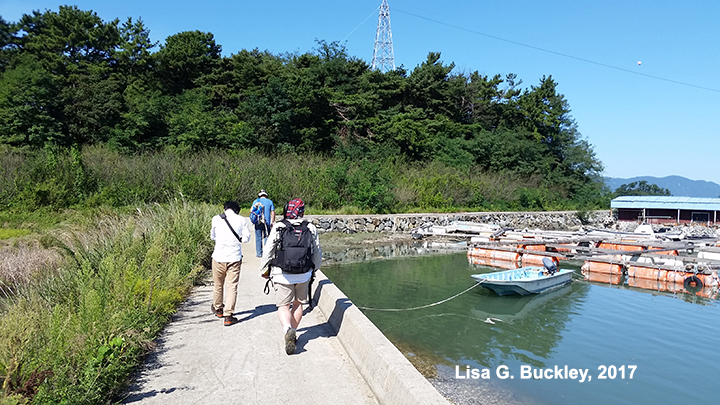
Our first stop was a possible reptilian track site. The area is a popular fishing spot, so there was good parking for the boat launches and anglers. We started our hike down to the first track site.
Strolling along one of the moorings for the small fishing boats on Bito Island.
The track site was a small exposure of finely-bedded (layered) silty sand that has some horizontal exposures. Here's Dr. Richard McCrea standing next to the track surface.

There are a great many similarities between doing fieldwork in South Korea and fieldwork in northeastern British Columbia. First, the bulk of the vertebrate fossil record for the Early Cretaceous in both areas is from the track record. There is skeletal material, but it is not common enough to tell an accurate story of life during the Early Cretaceous for South Korea and British Columbia. Second, both areas are heavily vegetated. We have to rely on either natural exposures along waterways and mountain tops, or those rocks exposed by the extensive industrial activity in both areas.

One thing we do not have in northeastern British Columbia is intertidal invertebrates occupying the track surfaces. Thankfully these snails were huddled in the cracks on the vertical part of the rock exposure and didn't hide the tracks.

Here is a close-up of the tracks exposed on the surface. They are very likely tracks of a large, Early Cretaceous turtle.

Our next stop was a larger track site that was a short car trip and a short hike away from Stop 1. It was a glorious day for a walk along the shoreline, and the scenery was beautiful.
The gorgeous coastal scenery on Bito Island.
I could look for bird tracks here all day.
Left to right: Drs. Richard McCrea, Martin Lockley, and Kim Kyung-soo, en route to the track site.
The track site is where the didactyl (two-toed) theropod tracks named Dromaeosauripus jinjuensis (Kim et al. 2012) were discovered (link to paper abstract).

We spent a little time sweeping off the small shoreline pebbles that covered the track surface.
Rich and Sujin standing behind the uncovered trackway of Dromaeosauripus jinjuensis.
Rich and our other grad student, Jason, at the Dromaeosauripus jinjuensis track site.
Here is a close-up of a section of the Dromaeosauripus jinjuensis trackway. Do you see the large theropod track stepping on the trackway?

Once we uncovered the Dromaeosauripus jinjuensis trackway, Rich got to work taking the pictures for a photogrammetry model.
Rich demonstrating photogrammetry in bright light conditions on the Dromaeosauripus jinjuensis trackway. Red arrows show the Dromaeosauripus jinjuensis tracks.
Site visits such as these are an important part of fossil heritage conservation. This trackway was described in 2012, but that doesn't mean that once it is published that it is forgotten about. This track site (and any other fossil site) will be examined every year to monitor its condition.

While the photogrammetry was taking place, I started hunting out my quarry: bird tracks! At this site, the smallest tracks we would see were those of Dromaeosauripus. We did see tracks of a small sauropod (think Brontosaurus for the trackmaker) on the same surface.
Sauropod manus (hand) and pes (foot) tracks, Bito Island. The arrow on the scale is 10 cm.
While I did not find any bird tracks at this track site, I did make a new friend. Meet (tentative identification) Scolopendra subspinipes, sometimes known as the Orange-legged Centipede.

I'm not the largest fan of encountering critters with more than six legs. I have been known to perform the Spider Dance at inopportune times. One such time was while using an outhouse in the field...admittedly not my most dignified moment. Thankfully I didn't find my new friend on my leg or in my backpack, although I did close all of the zips on my backpack after taking pictures of the centipede.

We were approaching 4:30pm when we went to the last field site for the day: a long stretch of shoreline on which large ornithopod tracks had been discovered. I immediately went into bird track mode and started with the rocks exposed near the edge of the forest.

I did find a suspicious-looking small trace, but there was not enough of it exposed for me to be sure that it was a vertebrate trace.

I also came across a medium-sized theropod track.

At this time the light was beginning to fade. Lighting plays a huge roll in seeing tracks in the field. The dimmer the light, the less likely you are to see small tracks. The best condition for seeing bird tracks in the field is a bright sunny day that casts shadows on low-relief surfaces. These were not ideal light conditions.
Dim light is not ideal for finding any track, let alone small, shallow bird tracks.
I started working my way down to the edge of the water around 6:30pm. I'll be honest: I was not expecting to find bird tracks this late in the day. I was still looking, but I knew my chances of recognizing bird tracks were slim. What caught my attention were all of the tiny hermit crabs. I knelt on to the wet, slippery rocks to try to get a picture of the hermit crabs...and my brain focused on a familiar pattern on the rock.

BIRD TRACKS!
I called people over, and we immediately started outlining the bird tracks that we could see using white chalk. Because this is a tidal-influenced area, Dr. Kim and his grad students began to salvage the track surface for removal back to the lab.

This part made me extremely nervous because the rock layer the bird tracks are on is very, but the surface came up in good condition. It turns out these were the first bird tracks to be found at this particular locality on the island. This was a good year for me finding bird tracks!

This was a full day! After we deposited the tracks in Dr. Kim's lab, we went to dinner at a sushi restaurant and ate more sushi in one sitting than I ever have in my entire life. We made it back to the Happy Owl Hotel by 11:00pm.
A very small part of the owl collection at The Happy Owl Hotel.
I downloaded all of my pictures and updated my field notes, and was definitely ready for bed at 11:30pm. The next day's adventure would prove to be just as busy, as we would visit the Jinju Innovation City track sites, and the Gajin-ri track site!

References

Kim JY, Lockley MG, Woo JO, Kim SH. 2012. Unusual didactyl traces from the Jinju Formation (Early Cretaceous, South Korea) indicate a new ichnospecies of Dromaeosauripus. Ichnos 19(1-2): 75-83.

Monday, December 4, 2017

Tracking Cretaceous Birds in South Korea: Chinju University

Hello Dear Readers!

I had an interruption in my planned blogging schedule with a long trip out of my office that included a keynote presentation at the Association of Professional Engineers and Geoscientists of British Columbia in Whistler B.C. on October 21, a couple of family visits, and presenting at the Afternoon of Palaeontology conference at the Philip J. Currie Museum in Wembly, A.B. I was also the host for the Real Scientists Twitter account for the week of November 12 (or as it should be officially changed to...Dinovember). THEN I had paper revisions and paper proof revisions to submit for a new ichnospecies of Ignotornis and the first occurrence of Ignotornis in Canada! In the parlance of the Internet, I haz a busy.

Now that I am back at my desk until the end of December, I can dust off Ye Olde Blog and continue with the tale of our ichnological adventure to South Korea! I'll be breaking our adventures of September 13th into two posts. This day was a combination of laboratory-based and field-based investigation, so there is A LOT to cover.

We left our mighty palaeontologists at the Happy Owl Hotel in Jinju.
Note: there are two spellings for the city. Jinju is the official name of the city, while Chinju is the European-style phonetic spelling that isn't being used much nowadays, but several official signs and building names still carry that spelling.

After our fantastic barbeque dinner (there are several styles of Korean barbeque and all of them are delicious) we were in bed (after updating notes) around 1:30 am.

We started September 13th bright and early when Dr. Kim drove us to his lab at Chinju University. There we met his graduate students Su-jin (who drove us from Daejeon to Jinju), and [CHECK NOTES]. We were given an introduction to all of the specimens that were available for study and those that are currently under investigation. Of course, I focused on the bird tracks, but there were so many specimens present that demonstrate the hugely diverse Early Cretaceous paleofauna of South Korea.

There was a bird track slab on the second floor of the Earth Sciences Department that was collected from Jinju Innovation City (more on that later). It preserved at least three bird trackways, and looked as though the ground the birds were walking on was pretty goopy - the toes do not have crisp, clean outlines that show digital pads, but they do show other details that might be missing from a non-goopy sediment, such as deeply impressed toes and webbing impressions.

Slab on the second floor of the Earth Sciences Department at Chinju (Jinju) University. 
The slab is on display for all of the students to see in the main hallway.
Since the track slab was on display in the main hallway, it also meant that I was on display while I was working. No one seemed too disturbed that I was lying on the display to get my measurements.
This part amused me somewhat. See the small gravel used as a decorative bedding to camouflage the supporting foam base? This may have been an outdoor display at some point because a cat had come into contact with the display and left some, um, commentary on what it thought of fossil bird tracks.

Apparently, you shouldn't send your bird track papers to cats to review.

This ranks a 1/10 in terms of animals interacting with fossil displays and fossil sites. The cat scat was easily removed with a plastic bag, and there were only two pieces. There was no smell of urine or evidence of fresh activity. If you want real horror stories of animals interacting with specimens, ask your local collections manager about moth or dermestid beetle infestations. Be kind to the poor souls and buy them a reviving beverage before requesting such a tale of misery and woe.

Step 1 of documenting a track slab such as this one was already done for me: all of the bird tracks on the slab were identified and had numbered stickers associated with them. All of the little white dots you see are number tags identifying a bird track.


This made Step 2 less time-consuming (but necessary) step to complete: outline ALL of the footprints with either a chalk or a soapstone pencil. This outlining step is crucial. First, it makes you look at the individual tracks. I mean, it makes you REALLY look at the tracks. You start to notice features in individual footprints that you might not otherwise see if you are just focusing on the number of tracks in a trackway.

Take a look at these lovely bird tracks.

Tracks 14, 15, and 16 are were made by the same bird, and by the same individual. There is still some overlying sediment that is filling in some of the toe impressions. Although there is some sediment filling in the backward-pointing toe (the hallux), we can see that is has a noticeable outside curve that is consistent in all the tracks. That's cool, and I'll be focusing on what this means for the trackmaker. 

Also, you can see that the step (also called the pace length in the literature) the bird took between track 14 and 15 is longer than the step between tracks 15 and 16. This is a really good example of something that frustrates people who don't really look at tracks: variation. 

Think about you walking from, say, your desk to the coffee/teapot. Are all of your steps equal in length? Did one foot catch a bit on the uneven carpet? Did you pass someone and move slightly off of your path to make sure you didn't shoulder-check them into the wall? There is absolutely no way that the step you take between track 14 and 15 is going to be exactly the same length as the step you take between track 15 and 16. Why? Because you are not a robot. And neither are the dinosaurs and birds that made these tracks. They are dynamic, complex living organisms that will make countless little adjustments as they walk. This is why I think it is important to spend time watching animals move in their natural habitats if you are going to study tracks. As soon as we stop viewing tracks as having been made by living animals, we've lost the purpose of studying fossil tracks: to learn more about the lives of extinct animals using records of their recorded behavior. [Steps off of soapbox.]

I don't have too many pictures of the rest of the team, as they were all down in the main laboratory, either taking photogrammetry images of track slabs (Rich) or making latex peels and plastic tracings of track slabs (Martin.) Rich was also mentoring the graduate students on how to take photogrammetry images. Photogrammetry is like any other computer tool we use in paleontology: garbage data in = garbage results out. In this case, the data are the digital photographs. If the photos are rushed and blurry, or if the settings on the camera change greatly between one photo and the next, or if the overlap of the photos isn't enough (we aim for at least 60% overlap for all of the images), then sure, you'll get a digital model, but you probably won't be able to collect much data from it.

We broke for lunch around 12:30 pm and went to a really good Chinese restaurant. I tried a soup that I was told had sea cucumber in it. If no one had told me I would never have known it was sea cucumber: it had the same taste and texture as portabella mushroom.

Over lunch, we planned our afternoon adventure. We were heading to Bitu Island to see some of the track sites in the field, including a site that has a dromaeosaur (a.k.a. the raptors from Jurassic Park) trackway! 

I was quite excited for our field adventure. All of the track sites we were going to see were on the shoreline, which - for my interests - means that there is a chance to see some modern shorebird tracks! I also enjoy shoreline prospecting: it is so different from the deep woods and mountain prospecting that we usually do in northeastern British Columbia.

Stay Tuned!