Thursday, January 4, 2018

Tracking Cretaceous Birds in South Korea: Bito Island

Happy New Year, Dear Readers!

I'm going to forgo the usual "Here are my goals for the New Year" post because...well, things are still up in the air, plan-wise. We still have no funding to continue the field documentation and excavation (a.k.a. research) of the Six Peaks Dinosaur Track Site (guest blog post on Real Scientists) near Hudson's Hope, British Columbia. This will be Year 2 of an uncertain field season. Right now, I'm just taking my work one day at a time, working on projects that I'm excited about. Some projects are research, while another is more literary in nature.

One of the projects I'm excited about is my science communication, and I must continue, Dear Reader, with my tale of Cretaceous bird tracks from South Korea!

We last left our ichnology heroes on September 13, 2017, at lunch at a Chinese restaurant after a morning of documenting tracks at Dr. Kim Kyung-soo's lab at Chinju University. We timed our lunch and travel to get from the University to Bito Island to hit the right part of the tide cycle, as our prospective field stops were all along the shoreline of the island. Doing field work in a tide-influenced area means you have to be aware of the local tide tables if you want to see outcrop. Our outcrops would be exposed during mid- to late afternoon.

The drive to Bito Island was lovely, with lots of coastal scenery (that does not photograph well at highway speeds). When we arrived at Bito Island around 2:45pm, Dr. Kim pointed out imagery of the Hare and the Tortoise, representing the Korean folktale of "The Hare's Liver." The Hare (representing the peasantry) had to be clever and quick to escape the Tortoise (representing nobility), who was tasked with fetching the liver of the Hare to cure the Dragon King. Here's a link to the story of "The Hare's Liver:" if you know of a better version, please let me know!

"The Hare's Liver." The Tortoise is likely happy because he thinks he's fulfilling his mission to retrieve the Hare's liver for the Dragon King, while the Hare is pleased that he's going to outwit the Tortoise and save his innards.
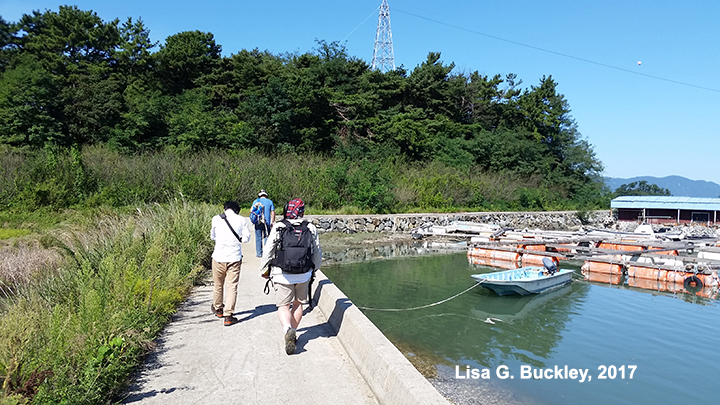
Our first stop was a possible reptilian track site. The area is a popular fishing spot, so there was good parking for the boat launches and anglers. We started our hike down to the first track site.
Strolling along one of the moorings for the small fishing boats on Bito Island.
The track site was a small exposure of finely-bedded (layered) silty sand that has some horizontal exposures. Here's Dr. Richard McCrea standing next to the track surface.

There are a great many similarities between doing fieldwork in South Korea and fieldwork in northeastern British Columbia. First, the bulk of the vertebrate fossil record for the Early Cretaceous in both areas is from the track record. There is skeletal material, but it is not common enough to tell an accurate story of life during the Early Cretaceous for South Korea and British Columbia. Second, both areas are heavily vegetated. We have to rely on either natural exposures along waterways and mountain tops, or those rocks exposed by the extensive industrial activity in both areas.

One thing we do not have in northeastern British Columbia is intertidal invertebrates occupying the track surfaces. Thankfully these snails were huddled in the cracks on the vertical part of the rock exposure and didn't hide the tracks.

Here is a close-up of the tracks exposed on the surface. They are very likely tracks of a large, Early Cretaceous turtle.

Our next stop was a larger track site that was a short car trip and a short hike away from Stop 1. It was a glorious day for a walk along the shoreline, and the scenery was beautiful.
The gorgeous coastal scenery on Bito Island.
I could look for bird tracks here all day.
Left to right: Drs. Richard McCrea, Martin Lockley, and Kim Kyung-soo, en route to the track site.
The track site is where the didactyl (two-toed) theropod tracks named Dromaeosauripus jinjuensis (Kim et al. 2012) were discovered (link to paper abstract).

We spent a little time sweeping off the small shoreline pebbles that covered the track surface.
Rich and Sujin standing behind the uncovered trackway of Dromaeosauripus jinjuensis.
Rich and our other grad student, Jason, at the Dromaeosauripus jinjuensis track site.
Here is a close-up of a section of the Dromaeosauripus jinjuensis trackway. Do you see the large theropod track stepping on the trackway?

Once we uncovered the Dromaeosauripus jinjuensis trackway, Rich got to work taking the pictures for a photogrammetry model.
Rich demonstrating photogrammetry in bright light conditions on the Dromaeosauripus jinjuensis trackway. Red arrows show the Dromaeosauripus jinjuensis tracks.
Site visits such as these are an important part of fossil heritage conservation. This trackway was described in 2012, but that doesn't mean that once it is published that it is forgotten about. This track site (and any other fossil site) will be examined every year to monitor its condition.

While the photogrammetry was taking place, I started hunting out my quarry: bird tracks! At this site, the smallest tracks we would see were those of Dromaeosauripus. We did see tracks of a small sauropod (think Brontosaurus for the trackmaker) on the same surface.
Sauropod manus (hand) and pes (foot) tracks, Bito Island. The arrow on the scale is 10 cm.
While I did not find any bird tracks at this track site, I did make a new friend. Meet (tentative identification) Scolopendra subspinipes, sometimes known as the Orange-legged Centipede.

I'm not the largest fan of encountering critters with more than six legs. I have been known to perform the Spider Dance at inopportune times. One such time was while using an outhouse in the field...admittedly not my most dignified moment. Thankfully I didn't find my new friend on my leg or in my backpack, although I did close all of the zips on my backpack after taking pictures of the centipede.

We were approaching 4:30pm when we went to the last field site for the day: a long stretch of shoreline on which large ornithopod tracks had been discovered. I immediately went into bird track mode and started with the rocks exposed near the edge of the forest.

I did find a suspicious-looking small trace, but there was not enough of it exposed for me to be sure that it was a vertebrate trace.

I also came across a medium-sized theropod track.

At this time the light was beginning to fade. Lighting plays a huge roll in seeing tracks in the field. The dimmer the light, the less likely you are to see small tracks. The best condition for seeing bird tracks in the field is a bright sunny day that casts shadows on low-relief surfaces. These were not ideal light conditions.
Dim light is not ideal for finding any track, let alone small, shallow bird tracks.
I started working my way down to the edge of the water around 6:30pm. I'll be honest: I was not expecting to find bird tracks this late in the day. I was still looking, but I knew my chances of recognizing bird tracks were slim. What caught my attention were all of the tiny hermit crabs. I knelt on to the wet, slippery rocks to try to get a picture of the hermit crabs...and my brain focused on a familiar pattern on the rock.

BIRD TRACKS!
I called people over, and we immediately started outlining the bird tracks that we could see using white chalk. Because this is a tidal-influenced area, Dr. Kim and his grad students began to salvage the track surface for removal back to the lab.

This part made me extremely nervous because the rock layer the bird tracks are on is very, but the surface came up in good condition. It turns out these were the first bird tracks to be found at this particular locality on the island. This was a good year for me finding bird tracks!

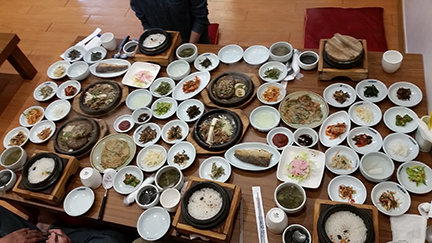
This was a full day! After we deposited the tracks in Dr. Kim's lab, we went to dinner at a sushi restaurant and ate more sushi in one sitting than I ever have in my entire life. We made it back to the Happy Owl Hotel by 11:00pm.
A very small part of the owl collection at The Happy Owl Hotel.
I downloaded all of my pictures and updated my field notes, and was definitely ready for bed at 11:30pm. The next day's adventure would prove to be just as busy, as we would visit the Jinju Innovation City track sites, and the Gajin-ri track site!

References

Kim JY, Lockley MG, Woo JO, Kim SH. 2012. Unusual didactyl traces from the Jinju Formation (Early Cretaceous, South Korea) indicate a new ichnospecies of Dromaeosauripus. Ichnos 19(1-2): 75-83.

Monday, December 11, 2017

Sound Bites: Hearing a Tyrannosaurus rex

If you are a fan of dinosaurs, probably know what sound accompanies this image.


Watching Jurassic Park for the first time (and several times after that) introduced us to what Tyrannosaurus rex would be like, in their movements, behaviors, and sounds. This scene is never, ever going to get old. It was also perfect that my first viewing of Jurassic Park was at a drive-in during a rainstorm.

Hollywood is no stranger to using odd things to recreate visual and audio effects sounds with which we are familiar...or have no familiarity with at all because they haven't been invented yet (lightsaber swooshes), because we don't regularly stab people in the shower (chocolate syrup was used for blood in the original Psycho), or because the sound is so far in the past that no human has ever heard anything like it.

Elephant, tiger, and crocodile sounds were used to recreate the iconic Tyrannosaurus rex sounds. I am most interested in the use of the crocodile gurgling. In my opinion, especially as a person who has spent a lot of time in the wilderness and has heard countless mammal sounds, the crocodile gurgling of the Tyrannosaurus rex this is far more unsettling than the classic roar.


Hollywood gave us something terrible, awesome-sounding, and not-at-all-subtle for Tyrannosaurus rex because we, as human beings living in a time dominated by large fuzzy roaring mammals (lions and tigers and bears, oh my!), expect our large predators to roar, snarl, and bellow. Most of the animals used to create the classic sounds of the Jurassic Park Tyrannosaurus rex are large mammals.

Extant Phylogenetic Bracketing and the Sounds of Tyrannosaurus rex

Figuring out how an extinct mammoth sounds, or how an extinct species of large cat sounds, is not that difficult because we have large pachyderms and large felids around to use as examples. We use large mammals as a comparison against large dinosaurs because hey, that's what we have to work with. However, dinosaurs are not mammals. Dinosaurs belong to a group of animals called archosaurs. Archosaurs took a completely different evolutionary path from our group, the synapsids (mammals and mammal-like reptiles.) The archosaur group and the mammal-like reptile group have been doing their own things, evolutionary-speaking, for at least 250 million years.

Our present-day representatives of archosaurs are the crocodiles and the small theropods (a.k.a. birds). These animals are much closer to large non-avian dinosaurs in terms of evolutionary history, anatomy, and likely behavior, than are large mammals. Crocodiles evolved before large non-avian dinosaurs, and small present-day theropods (birds) became specialized after large non-avian theropods evolved. We have the beginning of the story (crocodiles) and the end of the story (present-day theropods), with large non-avian dinosaurs landing in the middle.

Using crocodiles and present-day birds to test hypotheses (questions) about extinct dinosaurs is called Extant Phylogenetic Bracketing. The present-day examples (crocodiles and birds) give us examples of what is possible for extinct animals (large theropods) that are also part of their group (archosaurs). A lot of the information we have on theropod dinosaur behavior comes from comparisons to the behavior of present-day birds, such as parental care and egg clutch sizes (Varricchio et al., 2008; Varricchio and Jackson, 2016) and potential courtship behaviors (Lockley et al., 2016).

Enter Dr. Julia Clarke, professor of vertebrate palaeontology at the University of Texas. She used extant phylogenetic bracketing to take two unsettling sounds (crocodile vocalizations and the booming call of the Eurasian Bittern), scaled them up to Tyrannosaurus rex-size, and....dang.


Here is the link to The Telegraph news article that contains a video playing the sound. I'll give you a minute or two to go and listen.

Was that not completely disconcerting? What if you were in the forest, and heard (or felt like the host mentioned) that sound behind you? I guarantee you'd have a case of the freakies: I know I would.

Humans have (when compared to the rest of the animal kingdom) a rather limited range of hearing. Humans, in general, can hear sounds between 20 Hz and 20 kHz. Sounds below 20 Hz are typically referred to as infrasound. Our species doesn't really hear infrasound all that well. Check out this link from the Cornell Lab's Elephant Listening Project. There are three sound clips at 10 Hz, 20 Hz, and 30 Hz. Can you hear the sound?

I could not hear any of the clips (I did feel pressure in my ears), but that's not surprising: I have not evolved to communicate using low-frequency sounds, unlike elephants and some birds (the link goes to a recording of a cassowary).

However, just because we (as a species) can't hear infrasound doesn't mean that some of us may not sense it in other ways. I felt a pressure in my ears when listening to the clips and afterward, I felt a low-grade headache. There have been studies done that suggest infrasound may induce feelings of unease in humans. One such study was the Purcell Room Concert of May 31, 2003. The audience listened to music, into which infrasound was inserted at specific times (the audience didn't know.) The audience was then asked to fill out a questionnaire detailing their experiences during the concert. To quote the webpage:

"During our concert, infrasound boosted the number of strange experiences reported among the audience, even among those who were unaware of its presence. Unusual reports included a sense of coldness, anxiety, and shivers down the spine. On average, infrasound boosted the number of strange experiences by around 22 percent. It also increased the intensity of any feelings reported."

Does this sound like any unexplained phenomena? Turn down the sound for this clip: it's a little loud.


There is a strong possibility that what people experience as a sign of a ghostly presence (coldness, anxiety, shivers, unease, etc.) could be their sensitivity to infrasound.

Here's a chilling thought: if Tyrannosaurus rex had part of its vocalizations in the low frequency or infrasound range, not only would we hear that menacing gurgle, but the vocalization would likely trigger an anxiety reaction during the encounter.

I'll leave you with this lovely clip of a vocalizing American Alligator. Have a Creepy Monday!


Monday, December 4, 2017

Tracking Cretaceous Birds in South Korea: Chinju University

Hello Dear Readers!

I had an interruption in my planned blogging schedule with a long trip out of my office that included a keynote presentation at the Association of Professional Engineers and Geoscientists of British Columbia in Whistler B.C. on October 21, a couple of family visits, and presenting at the Afternoon of Palaeontology conference at the Philip J. Currie Museum in Wembly, A.B. I was also the host for the Real Scientists Twitter account for the week of November 12 (or as it should be officially changed to...Dinovember). THEN I had paper revisions and paper proof revisions to submit for a new ichnospecies of Ignotornis and the first occurrence of Ignotornis in Canada! In the parlance of the Internet, I haz a busy.

Now that I am back at my desk until the end of December, I can dust off Ye Olde Blog and continue with the tale of our ichnological adventure to South Korea! I'll be breaking our adventures of September 13th into two posts. This day was a combination of laboratory-based and field-based investigation, so there is A LOT to cover.

We left our mighty palaeontologists at the Happy Owl Hotel in Jinju.
Note: there are two spellings for the city. Jinju is the official name of the city, while Chinju is the European-style phonetic spelling that isn't being used much nowadays, but several official signs and building names still carry that spelling.

After our fantastic barbeque dinner (there are several styles of Korean barbeque and all of them are delicious) we were in bed (after updating notes) around 1:30 am.

We started September 13th bright and early when Dr. Kim drove us to his lab at Chinju University. There we met his graduate students Su-jin (who drove us from Daejeon to Jinju), and [CHECK NOTES]. We were given an introduction to all of the specimens that were available for study and those that are currently under investigation. Of course, I focused on the bird tracks, but there were so many specimens present that demonstrate the hugely diverse Early Cretaceous paleofauna of South Korea.

There was a bird track slab on the second floor of the Earth Sciences Department that was collected from Jinju Innovation City (more on that later). It preserved at least three bird trackways, and looked as though the ground the birds were walking on was pretty goopy - the toes do not have crisp, clean outlines that show digital pads, but they do show other details that might be missing from a non-goopy sediment, such as deeply impressed toes and webbing impressions.

Slab on the second floor of the Earth Sciences Department at Chinju (Jinju) University. 
The slab is on display for all of the students to see in the main hallway.
Since the track slab was on display in the main hallway, it also meant that I was on display while I was working. No one seemed too disturbed that I was lying on the display to get my measurements.
This part amused me somewhat. See the small gravel used as a decorative bedding to camouflage the supporting foam base? This may have been an outdoor display at some point because a cat had come into contact with the display and left some, um, commentary on what it thought of fossil bird tracks.

Apparently, you shouldn't send your bird track papers to cats to review.

This ranks a 1/10 in terms of animals interacting with fossil displays and fossil sites. The cat scat was easily removed with a plastic bag, and there were only two pieces. There was no smell of urine or evidence of fresh activity. If you want real horror stories of animals interacting with specimens, ask your local collections manager about moth or dermestid beetle infestations. Be kind to the poor souls and buy them a reviving beverage before requesting such a tale of misery and woe.

Step 1 of documenting a track slab such as this one was already done for me: all of the bird tracks on the slab were identified and had numbered stickers associated with them. All of the little white dots you see are number tags identifying a bird track.


This made Step 2 less time-consuming (but necessary) step to complete: outline ALL of the footprints with either a chalk or a soapstone pencil. This outlining step is crucial. First, it makes you look at the individual tracks. I mean, it makes you REALLY look at the tracks. You start to notice features in individual footprints that you might not otherwise see if you are just focusing on the number of tracks in a trackway.

Take a look at these lovely bird tracks.

Tracks 14, 15, and 16 are were made by the same bird, and by the same individual. There is still some overlying sediment that is filling in some of the toe impressions. Although there is some sediment filling in the backward-pointing toe (the hallux), we can see that is has a noticeable outside curve that is consistent in all the tracks. That's cool, and I'll be focusing on what this means for the trackmaker. 

Also, you can see that the step (also called the pace length in the literature) the bird took between track 14 and 15 is longer than the step between tracks 15 and 16. This is a really good example of something that frustrates people who don't really look at tracks: variation. 

Think about you walking from, say, your desk to the coffee/teapot. Are all of your steps equal in length? Did one foot catch a bit on the uneven carpet? Did you pass someone and move slightly off of your path to make sure you didn't shoulder-check them into the wall? There is absolutely no way that the step you take between track 14 and 15 is going to be exactly the same length as the step you take between track 15 and 16. Why? Because you are not a robot. And neither are the dinosaurs and birds that made these tracks. They are dynamic, complex living organisms that will make countless little adjustments as they walk. This is why I think it is important to spend time watching animals move in their natural habitats if you are going to study tracks. As soon as we stop viewing tracks as having been made by living animals, we've lost the purpose of studying fossil tracks: to learn more about the lives of extinct animals using records of their recorded behavior. [Steps off of soapbox.]

I don't have too many pictures of the rest of the team, as they were all down in the main laboratory, either taking photogrammetry images of track slabs (Rich) or making latex peels and plastic tracings of track slabs (Martin.) Rich was also mentoring the graduate students on how to take photogrammetry images. Photogrammetry is like any other computer tool we use in paleontology: garbage data in = garbage results out. In this case, the data are the digital photographs. If the photos are rushed and blurry, or if the settings on the camera change greatly between one photo and the next, or if the overlap of the photos isn't enough (we aim for at least 60% overlap for all of the images), then sure, you'll get a digital model, but you probably won't be able to collect much data from it.

We broke for lunch around 12:30 pm and went to a really good Chinese restaurant. I tried a soup that I was told had sea cucumber in it. If no one had told me I would never have known it was sea cucumber: it had the same taste and texture as portabella mushroom.

Over lunch, we planned our afternoon adventure. We were heading to Bitu Island to see some of the track sites in the field, including a site that has a dromaeosaur (a.k.a. the raptors from Jurassic Park) trackway! 

I was quite excited for our field adventure. All of the track sites we were going to see were on the shoreline, which - for my interests - means that there is a chance to see some modern shorebird tracks! I also enjoy shoreline prospecting: it is so different from the deep woods and mountain prospecting that we usually do in northeastern British Columbia.

Stay Tuned!

Tuesday, October 10, 2017

Tracking Cretaceous Birds in South Korea: Daejeon

Hello, Dear Readers!

Welcome back to Tracking Cretaceous Birds in Korea! Our first two days of our trip were spent in the city of Daejeon, home of the Natural Heritage Center!

Simplified map of South Korea, from the Daejeon tourist information brochure.
Daejeon is a perfect example of a city that says "Science? Heck yeah: we LOVE SCIENCE, and we know you love it as well!" It is one of the few cities I have visited that does both a) a spectacular amount of research and heritage conservation, and b) is so proud of it that they talk about it on tourist brochures.
"Enjoy visiting Daejeon, a city of science, culture, and ecology." Yes, you see that correctly: science is highlighted.
Editorial Note: Daejeon - and the entire experience of visiting Korea - shone the world's largest spotlight on how stingy North American culture and government is regarding respect and resources for heritage conservation and research. We had many long conversations with our Korean colleagues on this subject. Oh yes: researchers talk to one another quite extensively. We ALL know who has been naughty and who has been nice. What we were blown away by was the overall attitude that giving resources to heritage research and conservation is the right thing to do. It's considered good for the country, good for the general education and enlightenment of the population, and good for the world. In contrast, the North American mindset is "How will giving resources to heritage make me money and benefit me?" I think this is part of the colonialism mindset. We should be ashamed of ourselves, North America.
Entrance to the Natural Heritage Center.
After meeting with staff of the Natural Heritage Center (a complex of several buildings and an interpretive center), we were taken to the collections building to see the dinosaur and bird tracks. Much like northeastern British Columbia, much of Korea's ichnology specimens occur on large rock slabs. Their collections facility is set up with this in mind:

Ichnology collections of the Natural Heritage Center in Daejeon, South Korea. Check out the shelving!
The collections facility also has small cabinets for the smaller track specimens. I definitely appreciate the removable plexi-glass covers on all of the drawers.


There are also several track specimens attached to heavy metal shelves on the walls. How do we access those? Well, fear not! Those counter tops are heavy duty (can take the weight of several specimens and an ichnologist or two), and there's a lift!

Dr. Richard McCrea gets his photogrammetry camera ready while Dr. Kyung-soo Kim positions the lift to access wall specimens.
There were so many specimens to document that time seemed to fly for us. While Rich documented specimens using photogrammetry, I collected primary data and images from bird track specimens of interest, and Martin collected data and latex peels from bird, dinosaur, and other vertebrate track specimens of interest.
Drs. Martin Lockley and Richard McCrea planning their specimen documentation strategy.
Dr. Richard McCrea collecting photogrammetry images for future 3D digital models.

Dr. Martin Lockley applying latex.
Of course, it's hot and humid in South Korea: we made a point to stay hydrated while working. We also had to counteract the humidity. Ichnologists are an ingenious bunch, so it did not take long to secure a hair dryer.
Ta-da! This latex peel was ready in the couple of days we had in Daejeon.
Our colleagues made sure that we took lunch breaks. Our first lunch in Daejeon was a version of bulgogi beef, spicy onion cakes, and a huge variety of side dishes.
Ready to fuel ourselves on bulgogi for an afternoon of ichnology!
Left to right: Me, Dr. Richard McCrea, Dr. Martin Lockley.
Our hosts took care of the ordering.
Dr. Kyung-soo Kim and his graduate student Won-mi.
Everything here is delicious!
Our second lunch in Daejeon was a great spicy soup and rice. There was always a spicy and a regular version of soups. Being a fan of spice, I always ordered the spicy version. With the exception of one green pepper, there was no dish that I encountered that was too spicy.

Spicy hot soup, rice, and kimchi.
I have very few images of me in collections, as I was too busy documenting specimens. However, I have plenty of pictures of Early Cretaceous bird tracks! Here is a very small sample of everything that I saw:

A specimen of one of the ichnospecies of Ignotornis, likely Ignotornis yangi.
Jindongornipes kimi (outlined in blue chalk.) This is a fairly large bird track, with a nice hallux impression...sometimes.
Speaking of inconsistently preserved hallux (reversed toe) impressions, this is a great specimen that is going to be used to answer a couple of Cretaceous bird track questions I have.
Well hello there, fascinating specimen!
I also investigated some of the large slabs for very shallow bird tracks. Small, shallow tracks are difficult to see even in good light. One little tool I've found useful are these mini-flashlights. Ever since our adventures without a flashlight documenting the tyrannosaur track site, we never leave home without some source of light.
I have one of these mini-flashlights attached to every one of my field bags.
The low-angle light highlighted these small, tridactyl bird tracks.


These tracks are very similar to an Early Cretaceous bird track type that we find in northeastern British Columbia. I have to do some more detailed comparative work to be sure, but I'm fairly excited about this!

After lunch on our second day in Daejeon, we took some time to check out the displays of the Natural Heritage Center.
The outside of the interpretive display area, with silhouettes of important fauna of South Korea.
Right outside of the entrance, is a nice little habitat for the Reeve's Turtle, an endangered species.
Interpretive sign for the Reeve's Turtle habitat.
We actually saw some Reeve's Turtle! They must have decided not to wear their jaunty hats (as seen in the sign.)
Here's our friend, the Reeve's Turtle!
The entrance of the interpretive center has a large tree, and perched in it were several taxidermied birds. The picture is fairly dim: I don't use flash photography for displays that have textiles (feathers and fur included.)
Look HOO is here! A Great Horned Owl!
The displays were very good: they never shy away from the scientific importance of historic places, ecosystems, and heritage sites. A great example was a display on proper etiquette for visiting caves.

Textual and pictorial lesson on cave etiquette. Don't poke the cave fauna!
Tracks featured prominently in the displays. Here are crane tracks to show visitors where to stand on an interactive display.
They even included the teeny hallux impressions and the small webbing. Should have sent a poet.
The taxidermy collection showcased several bird species. Of course, I focused my pictures on modern analogs to our Cretaceous shorebirds and wading birds.
The Red-crowned Crane. Check out the feets!
Of course, with all of the owls that are in South Korea, I really had to take pictures of the owl displays.
Collared Scops Owl is judging us all.
There were track displays as well!

Plant-eating dinosaur, aka ornithopod tracks.
The dinosaur track displays we saw at the interpretive center are very similar to how we do our displays at the PRPRC: track-oriented. The dinosaurs that are presented are there to show what the trackmakers looked like. Skeletons, being rare in South Korea, are not the centerpiece of displays. Goseong is a very important track area: I'll write about our visit there as well!

After we visited the displays, we returned to the collections and worked until around 6:30pm. We were waiting for two graduate students, Su-jin and Peter, to pick us up and drive us to Jinju, our next research destination.

Our drive to Jinju was pleasant. I was absolutely not prepared for the surprise that awaited us when we arrived at what was going to be our home for the next three days:
The Happy Owl Hotel! IT'S AN OWL-THEMED HOTEL!!!
I cannot begin to describe the excited noises I made when we pulled up to the Happy Owl Hotel.
Owls are my favorite dinosaurs. This is an owl-themed hotel. If I ever need to do a writing retreat for a future book, I'm staying at this hotel. Now you'll see a *very* small sample of all of the pictures I took.
I'm home.

If you thought the outside was full of owls, wait until you see the inside!


There were even more owls in the reception area!


Try as I might, I don't think I photographed all of the owls on display in the Happy Owl Hotel...but I tried!

We crashed in to bed around 1:00am local time. It was a long day, and we knew we were in for a similarly long day tomorrow at Dr. Kyung-soo Kim's lab at Chinju University and targeted field sites. 

Tune in next week for our adventures at Chinju University and our visits to field sites!

Saturday, September 30, 2017

Tracking Cretaceous Birds In South Korea, The Introduction

Hello Dear Readers!

It has been a while since I have dusted the cobwebs off of Ye Olde Blog! I will break my blog silence by starting a series of weekly posts on our recent tracking adventure to South Korea!

We were invited by our colleagues Dr. Kim, Kyung-soo and his research group, to visit various Early Cretaceous field sites in South Korea.

NOTE: Ever since this trip was planned, I heard no end of "jokes," half-jokes, and concern about being in a "potentially dangerous part of the world," given the political climate of 2017. While I understand that those who were truly concerned meant well, I was not concerned for two reasons. One, our hosts were not concerned. If anyone was going to know the up-to-date status of the situation, it was going to be our hosts. I trusted their read of the situation. Two, field work is an inherently risky venture. No matter where you conduct field work in the world, there are going to be area-specific risks. The risks we typically face in northern western Canada are helicopter crashes, wild animal attacks, irate and/or intoxicated people, physical injury, and exposure. Some risks you can mitigate. Others you cannot. I'm not naive, but I'm also not going to fret myself to a point where I'm too scared to take a risk. I'm too old for that ****. Your Mileage May Vary.

These track sites preserve an amazingly diverse ichnofauna (ichnofauna = the critters present based on what you can tell from tracks alone) of non-avian and avian dinosaurs...aka BIRDS. And what birds! There are Early Cretaceous bird track types that are found in Korea and no where else (to date.) Since my work largely deals with Early Cretaceous bird tracks, this was an opportunity to see examples of these track types first hand. So far, I have been limited to working with data, images, and the occasional replica of Cretaceous bird tracks from Korea. There is nothing like seeing the original specimen to see first-hand the intricate details.

Not only would we see these great bird track types in person, we would also be able to collect images to create 3D digital models using the technique called photogrammetry, pioneered in vertebrate paleontology by Neffra Matthews and Tom Noble. Being able to "bring" 3D replicas of track specimens back to our lab means that we can spend much more time examining the specimens in detail. Having on-site 3D models also means that we can compare the bird tracks of Korea side-by-side with the Early Cretaceous bird tracks we find in western Canada.

This visit to Korea will allow us to address some important questions we have of birds and their tracks of the Early Cretaceous:

- What bird track types are unique to western Canada and Korea, respectively? What bird track types are shared? This will give us updated information on where different groups of birds were in the Early Cretaceous world.

- How many different ways can one bird track type appear in the fossil record? A large sample size of bird tracks - showing different types of preservation - are needed to make sure that the differences we see among bird tracks are due to actual shape differences in the bird foot. The same bird foot can walk on mucky mud and firm sand and leave two tracks that look different. The sample size of the Korea bird tracks is an ichnologist's dream come true.

- Do bird track types change over time? In both western Canada and Korea we have rock layers that preserve several stages of the Early Cretaceous. Specifically, we're looking at Aptian (113-125 million years ago) and Albian (100.5 - 113 million years ago) age track-bearing layers of the Early Cretaceous. Western Canada also has track-bearing layers that are 145 - 125 million years old. This means we can see what birds were doing in the world (using their tracks) up to the Aptian, and then compare in detail the changes that happen with bird tracks in the Aptian and the Albian stages in both western Canada and Korea.

Our flight out of Fort St. John on September 9 was at 5:45am (meaning a 4:30am check-in) so, in true remote-living style, we drove two hours the night before and got a room. We groggily boarded, and thankfully didn't have to sky-check the camera equipment.

TRAVEL NOTE: When planning an international field expedition that involves air travel, keep in mind the small service or connecting flights. They have much smaller carry-on capacity than the longer/larger flights. You may not want to release your camera gear to the tender (?) mercies of checked luggage.

We flew from Fort St. John to Vancouver, and after a short layover, boarded and settled in for a 10 hr flight across the Pacific Ocean. The flight was good: I even got a bit of writing done. The only questionable moment was self-induced: we watched "Alien: Covenant." Don't get me started on the epic disappointment that are the new Alien movies.

Yeah, Ripley: I know. I know.
We landed at the Incheon International Airport around 1:30pm local time, collected our luggage, and met our host at one of the coffee shops. We then waited for Martin's (Dr. Martin Lockley) to arrive around 4pm. Once we were all herded together, we started the three hour drive to the first destination of our adventure in Korea: the Natural Heritage Center collections facility in Daejeon!

Stay tuned for the next part of the Adventure!