Thursday, September 1, 2016

Responsible Fossil Stewardship: You Might Not Get To Do Exactly What You Want With Fossils

One of the mostly pleasurable tasks on returning from a long field expedition away from the Internet is checking out the latest fossil news and posts. I say mostly because, every once in a while, I am alerted to such posts that reinforce all of the negative attributes that most palaeontologists I know try to remove from fossil heritage conservation: greed, selfishness, and short-sightedness.

I have to thank my husband for this hat tip. He was browsing fossil-related news and said "Oh, you'll love this. Check this out." It is a piece entitled "Exploring Canada's Socialist Dinosaur Paradise." I was immediately skeptical of the "socialist" part of the title. Last time I checked, Canada was a federal parliamentary representative democracy. This alerted me that, somewhere in this article, someone was going to complain that they weren't allowed to do something they wanted to do with fossils. I had hoped to be wrong. I had hoped that maybe it was just a bad case of the headline not matching the article. What I was NOT expecting was to read these complaints from the author themselves. The author is supposedly a science writer and spent time in the field with someone who takes their responsibility as a steward of Canada's fossil heritage seriously.

Please read the article for yourself, but the tl:dr message from the article was this: the author thought that not being able to do what they liked with dinosaur bone from Alberta was "absurdly socialist" and couldn't (or couldn't be bothered) to understand why these laws were in place. Rather than turn this revelation into a teachable moment that could have educated many on why fossils (and other heritage resources) are important to conserve and protect, they did the mature thing and got snarky.

Life is hard when you don't get to do exactly what you want, when you want, especially when you have to consider the long-term well-being of the most non-renewable resource on our planet: our heritage.

Let's hit the "highlights" of the article.

1. Researchers don't want bone fragments, so everyone should be able to fill their pockets.

This section from the article made me choke on my tea because it was clear that, even though the author went into the field with a trained palaeontologist, they didn't actually pay attention to the methods of prospecting.

"Paleontologists have little interest in the scattered fragments at the surface, which retain little information about where they came from and are unlikely to be connected back into a larger skeleton. They focus efforts instead on excavating bones still stuck in place on the hillside, where it might be part of a more complete animal hiding deeper within."

Do you want to know how palaeontologists actually know where to dig up the intact bones? They follow the bone fragments that have already weathered out from the skeleton to their source. Those bone fragments are every bit as important as the skeleton itself. The idea that palaeontology is all about collecting the most complete and eye-catching specimens is a rather Hollywood, Indiana Jones view of how fossil conservation works.

Museums regularly archive what they jokingly refer to as Underwhelming Specimens: those specimens that look kind of blah, but are actually treasure troves of data. Our own research center has its share of Underwhelming Specimens: bone fragments, pieces of leaves, smudges of Triassic fish. We archive them as diligently as we archive the complete specimens. We're not just filling cabinets with pretty fossils: we're collecting data. Heck, I'm not an expert at identifying all fossil bones (no one is): that thing I identified as a bone fragment might turn out to be a skull bone of a previously undescribed fish or reptile. There may be biochemical data that can be extracted from bone fragments that tell us about the dinosaur's ecosystem. I do not know exactly what data a future researcher or student will be able to collect from bone fragments, but I want them to have that opportunity. If we don't archive these Underwhelming Specimens, those opportunities won't exist. Saying that bone fragments are of little interest to palaeontologists - especially when that person is not an expert in what can be accomplished with bone fragments - is ignoring data, which is bad science and bad science reporting.

2. Canada's Heritage Laws/Policies: They're Speaking for the Fossils

The author states: "It’s nearly impossible to legally pick up a fossil and put it in your pocket in Alberta. The province has among the most restrictive regulations for fossil collecting in the world."

Let's take a closer look at Canada's heritage laws. Canada's fossil heritage laws are governed province by province: each province has jurisdiction over their fossil heritage. One aspect that is common for all the provinces is this: fossils from Crown Land (Canada's version of public land, for my American readers) and/or from provincial and national parks and protected areas are the property of the Government of Canada. The government gets to decide the who, what, where, why, and how of fossil conservation and fossil resource management. This is because - and I'm going to say this slowly so that everyone can follow -

FOSSILS
ARE
PART
OF
EVERY
PERSON'S
HERITAGE.

This is a very simple concept. No one person has the right to sell, destroy, or alter a piece of our country's (and our world's) heritage unless they plan to get permission from each and every person who calls Canada home. There is universally more leeway for fossils found on private land, but even so, it is recognized that, on private or public land, the fossils there are part of the country's heritage.

Had the author done their homework, they would have known that Alberta's fossil heritage laws are not even the most restrictive in Canada. This section is basically a "Here, let me Google that for you" for fossil heritage acts in Canada. I found it at 11pm by Googling "fossil collecting laws Canada".

I was going to provide a link to each of the province's relevant heritage acts, but I don't have to. The best resource comes from The Fossil Forum. This post highlights the heritage laws, province by province, and their policies on fossil collection. The link also provides the sources (and links!) for each of the excerpts of the provincial heritage acts. If you, like me, enjoy reading pages of heritage law, you're welcome. It's an interesting read.

Keeping track of provincial fossil heritage regulations is not just a hobby for me: the researcher staff at our facility have long been working with various provincial branches for clear, concise regulations as they relate to managing British Columbia's fossil heritage. Progress is being made. The most helpful statement for British Columbia's fossils that has been clarified is that fossils collected from Crown Lands are property of the Crown. We do not own ANY of the fossils curated in our archives. We do not want to own any fossils.

Fossil Stewardship versus Fossil Ownership

What disappointed me the most in this article was the lack of consideration of what it means to be a fossil steward, rather than a fossil owner. A person who owns a fossil has physical possession of that fossil for their lifetime (or as long as their interest and resources last). There is a small pool of people who derive any benefit from that owned fossil: immediate friends and family. There is no demand or expectation that the fossil owner will use their fossil collection for educational outreach. There is little continuity from one fossil-owning generation to the next. There is no guarantee that your children or grandchildren are going to be interested or able to care for your fossil collection once you are unable. There is no expectation that records of the who, what, where, when, why, and how of the fossil's past will be meticulously kept. In short, the personal ownership of fossils is finite and fraught with uncertainty.

A steward of fossil heritage knows that their time on this planet is finite and minuscule. You cannot escape the idea of your own mortality and impermanence when you look at a fossil that was a living animal 115 million years ago. That fossil existed long before you, and has the potential to exist long after you die. Caring for fossils is the realization that this collection must outlast not only your generation, but countless future generations. We merely hold vigil over The Dead, over our Past, and will do our very best to pass the source of that knowledge on the future generations. I cannot express both the honor and humbling weight of this responsibility.

Sadly, this responsibility of being a good fossil steward was neglected in the article that chose to complain about "socialism" just because the author could not take a piece of bone home with them.

3. Montana is not absurd because there, people can make money on dinosaurs.

Another thread I was waiting for when I saw "socialist" in the article title was how the commercial fossil trade system in the United States is better because people can do what they like with fossils found on private lands. The author did not disappoint:

"The rules are almost absurdly socialist, especially when compared to just south of the border in Montana, where commercial fossil hunting is both big money and big controversy. The idea that a chunk of rock in my pocket should still be subject to such intense government regulation seems a little silly."

Big controversy indeed. The issue of resolving commercial fossil collection with responsible and ethical fossil heritage management is ongoing, and frustrating as hell to those of us who are trying to champion for the best practices for managing our fossil heritage. I have written previously on the issues that academic palaeontologists have with the commercial system as it stands. Here are the links where I discuss

- the issue of Propoki case and the illegally exported Tarbosaurus
- the issue of the Montana Dueling Dinosaurs and the importance of fossil archive continutity
- the critique of the commercial fossil system, the predicable rebuttal, and ways I think we could move forward, along with ways to appreciate fossils that do not involve ownership

My personal opinion is that, as it stands, the commercial fossil trade, which promotes not only treating heritage resources as luxury items but the illegal fossil trade plaguing other countries, is broken and needs a complete overhaul. Unfortunately, the groups involved are not there yet, or ready to accept critique of the system as anything other than personal attacks. The current incarnation of the commercial fossil trade needs to be overhauled for the sake of not only one country's fossil heritage, but for the fossil and cultural heritage of all of the other countries that have been negatively impacted. This is not "silly".

4. What the Article Got Right
The article does state why these fossil heritage protection laws are in place: there is a black market for fossils, and people will go to extraordinary means to thwart those laws for selfish financial reasons:

"But paleontologists here...say the law works well to reduce conflict over bones, and to ensure that dinosaurs stay close to home where they can benefit science, public museums, and local tourism."

THIS is why we have these laws. The laws recognize that documenting and conserving our fossil heritage isn't just stamp collecting. It's ensuring that these resources will be present - in their home areas - for science, science education, and public outreach.

Here's an example from my home province of British Columbia. Prior to the overhaul of the previous fossil heritage resource management plans, the best collections and displays of British Columbia's fossils were not within the province. There was a long history of out-of-province and out-of-country institutions traveling to British Columbia, making research-level collections, and then leaving the province with the fossils. Small collections were kept here and there, but the best place for people to see British Columbia fossils was outside of British Columbia.

From a research and fossil conservation stance, this was fine: these institutions had the will to commit resources to British Columbia's fossils. I thank them heartily for this. However, from a public awareness stance, this fossil drain resulted in a net loss for British Columbia. There was no opportunity for British Columbians to develop a sense of cultural appreciation and pride in British Columbia's fossils because the fossils were not there to appreciate. People need to see to appreciate, and the fossils have to be in British Columbia to be seen by British Columbians. This is what the fossil heritage laws recognize.

This trend is slowly changing. We display fossils that we have collected in British Columbia. We offer fossil-related educational programming for children, as well as do many many public presentations to spread our excitement for British Columbia's fossil heritage to everyone we see. In fact, the next lecture tour we do will be on the work we did this summer on a great 115 million year old dinosaur track site near Hudson's Hope.

We will continue to work with British Columbia to not only establish clear fossil heritage protection laws, but also to enact management strategies that detail not only how to responsibly care for our fossil heritage, but to responsibly monitor its use for private collection, public outreach and education, and research. It's painstakingly long-term work, but British Columbia's fossil heritage is worth the effort and diligence. All fossil heritage is worth this level of effort. After all, we only get one shot to do this right.

Monday, May 16, 2016

Raven Regurgitates: Strange Woman Now Collects Bird Barf

I'm already the strange woman in the ditch looking at bird tracks, and the strange woman dashing on to the middle of the road to pick up roadkill, so I might as well be that bloody strange woman walking along the bridge on the highway, picking up raven barf.

We all have our hobbies, after all.

Yesterday (Sunday, May 15) our dojo did our annual highway cleanup. Having recently received the renewal for our institution's wildlife salvage permit, I was on the look out for recent roadkill. Birds and small mammals are all my recovering dermestid beetle colonies can handle at this point (thanks, wolf spider), but besides a couple of very flat mice, there was no roadkill to be had.

Wuz in ur coloneez, nomming ur beetlz.
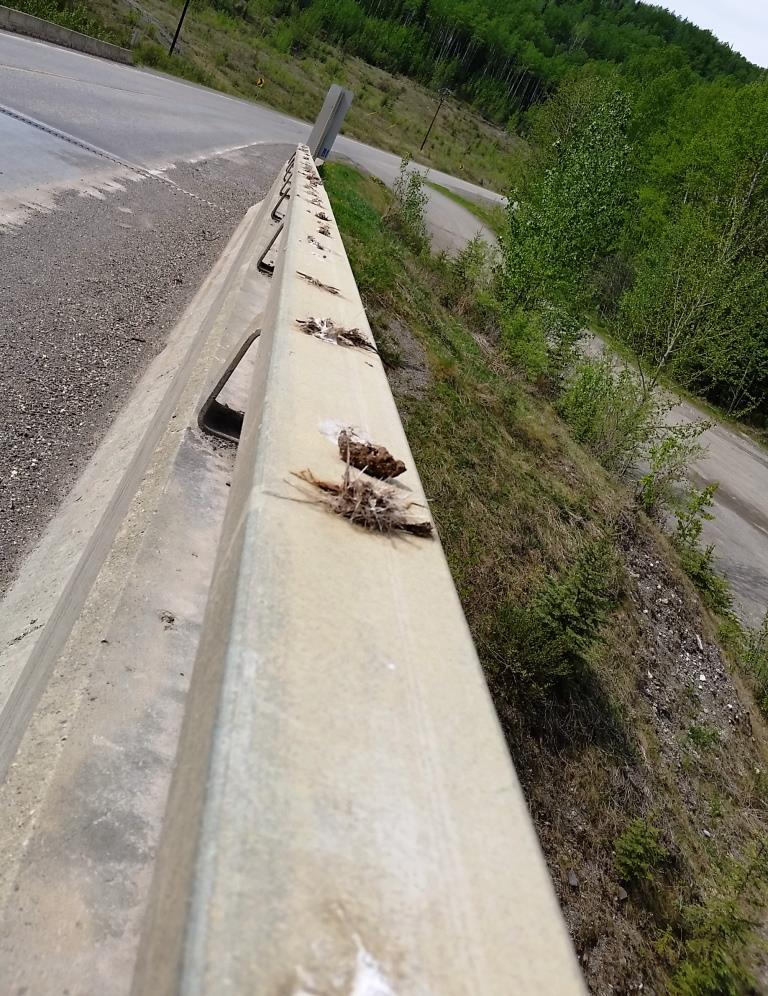
What we did see, when walking over one of the highway bridges close to the local boat launch, was a railing full of raven traces in the form of poop (yes, it's feces, but poop is more fun to write) and regurgitated pellets!

Most people are familiar with owl pellets or regurgitates. Owls tend to swallow their prey whole or in large chunks. Bone, fur, feathers, scales, skin, exoskeletons, and anything that the prey was eating (seeds and vegetation) are all swallowed. The gizzard of the owl compacts all of this hard to digest and indigestible material into a pellet, which the owl later regurgitates.


Owl pellets are fascinating, and form the base of a really fun educational activity: owl pellet dissection! It's a wonderful way to demonstrate the food web and predator-prey interactions, and predator diets. Owl pellets are also an invaluable source of dietary data for ornithologists studying the prey of target owl species. Owl pellets can also provide insight into the preservation of small mammal fauna from Cenozoic sediments: a paper by Terry (2004) examines what happens to the pellets of extant Great Horned Owls (Bubo virginianus) as they break down in a temperate forest environment. This another great example of how studies on modern ichnology (pellets are traces of an organism, so they are 100% in the realm of ichnology!) give us a better understanding of fossil ichnology.

Owls are not the only birds that regurgitate pellets: birds of prey, gulls, herons, cormorants, shorebirds, and corvids. Bird species that consume a great deal of indigestible material with their meal are likely to hack up pellets.

This morning I went to the bridge to see how many raven pellets I could collect for our institution's summer educational activities. We already have a Barn Owl pellet dissection activity, but Barn Owls are not native to northeastern British Columbia. The Common Raven, however, is ubiquitous in our region.

It was easy to see which side of the bridge the ravens preferred to perch on: the side that is closest to the boat launch. Our local ravens figured out that where there are trucks, there are people and the tasty things that people leave behind.

This Common Raven watched me from the boat launch the entire time I was rummaging around their bridge perch.

Clearly ravens spend a great deal of time on this railing.


I set to work choosing my samples. It was clear which deposits were pellets, and which ones were raven poo.


I did not arrange these deposits for the photo. The deposit on the far left has passed through the digestive tract and was deposited via the cloaca: you can see the white material (uric acid) and the small mounds underneath the uric acid. The deposit in the center is a nicely intact pellet. There is white material in the pellet, but it is solid, thin, and fragments of a once larger object. Our working hypothesis is that it is eggshell that this particular raven picked out of the trash. The deposit on the far right is full of fibrous vegetation and uric acid. It may have been a pellet that was later pooped on, or it was fecal in origin and has weathered a lot before I came across it.

I collected two intact pellets, and have passed them on to our Education Coordinator who will now heat sanitize the pellets. This site is easy to access, so we have the opportunity to collect more throughout the year. Once the pellets are sanitized, the kids participating in the Owl Pellet Dissection can compare the diet of a Barn Owl to that of their local Common Raven.

Wish me luck in finding more local bird pellet locations!


References

Terry, R. C. 2004. Owl pellet taphonomy: a preliminary study of the post-regurgitation taphonomic history of pellets in a temperate forest. Palaios 19(5):497-506.

Wednesday, April 20, 2016

Spring Cleaning for Demestid Beetles

Hello Dear Readers!

Spring is in the air, and with spring comes the traditional Spring Cleaning. Spring Cleaning is not something one thinks about when they think "flesh-eating beetles", but in our case it was high time that the Homeworld Colony received a thorough mucking out.

Dermestid beetles do like to frolic in their own filth, but sometimes that filth (beetle feces, chewed up bits of paper and foam, hair and feathers from specimens they process, shed carapaces/exoskeletons) builds up to the point where either 1) the beetles can reach the top of their enclosure and mount a Great Escape, 2) they become so busy with roaming around the catacombs of their filth that they forget they have a job to do, or 3) their much-loved filth becomes soggy, matted, moldy, or plain unnavigable. At that point, it is time to muck out the colony.

Let's look at the brief history of the Homeworld Colony. This colony used to be home to my colony of Dermestes maculatus, the Hide Beetle. These are the most common dermestid beetles used in laboratories and museums for defleshing skeletal specimens. I have two experimental colonies of Dermestes lardarius, the Larder Beetle or the bacon beetle. These dermestids were wild caught, and by that I mean I collected them from around Maia's (my cat) soft food dish, or they were given to me by very understanding friends. NOTE: you know a person is a really good friend if they don't mind you crawling around their baseboards and kitchen looking for beetles and their larvae.

Two years ago I took both the Hide Beetle and the Larder Beetle colonies outside for an education activity to show kids the difference between the two types of beetles, and to show them the skulls. It was a warm day, and I found out the hard way that our local Larder Beetles fly at a much lower temperature (around 20 Celsius) than the Hide Beetles. Larder Beetles are not the most graceful or speedy fliers, but enough managed to fly from Miranda Colony (yes, I am a Firefly fan) to Homeworld (also a Babylon 5 fan) to form what I can only describe as an invasion colony. The Larder Beetles out-competed the Hide Beetles, and now I have three colonies of Larder Beetles.

Except that Homeworld's processing speed started to lag. No progress was being made on any of the specimens. I could see beetles in the colony, but the colony was not teeming with activity. This past fall we discovered that a Wolf Spider had entered the colony. I have no idea how long it was in there, but I'm sure it had a fine time snacking away on my defenseless beetles.

J'accuse! The offending spider.
There are many reasons a colony can collapse, and sometimes it is necessary to give the colony a "fresh" (if that term may be used for dermestid beetles and dried heads of animals) start. Today our field assistant Linda and I decided to hit the colony's reset button and give it a good cleaning.

Here's what Homeworld looked like when we started.

Dermestid beetles living graciously.
You can see that there are several layers of beetle activity captured in this colony. Foam, cardboard, fur and feather form an organic stratigraphic column that shows when each specimen was processed. This colony had not received a thorough cleaning since it's start date in 2013.

First we brought everything outside, and donned our eye protection, particulate masks (I do not want to breathe in beetle poo), and gloves. Next, we removed all of the in progress specimens from the colony and placed them in the receiving bucket. This included a cougar skull, a wolverine skull, a White-winged Crossbill, a Purple Finch, and a Swainson's Thrush.


Once the specimens were removed, we had to sift through the refuse to salvage as many living beetles as we could. We did a couple of handfuls by hand...

Beetle waste.

...before we said "Hey, we're not just biologists: we're also geologists! We have screens!" and brought out a 2 mm screen. This saved us a lot of time and the lives of many larvae and adults.

Before sifting.

After sifting. It was much easier to see scampering beetles and wriggling larvae with all of the feces removed.
We made sure to save the beetles "apartment buildings", or the foam in which the larvae like to burrow to pupate.

If you store anything precious in polystyrene foam, check on it occasionally: if you have any resident dermestids, they will find the foam.
It was a great day to be outside. We were treated to a serenade by the European Starlings. These starlings had quite the repertoire of songs: we heard mimicry of Red-tailed Hawks, American Robins, and a Western Meadowlark.

We also saw that love was in the air, bird-style. A male and female House Sparrow landed on our garbage bin and proceeded to mate in front of us. Linda took a couple of photos and a video. The video shows the last of five matings.


"Birds do it, bees do it..." Photo and video credits: Linda Amos.


After all of that sifting and sorting, we did not find as many beetles in the lower layers of the colony as we had hoped. The colony was slow in its processing speed simply because there are not enough beetles in there for visible progress. All of the newly found beetles will be added to this colony to give it a boost while the survivors slowly rebuild their numbers. Stay tuned for progress reports!

All "clean"! Homeworld 2.0 is ready to process the wolverine (bottom), cougar (left), Purple Finch (top left), Swainson's Thrush (top right), and White-winged Crossbill (right).

Thursday, March 31, 2016

Fool Me At All, Shame On You Always: How Not To Do April Fools' Day

April Fools' Day is tomorrow, and I am waiting with mild trepedation over what faux science gags I am going to see on the Internet. What I was not prepared for was to have someone actively try to recruit me to deceive the public in a pretty rotten way.

Let's be clear right from the start, Dear Reader: I love a good prank. I've been on the receiving end of many a gag courtesy of my colleagues. The most recent prank was having my office filled with toy spiders - we refer to it as The Spidering...this happened over a year ago, and I'm still finding spiders. We have a rather cute, so obviously over the top so as not to be taken seriously video that we're going to post tomorrow that is 100% fun, and in no way would ever be confused with real science. What we do not do, nay, what we REFUSE to do is to actively deceive the public with regards to fossil discoveries, fossil heritage appreciation, and fossil conservation.

Enter my phone conversation from Tuesday afternoon.

I'm out of town, picking up some supplies for the up-coming field season. My cellphone interrupts my browsing. It's a phone number from British Columbia. NOTE: As technologically slow as I am, I am pretty good at Googling phone numbers - I know exactly which organization made this call.

I will refer to the person on the other end as Skippy. Skippy was all excited to tell me of their great idea. There is a project that is going ahead somewhere in British Columbia (not in my neck of the woods), and those involved thought that a great way to get publicity would be to announce a fake dinosaur skeleton discovery as a result of said project. This plan was considered a good idea because, well, April Fools' Day. Skippy continued: they even wanted to get the public involved in submitting names for their new fake dinosaur find. Skippy was wondering if they could use our institution's name to lend their April Fools' prank credibility.

Dear Readers, guess how I responded. I think I was quite polite under the circumstances.

The first words out of my mouth were "Absolutely not!" I went on to say a version of this:

There is already a culture of mistrust in the general public towards science and scientists. The public is also deeply interested in fossil discoveries and news, and trusts that when such news is announced, it's for real. Faking a fossil discovery in British Columbia, using the name of a well-respected institution such as ours, would only serve to fuel such public distrust of scientists. There is no way that we could in good conscience take part in such a scheme.

I ended the conversation with Skippy by saying "And I had better not see our names anywhere near anything that you publicize." Skippy's response was "You won't be included," wording that makes me think that they are actually still planning to go ahead with this Scicomm Wrong.

Half-assed publicity stunts such as these give me nothing but anger and frustration. This is nothing more than manipulating people's natural curiosity about dinosaurs and fossils for a project that will do absolutely nothing to further their appreciation of their province's fossil heritage. There is no way that this can be spun as a scicomm opportunity: had our name been associated with this scheme, we would have lied to the public - April Fools' Day or no - and given them a reason to get excited about dinosaurs in British Columbia. People trust us, whether they consciously recognize that trust or no, to give them trustworthy and factual information about the fossil heritage in British Columbia.

I will not apologize for this: I respect and greatly appreciate the public's natural interest in their fossil heritage. For as long we are at the helm of our institution, we will never abuse that interest for the sake of tacky publicity.

British Columbia is only just starting to develop a cultural appreciation and respect for the province's fossil heritage. The idea that the public has a sense of ownership and pride over their province's heritage is not yet at the levels we see in Alberta, where fossils have been part of the cultural identity for decades. Being an institution operating in British Columbia and actively promoting a culture of pride and responsibility for fossil heritage resources is a serious business for us. We also rely on the goodwill of the public to be supportive of fossil heritage protection and conservation. We will not lightly throw that hard-earned trust away for the sake of a "joke".

Unfortunately for many of us scientists engaging in science communication about our respective fields, we are bombarded with examples of credible-looking fake-umentaries presented by organizations that are trusted by the public as providers of accurate information, all for the sake of publicity. Pick your favorite cryptozoology hunter show - my favorite examples are anything involving Bigfoot, which I have written about previously. Newsweek recently put out a special issue on Bigfoot. National Geographic has also jumped into the realm of presenting Bigfoot "research"Discovery Channel's Megalodon fakery. Discovery Channel's Mermaids fakery. These are all communication brands that have the trust of the public, and that trust is manipulated each and every time a fake-umentary or sensationalized show is presented as fact.

Public Service Science Announcement (PSScA): there is indeed such as thing as bad publicity, especially when it deliberately exploits people's science curiosity for the sake of clicks or views.

So, Dear Readers, I will be online this April Fools' Day, making sure that I keep track of this newest plan to exploit the public's love of fossils. I hope the group involved has had a sober second thought and will abandon this plan. Stay tuned.

Friday, February 26, 2016

Busy Beetles!

Hello Dear Readers!

Get ready to feast your eyes on the results of my newest research tool - a GoPro! We picked up a GoPro Hero4 to try out in the field as part of my neoichnology studies. The best part of any new research technology is getting used to using it, and what would be better than sticking a GoPro in to one of the dermestid colonies and hitting "Record"? You're right - I can't think of anything better.


I call this clip "Beetles and the Wolf", a stirring tale that follows the epic journey of several Larder Beetles around the terrain of a Grey Wolf skull. I challenge you not to watch this and hear Yakety Sax playing in your head. Note: the video has been sped up considerably. The beetles are not this fast.

Enjoy!

Saturday, February 20, 2016

Stubbed Toes and Blood Owies: Footprint Pathologies in Theropod Dinosaurs

Hello, Dear Readers!

Here is another post going into the highlights of one of our more recent papers dealing with dinosaur ichnology: the study of foot injuries in the fossil record!

Have you ever stubbed your toe? Pulled a muscle in your leg? Walked anywhere with a rock in your shoe? It doesn't take major discomfort to figure out that foot and leg injuries can result in you walking "funny". Perhaps you had to hop around on one foot for a bit. Maybe you could only take a certain length of step using your injured leg. All of the compensations that you make to avoid further or greater discomfort or pain have a good chance of being seen in your trackway. These modifications due to pelvic limb injuries also have a good chance of being preserved in the fossil record.

Tread Carefully

Of course, we have to be careful when looking at a fossilized trackway and seeing something "odd" about, for example, the gait of an animal. One aspect that can confuse people about vertebrate ichnology is that there is a HUGE amount of variation how footprints are preserved and  in how the animals themselves moved. All of that variation is perfectly normal. Dinosaurs (and any other vertebrate ambling over the landscape) are not metronomes. They are not robots. They will absolutely not take a step that is EXACTLY 345 cm long each and every time they step, or place their feet EXACTLY the same way every time. Some oddities in trackways are just that: oddities that are due to the natural variation in how a living, breathing, complex animal interacts with its environment as it moves from Point A to Point B. 

In other words, when we look for phenomena that we can call pathologies, we are looking for repeated abnormalities in footprint shape and movement. This is the framework we used to review reports of fossilized footprints that preserve oddities that cannot be explained by poor preservation or an animal being an animal.

What Is An Ichnopathology?

When we discuss pathologies, or in this case ichnopathologies, we're talking about trauma (bone or soft tissue) that would result in an animal walking differently than it would be expected to walk. 

A pathology of the foot would result in direct preservation of the soft tissue and/or skeletal trauma that foot experienced, such as a dislocated, broken, or amputated toe.

A pathology of the lower (tibia and fibula, and muscles) and/or upper leg (femur and muscles) would result in a pace (a footstep) and stride (how the animal moves from right footprint to right footprint, or the "right-left-right" sequence of the trackway) that is different, such as a limp, shuffle, or foot drag, while the footprint itself may (but not always) look completely normal.

What Is Not An Ichnopathology?

There are footprint phenomena that are not ichnopathologies, no matter how strange they may look. Here are a couple of examples.

A. Missing Toes versus Natural Morphology

Here's the danger of looking at isolated, singleton footprints. Let's say you see a single footprint with a missing digit II (inner toe). Is this footprint the result of an injury, or is it the footprint of a dromaeosaur? It may be easy to see that the toe is missing, but looking at the trackway is essential in making an accurate interpretation of why that inner toe is "missing".

Compare these two images:
From Abel, 1935 (McCrea et al. 2015)

Dromaeosauripus yangjingensis, Xing et al. 2012
The top image from Abel (1935) shows a large theropod trackway with a toe missing on only the right footprint. The bottom image from Xing et al. (2012) shows that there is a toe "missing" on both left and right footprints. Both trackways show this as a repeated occurrence. When we see a toe repeatedly missing from one foot only, that is a likely candidate for a pathology. When we see a toe missing repeatedly on both feet, it was likely never there to begin with, as is the case with dromaeosaurs. In fact, a consistently missing digit II is one of the synapomorphy-based characters we can use to confidently identify a trackway as belonging to a member of Paraves.

We have also observed dinosaur trackways where only one footprint shows a missing toe, while all of the other toes are more or less impressed. Those occurrences are most easily explained by preservation, rather than injury or anatomy: not every footprint within a trackway is going to be beautifully preserved.

B. Limping versus Laterality

Remember before when I said that animals aren't metronomes? It is not uncommon for perfectly healthy animals to favor one limb over the other. This might result in a trackway that looks like it preserves a limp. However, "limping" is a loaded term: it implies that there was a injury or defect that caused the animal to walk the way it does. Data collected from emus (Dromaius novaehollandiae) shows that emus may take longer paces when stepping off with their right foot than if they step off with their left foot (McCrea et al., 2015). In other words, emus are right-handed, or right-footed. Ostriches have also been observed to be a bit right-footed (Bachiodonna et al., 2010). These irregular walking patterns aren't the cause of injury, but rather because of laterality.

C. Anatomical Anomalies

I have a few bizarre requests for the Universe in terms of cool fossils to be found. One is polydactyly in dinosaurs, or even in a fossil felid trackway. When I was a child my family adopted a polydactyl cat (also known as a Hemmingway cat). Charlie's hands sported two extra digits each, while his feet each had one extra digit. If Past Me had known Present Me was going to be this much of an ichnology geek, Past Me would have taken pictures of his footprints. No matter how many toes a cat has, there are still features on the foot (and the footprint) that would make it easy to identify it as a cat footprint, like the tri-lobed metatarsophalangeal pad.

FLOOFY TOES! An image of a Maine Coon cat with polydactyly. Although Charlie was not a Maine Coon cat, this is what his forepaws looked like - each extra toe had a functional claw. From mcpolydactyl.com

Polydactyly is not as uncommon as one might think in the fossil record. Early tetrapods, specifically the early amphibians, that first started making their appearance on land in the Carboniferous had more than five fingers and toes on their hands and feet.
Transition of limbs from lobe-finned fish  Eusthenopteron (A, left) to early tetrapods Acanthostega (F) and Tulerpeton (G). Since hands and feet are modified fins, the trend from fin to foot involved digit reduction. By Conty (Own work) [Public domain], via Wikimedia Commons
Figure 4 of Niedzwiedzki et al. (2010), showing a laser scan (left) and a reconstruction of a Middle Devonian footprint from Poland. There may be up to seven digits in this footprint, with superimposed Ichthyostega (middle) and Acanthostega (right) foot.

Let's fast forward to the Mesozoic. Would we necessarily recognize polydactyly in the footprint of a more derived, specialized tetrapod, like a theropod? There are four-toed footprints that are attributed to theropods. Saurexallopus is interpreted to be the footprint of a theropod with four functional toes. The trackmaker was possibly an oviraptorosaur, such as Chirostenotes (Gierlinski and Lockley, 2013). Having a more well-developed digit I compared to other theropods that were running around at the same time (Late Cretaceous) was normal for Chirostenotes and close relatives, so this is a case of anatomy rather than polydactyly.

3D digital model of Saurexallopus cordata (McCrea et al., 2014) from the Late Cretaceous (early Maastrichtian) Peace Region of British Columbia, like other ichnospecies of Saurexallopus, has a well-developed digit I that impresses with the rest of the weight-bearing toes (digits II, III, and IV).

There are other trackway phenomena that can give the appearance of polydactyly. One of these is a really busy track surface. Busy track surfaces often show animals walking over the footprints of other animals. This often results in dinosaur (and bird) footprints that have the appearance of extra toes, when the simplest explanation is that the footprint is actually one footprint stepping on a different footprint. Another example is when a theropod (usually three-toed) sinks into a substrate deep enough that the hallux and the metatarsus does impress - it gives the appearance of a theropod print with "extra" toes. We see this at the Flatbed Creek Dinosaur Track Site near Tumbler Ridge, where these theropod footprints look like they have five toes instead of the usual three. One toe is indeed a toe - digit I - but we don't usually see that in non-avian theropod footprints. The other "toe" is the tarsometatarsus.

Flatbed Creek Dinosaur Tracksite, showing two theropod footprints that sunk into the wet, organic-rich ground deep enough to impress the hallux and the metatarsus (from McCrea et al. 2015). Bonus quiz: are these left and right footprints?
I think that if true polydactyly is to be recognized in theropod footprints, it will have to be in a footprint type that is well-studied and found in many different places, like Eubrontes. This is assuming that archosaurs (crocodiles, dinosaurs, birds) have high enough occurrences of a congenital anomoly like polydactyly in natural populations (in crocodiles it may be related to incubation at extreme temperatures - Google Books link). Polydactyly has also been documented in wild birds: follow this link for a report of polydactyly in a Domestic Pigeon.

Now For the Painful Stuff

You've seen some examples of what are not ichnopathologies. Now you get to be rewarded with the really painful looking footprints and trackways...the ones that you look at and cringe because there is no way those injuries were not extremely uncomfortable. Here I will show the recent additions to the owie-ichnology literature. All of our examples come from non-avian theropods. Much like our modern hawks and eagles, Cretaceous theropods likely used their feet for much more than walking: the feet were also a means of prey capture and restraint (Tanke and Currie, 2000). Theropods led hard, fast lives, and that wear-and-tear showed up on their feet.

Despite all that foot use, wild modern birds of prey have a low occurrence of foot injuries: Bedrosian and St. Pierre (2007) documented a 14% pelvic limb injury rate in Red-tailed Hawks and American Kestrels. Like our modern birds of prey, foot-related injuries are not common in non-avian theropods. The percentage of injured theropod feet is small: Rothschild et al. (2001) observed that healed stress fractures in foot elements ranges from 0.3% to 6% in large theropods. Other injuries to feet include bony growths that likely resulted from infection/osteomyelitis. So, as these injuries are uncommon in theropod foot bones, we can extrapolate that the resulting footprints from injured feet are uncommon. When we see an ichnopathology, we're lucky (the trackmaker, however, was less fortunate).

1. Trackway Ichnopathology

A trackway of a large theropod (cf. Irenesauripus mclearni) from the Early Cretaceous Gates Formation was reported to us. At first we thought it might be one theropod following right behind another theropod, because the steps the animal was taking were WAY too short.
Pigeon-Toed Waddling Gait in Irenesauripus mclearni, Early Cretaceous Gates Formation. McCrea et al. (2015).
We looked at the substate: it was firm when the animal walked on it, so it wasn't simply having a tough time slogging through the muck. Then we noticed that the right foot was turned in much more than we usually see in large theropods: non-avian theropods tend to walk with their middle toes pointed roughly straight ahead, or in parallel with the trackway. This theropod was waddling. More specifically, this theropod was using a Pigeon-toed Waddling Gait. It's hard to say if this gait was the result of an injury to the foot or leg, or if this was a developmental anomaly.

2. Swellings and Dislocations

The most "showy" injuries are those that involve a swelling and/or dislocation of a toe. Theropods had no way to reset a dislocated toe, so it would have to walk around with that injury.

Here is a dislocation and swelling related ichnopathology from the Dakota Group (late Early to early Late Cretaceous) in Colorado.

OUCH! From McCrea et al. (2015)
The second most striking dislocation injury I've ever seen in a footprint is this large theropod footprint from the Late Cretaceous (approximately 97 million years ago) Kaskapau Formation in northeast British Columbia. Not only is the middle toe (digit III) severely dislocated, but the outer two toes have seemed to compensate for this injury by spreading way out. Unfortunately, the Kaskapau and the Dakota Group pathological footprints were found as singletons. Good news is that, if these animals' footprints are preserved elsewhere, we have a good chance of linking the footprints to their trackmakers.

Kaskapau large theropod footprint, which we call "Broken Toe" among ourselves. McCrea et al. (2015)

Footprint swellings like these are also seen in modern birds. Here is a Canada Goose trackway that I collected a couple of years ago. At the time I made the replica, the toe swelling was hidden by the muddy sediment, but it came out beautifully in the plaster replica.

Canada Goose trackway with a noticeable swelling on the outer toe (digit IV). From McCrea et al. (2015)
As painful as these two footprints look, they were a mere inconvenience compared to what this trackmaker must have suffered. Check out this large theropod footprint (first reported by coauthor Darren Tanke) from the Late Cretaceous Wapiti Formation in northwest Alberta.
Unfortunately, this isolated footprint was lost in a landslide before it could be recovered. (McCrea et al. 2015) 

Yes, you are seeing that correctly: the animal, likely a tyrannosaur (based on the size, and shape of the toe claw, or ungual) stepped on its own toe. Check out how narrow the impression is right before the claw. This could be a trick of the preservation, or it could be that the tissue around the claw was beginning to atrophy - this leads to the next level of ichnopathology, also related to tyrannosaurs.

3. Amputations

In 2011 a large theropod trackway consisting of three footprints was reported to us from the B.C. Wapiti Formation. On documenting the trackway, we noticed something peculiar: the inner toe on the left footprints was far too short, while the inner toe on the right footprint was a normal length. Not only did we have the first tyrannosaur trackway preserved, we had one with a rather nasty pathology - a missing toe!

Bellatoripes fredlundi, the first documented tyrannosaur trackway from the Late Cretaceous Wapiti Formation. There were two other trackways made by the same type of trackmaker, as well as a non-pathological footprint (the middle one), which made it possible to name this track type. Naming critters or their footprints based on pathologic specimens is a big no-no. Figure from McCrea et al. (2014)

An Ichnopathology Pain Scale

Everyone is familiar with the pain scale used in hospitals. There is a much (in my humble opinion) pain scale, courtesy of Hyperbole and a Half. Both these pain scales and all of these foot injuries made me ask "What would a theropod pain scale look like?"

So I dusted off my pencils, Googled horrible foot injuries in animals, and used the Bellatoripes fredlundi trackway and all of those horrible swellings and dislocations as inspiration for The Theropod Pain Scale.

There are two reasons I am immensely proud of this image. First, looking at it made all of my staff simultaneously laugh and cringe in empathy pain for the poor afflicted theropod: apparently the lip quiver did them in (yes, I know the presence of lips is debated in archosaurs - the image was meant to have a touch of comedy in it). Second, it was published! The coauthors liked it, but that didn't guarantee that the reviewers or the editor would have liked it. I'm glad they did - I do my best teaching and interpretation with humor.


The study of ichnopathologies, just like the study of tracks and traces, gives us a closer look at the complex biological lives of these now extinct large theropods. Fossilized evidence of injuries reminds us of the fragility and vulnerability of animals often portrayed to the public as rough, tough, indestructible eating machines. Even the most fearsome predator has off days and oopsies. Ichnopathology research also demands that we make use of our living laboratory - outside - as an opportunity to look more closely at the common animal trackways we might take for granted. Each one is an opportunity to learn how an animal's life is reflected in its footprints.

Owie and Ouchie References

Main paper: McCrea RT, Tanke DH, Buckley LG, Lockley MG, Farlow JO, Xing L, Matthews NA, Helm CW, Pemberton SG, Breithaupt BH (2015) Vertebrate ichnopathology: pathologies inferred from dinosaur tracks and trackways from the Mesozoic, Ichnos, 22:3-4, 235-260

Abel O (1935) Vorzeitliche lebensspuren. Gustav Fisher, Jena.

Baciodonna L, Zucca P, Tommasi L (2010) Posture in ovo as a precursor of footedness in ostriches (Struthio camelus). Behavioural Processes, 83, 130–133.

Bedrosian BE, St. Pierre AM (2007) Frequency of injuries in three raptor species wintering in northeastern Arkansas. Wilson Journal of Ornithology, 119(2), 296–298.

Gierlinski G, Lockley MG (2013) A trackmaker for Saurexallopus: ichnological evidence for oviraptosaurian tracks from the Upper Cretaceous of western North America, p. 526-529 in Titus AL, Loewen MA (eds.) A the top of the Grand Staircase: the Late Cretaceous of southern Utah. Indiana University Press.

McCrea RT, Buckley LG, Farlow JO, Lockley MG, Currie PJ, Matthews NA, et al. (2014) A ‘terror of tyrannosaurs’: the first trackways of tyrannosaurids and evidence of gregariousness and pathology in Tyrannosauridae. PLoS ONE 9(7): e103613. doi:10.1371/journal.pone.0103613

Niedzwiedzki G, Szrek P, Narkiewicz K, Narkiewicz M, Ahlberg PE (2010) Tetrapod trackways from the early Middle Devonian period of Poland. Nature 463: doi:10.1038/nature08623

Rothschild BM, Tanke DH, Ford TL (2001) Theropod stress fractures and avulsions as a clue to activity, p. 331–336 in Tanke DH, Carpenter K (eds.). Mesozoic vertebrate life: new research inspired by the paleontology of Philip J. Currie. University of Indiana Press.

Tanke DH, Currie PJ (2000) Head-biting in theropods: paleopathological evidence, in Perez-Moreno BP, Holtz Jr., T, Sanz JL, Moratalla J (eds.). Aspects of theropod paleobiology. Gaia, 15:167–184.

Xing L, Li D, Harris JD, Bell PR, Azuma Y, Fujita M, Lee Y−N, Currie PJ (2013) A new deinonychosaurian track from the Lower Cretaceous Hekou Group, Gansu Province, China. Acta Palaeontologica Polonica 58(4), 723–730.

Thursday, February 4, 2016

Tracking the Wild in Your Neighborhood, Part 3: Of Mice and Birds

I have owls on the brain. My owl fascination (obsession?) is no secret. They are my favorite of the extant (living) theropods, followed hard on the hallux by diurnal raptors, vultures, and shorebirds.

Owls, traditionally known as harbingers of death and doom, are one of our Wild Neighbors: owls are often seen in city settings as long as there are trees. Parks, running trails, and cemeteries are great places to start looking for your Friendly Neighborhood Owl...

...OK, the friendly part is a lie. Don't let their adorable floofiness and their presence in your area fool you: owls are still wild animals. Mated pairs begin setting up their breeding territories in the early Spring, and owls take the word territory seriously. They will fiercely guard their territories. Also, while many owls are nocturnal (active at night), they still defend their territories during the day, much to the dismay of people who wander into those territories.

The most famous recent example is Owl Capone in Salem, Oregon: this Barred Owl was (and I'm going to guess we'll see Owl Capone again this year) was swooping silent but deadly onto joggers' heads and making off with their hats, leaving scratches in the process. There are now signs (made for the community courtesy of the Rachel Maddow Show) posted around Bush's Pasture Park, and they are all that is right with the world.


We may laugh at the idea of a hat-stealing owl, but keep in mind that having to constantly defend an area is stressful for owls. If you see an owl flying around your neighborhood in the early spring, keep a respectful distance. Don't hoot at them or chase them: this is the owl equivalent of a person running up to you and screaming "You want a piece of me?" in your face.

Also, keep your eyes on the ground! Owls are predators of rodents, birds, and insects. Owls are great at rodent control, and strike their rodent prey from above. Check out this BBC Earth video on filming a Barn Owl striking a target. It is simply amazing. My favorite part of the video is the shot from underneath.

"Oh, rats." The safe for work version of what a mouse's last thoughts would be on seeing this. Screen capture from BBC Earth video "The moment a hunting Barn Owl strikes its prey."
Owls hunt rodents year round, which means that you could see owl hunting traces in your neighborhood! They can hear rodents tunneling away under the snow, and will strike the snow to catch their frosty feast.

I have yet to see any owl hunting traces in person. The Internet is full of them, as well as the landing traces of other birds. While I keep hunting for my own owl trace, I do have some other landing traces of birds that may* have been going after rodents.

* It can be difficult to determine the exact timing of events when you're looking at more than one trace. There are clues you can use. Do the edges of the footprints look the same? Did the animals sink in about the same depth? This means the sediment didn't change much between Animal 1 and Animal 2 making their marks, and is more likely they were made at the same time. If one trace looks freshly made, and the other one has melted or frosty edges, they were likely not made at the same time.

Hunting Trace 1: The Magpie and the Mouse.

I took this photo outside of the University of Alberta Earth and Atmospheric Sciences building February 2, 2009.

I don't know for sure that the Black-billed Magpie was making a serious effort to go after this small rodent, but there is a bit of a trackway kerfluffle near the first rodent hop on the right of the image - the magpie was trying to make contact. Black-billed Magpies are omnivorous, and have no problem digging into meat when it is available. One of the difficult parts of ichnology is determining motive. Did these two events - the rodent hopping and the magpie landing - even happen at the same time, or did minutes pass? If they happened at the same time, was the magpie seriously looking for a rodent snack or was it being mischievous, as corvids are known to be. Was it just playing with the rodent? I don't know. Part of thinking about the different scenarios is what makes ichnology fun!

Part 2: The Bird and the Bouncy Mouse.

I took this image January 2, 2016.

I played with the contrast a bit to highlight the small tracks of the small rodent (presumably a mouse). The mouse trackway and the crater had the same type of preservation. The mouse track didn't walk over the crater (no footprints in the crater). The crater, while poorly defined, also had some clues. There were no footprints (other than mine), like those of a dog or a fox, leading up to it or leading away from it. This crater appears out of thin air. There seems to be a sweeping motion captured on the left hand side of the crater, and a hint of two wings.

Even with the clues, this is not enough for me to say with 100% certainty that either of these are bird hunting traces. It's promising, but it's not good enough. Lucky for us owls, hawks, and corvids are living right alongside us, so we just have to be patient when looking for trackways recording their behavior.

Trackways, modern and fossil, capture brief snapshots of the lives of these animals in time and space. The majority of animal trackways record what the animals spent the bulk of their time doing: moving from Point A to Point B. Birds of prey and corvids do most of their moving in the air, so when they do make contact with the ground, chances are it's for a pretty interesting reason!

So, I will be continuing my quest for the elusive Owl Hunting Trace. Keep an eye on your neighborhood skies for your local predatory birds, and an ear ready to identify local owls: you might be treated to a sneak-peek into their stealthy lives!