Showing posts with label women in science. Show all posts

Tuesday, February 3, 2015

Fortune Cookie Advice - For Real

Since this advice works as well in the coffee house, tea shop, or cafeteria as in the pub, here's my post full of nuggety accumulated experience advice that I posted on the Prehistoric Pub, dealing with the pitfalls and the advice to (hopefully) avoid them in academia (with a paleo slant, of course).

-----------------

I'm picking up a shift at the Prehistoric Pub today. Faces come and go, but if they are the faces of students starting out in paleontology, there is a look they all have in common at one point or another: that look when you jump into the deep end and realized at the last moment that you aren't as strong a swimmer as you thought. The look of feeling in over your head, feeling overwhelmed.

That feeling that makes you sit down and mumble to your confidant "I don't know if I can do this."

If that describes you or someone you know, have a seat at the bar. I've got some advice that I've accumulated from time, some experience of learning from dumb-ass mistakes, and some experience of learning from events that you simply can't control, and hopefully a way out of the seductive mind-traps that we all fall into.

Wine? Beer? Soda? Mineral water? Hot chocolate? The virtual bar is well-stocked.
I can only speak from my experiences, and the experiences of what I observed in student colleagues, colleagues, advisers, and mentors. All of my advice comes to you through my personal filter. 

Do what you love, and you will work harder than you have ever worked in your life.

If I could find the person who first said "Do what you love and you'll never work a day in your life", I'd give them a metaphorical smack on the back of their head. (This quote gets attributed to Confucius, at least according to goodreads.) More accurately, I'd give this metaphorical smack to those who use this quote to say that doing what you love is easy, while doing what you don't like is difficult.

I love paleontology. The exploration, the discovery, analyzing data, writing up the papers, telling the stories of the past of our planet to kids, the public, and colleagues - it's an honor to be part of the system that opens the doors to understanding our past.

If it feels like a difficult system to be a part of, it is. It takes a lot of time, a lot of training, and a lot of discipline to get into a position where you can start unraveling the mystery of the history. In short, it takes a heck of a lot of hard, hard work.

I was at a conference, standing around and chatting with colleagues in between talks. A prospective student who was interested in joining a certain lab had joined the conversation. Student started asking questions. These questions started to piss me off:

Student: "I know So-and-So-Grad-Student in this lab, so that will make it easier for me to get in, right"?
Us: "That's not how you get into a lab. You have to contact the PI and see if they are taking students. Even if they are, you have to submit your proposal and application like everyone else."

Student (persisting): "You people are clearly succeeding. What are your tricks?"
Me (rather irritated at this point, and yes, I swore): "Tricks? There are no tricks. This is hard-ass work, and I'm a tenacious bitch. That's why I've made it this far."

The others who were with me started giving the now shocked Student, um, softer good advise (for lack of a better word), but I was annoyed by this line of thinking. Clearly hard work was not first and foremost in this Student's mind. They persisted on believing there was a gimmick, a trick, a sham that made all of this seem so easy.

My wish is that I never make this look easy. I don't ever want to fool people into thinking it is easy. There is no innate brilliance that makes paleontology easier for some and harder for others. It. Is. Not. Easy. This shit is hard - hard to do, hard to keep the energy and ambition up to do it. Loving what you do gives you something to focus on when you're submitting yet another grant application, when you're rewriting that paper that got rejected again, when you're told by your funding agency that they support museums but don't support research. Maybe you've made a mistake that is now going to cause you seemingly endless hours of work to correct. Maybe you're trying out something new, and there is no clear path to follow. That happens. That love for your path is your carrot, the hard work is the stick. You can't have one without the other. Loving what you do doesn't make the bullshit easier to deal with - it just gives you a target at which to look past the BS. Do what you love, and you will work harder than you ever have in your life because you will want to make it work.

Who are you?

This next story makes me sad. The Student character represents several individual students I've seen through teaching labs, running volunteer programs, and being in labs.

I know this Student is bound and determined to pursue paleontology as a career, and I have not even spoken to them yet. How can I tell? Student has come to class wearing an Indiana Jones fedora, hiking boots, canvas pants, and a pocketed photographer's vest. They announce in grand tones that they are going to study dinosaurs, and scoff at using mammal bones in osteology labs. It's bones, after all. Student knows bones, because dinosaurs. Student receives soul-crushing 20% (or lower) on the bone lab, and, fighting back tears of disappointment, comes to the lab instructor all confused. HOW?

Here's a confession. I was that student. On my first comparative anatomy bone lab I crashed and burned, Chicxulub-style. I may not have had the fedora or the vest, but I was convinced that years of being a dinosaur fanatic was enough to prepare me for what it takes to be a scientist. Hell no.

Why does this scenario make me sad? I saw the same familiar pattern repeated in each new set of undergraduates. They are so determined to assume the mantle of paleontologist that they take an idealized, TV-promoted distillate of what a scientist appears to be and lose themselves in that ideal because that is all they know about the people who do paleontology. They only know what they have seen in the media, in books, in movies. These students have no sense no real sense of who the people they idolize are, and no sense of who they themselves are as individuals. Cosplay is all fun and games until someone loses their identity.

Make sure you develop who you are, inside and outside of the scientist realm. If you don't yet know, that's OK. It's a constant work in progress. An easy way to do that is start by a fill in the blanks exercise. "I am a scientist who feels/does/thinks _________." What's in your blank? Is it art? Jazz dance? Bar tending? Archery (guilty)? Martial arts (guilty)? Are you a bird fanatic (guilty)? Do you have causes you are passionate about? Great! You do not have to give up who you are or the non-paleontology (or science) things that excite you to be a paleontologist. They are part of your identity. Being comfortable in your own skin, quirks and all, will go a long way to helping you identify who you are as a scientist. Scientists are people, and people have varied interests. Be a person...

Do Unto Others...

...unless that person is a jerk. Do. Not. Be. A. Jerk.

All paleontologists are people. Some people act like jerks. Therefore, some paleontologists are going to act like jerks. You will encounter jerks. I'm sorry. It sucks to be on the receiving end of such behavior, especially if others brush it off as "Oh, that's just So-and-So. Pay it no mind."

There is no rule that someone has to be who you would classify as a good person to be a good scientist. There are no end of stories of people who have done good work, even brilliant work, and have been people you would not want to go to the pub with, be in the lab alone with, or share research ideas with. Some people are just jerks. It might be that they don't know they're jerks. It might be that they just don't care. Regardless, the outcome is that they hurt colleagues and students, building resentment and distrust in a community which is so much more than a sum of its parts.

Some people, intentionally or otherwise, try to emulate their jerk-heroes, or buy into the destructive culture of a particular lab setting. Here's a personal example: I interned at a (non-paleo) lab in my youth. My supervisors were two men in their mid-late 30s. The room in which they conducted my orientation was decorated with female porn centerfolds. It was also the room in which my temporary desk was placed.

I did not feel like I belonged in that lab. It felt like the supervisors were symbolically telling me this was a no-girls allowed space. It gave me a sick, disgusting feeling when they would look at their centerfolds while talking to me. I was horridly uncomfortable. I was also scared. I was scared to tell anyone because I thought I would get in trouble for making a fuss. I was scared that, by not playing along with this lab environment, I was not cut out to be in science. I was scared of not being accepted by the boys' club culture of the lab. Not only did I make it through the one day introductory orientation, I chose that lab to work in to prove that it didn't get to me, to prove that I belonged. I didn't want to rock the boat and call this out for what it was: inappropriate and unacceptable in a professional setting.  I thought speaking out was a weakness. I was so wrong. It is never weak to call out BS. Always stick up for yourself. Always stick up for people who are not in a position (or don't feel they can) stick up for themselves. Don't contribute to a culture you would not want to be on the receiving end of.

Here's some advice that needs to be emphasized a heck of a lot more than it is now: the ends no longer justify the means in science. The culture of accepting crappy behavior from someone just because they do exciting work is dying a long-deserved death. There are now enough people in paleontology that you don't have to suffer a jerk when you encounter one. And, in the event that you do encounter a jerk, there are people and resources there to help you. Don't keep it silent.

You do not need to belittle others, downplay their work, be jealous of them, steal their work or credit, or marginalize them to do good science. If you feel the need to do that to be in science, to be in paleontology, sit yourself down for a second and ask "Why am I doing this?" If "being the best" is your goal instead of "doing your best", it's deep self-reflection time. Take-home message: if you wouldn't want to be on the receiving end of your actions, your actions are inappropriate. If someone tells you your actions are inappropriate, you owe it to yourself and the people you work with to consider that they might be correct.

...Oh, and if you are called on jerk-like behavior, DO NOT try to justify it as "Oh, I was just so excited and eager" and other lame-ass excuses. When people say that to you, they are saying that their obnoxious behavior towards you is justified because of science. No. Science does not need people who try to use students to access your data for a paper that they have not told you about, but are going to try to publish first (for an extremely specific example). Science does not need the person who is so desperate to be noticed (or is a show-off) that they belittle someone during the Q & A of their talk. As Andy Farke said, to quote the great ones, "be excellent to each other."

Who are you racing against?

Have you ever had one of those days when you feel as though you are "behind"? You're publication list is woefully small compared to that of a lab colleague. You were rejected for that NSF/NSERC grant, while your lab colleague's was successful. Here is my favorite: did you start your program before those people who are now Ph.D.s?

Welcome to the race. Except that it isn't a real race. Oh sure, there is competition for research money, for publication spaces, for talks, for jobs. Even so, one of the biggest morale killers is feeling and behaving as though you are competing against someone. (That feeling could also tempt you down the Jerk Path.)

I get it. It's likely the most common mind-trap I fall into. I've looked at people younger and better funded than me and have thought "I don't stand a chance against this. How can I possibly compare?" The honest answer is that I can't compare. No one can compare, because every person's situation is unique to them and them alone. The only person in your race is you. You have to find your own academic pace so that you can complete a marathon, not a sprint. Don't feel that you have to burn yourself out: there is a culture in academia that accepts stress and pushing oneself to the breaking point as some sick badge of honor, and it's dangerous. There are enough challenges in academia without approaching it with the attitude of being "better" than someone, or trying to "win". Also, do not buy into the notion, if you find that academia isn't for you, that you are a failure. I call shenanigans on that idea. You are going to feel loss and disappointment over a plan that did not work out. You have to rethink the idea of failure. If A doesn't work out, then that means you should try X. A plan not working is an opportunity (albeit a bloody frustrating one) to try something different. You have failed no one.

You are not alone in feeling the way you are. You are surrounded by people at all stages of their academic careers who have felt this way at one time or another. There are people who will give you advice. Some of it will be good. Some of it won't be good for you. You get to choose what advice you follow.

Remember the way you feel now. One day a student or a colleague is going to come to you and say "I don't think I can do this.

Sunday, September 21, 2014

The Race In Your Head

Hello, Dear Readers!

Today I rewarded myself for finishing a long-suffering paper on Saturday by participating in "That Dam Run" in Hudson's Hope - a 16 km/10 mile jaunt over the promised dam, the sediments exposed by said dam are a hot spot for Early Cretaceous Gething Formation vertebrate traces (yes, I looked for fossils on the way). The run also took us up and down the ski hill and over lovely trails lightly shrouded with yellow autumn foliage.

I am fairly low-key in my approach to running races. First, I don't ever enter a race with the idea of racing against someone. I really couldn't care less if I don't come in first. The only thought I consciously take with me into a race is "I'm going to do this." After that, I can think of whatever my mind free-associates.

Today my mind free-associated its way to life in academia as I have experienced it, and because my brain isn't necessarily creative when it wanders, it kept returning to the idea of academia as a race, and something that one should strive to "win."

I am still a graduate student, and still have another semester or two to go before I finish my research and defend. I took six years to complete my undergraduate degrees in zoology and geology, and had to withdraw from my first masters program for financial reasons. That prompted a year and a half academic hiatus while I recovered, and I resumed my academic career by finishing my masters program in five years. I am in my fifth year of my doctoral program, and for the exception of the times I have had to physically be on campus to fulfill course requirements, I have worked full time in a museum while conducting my graduate research.

If I dwelt on the pace of my academic career, it would be easy for me to focus on my graduate student colleagues who started their programs after I did and now hold PhDs. If I wanted to, I could easily feel that my progress is inferior, and potential future employers and colleagues could judge me unfavorably based on the amount of time it is taking me to finish my degree. I could focus on the faster pace of my student colleagues and think "I'm going to beat so-and-so" and use the motivation of "winning" by competing against a student colleague. I could push to publish more papers than a colleague. I could push to give more talks than a person. I could push to finish my degree before a person.

I could approach my academic career as a race against colleagues, but I won't. I blatantly refuse to compete against any colleague. I openly talk about how long it has taken me to complete my graduate work because I feel no shame or embarrassment in regards to my progress. I do not measure my progress as it relates to the progress of others. I don't need to use someone else to set my pace. I have found a pace that I can maintain in the long run, and by nature and training I am a long-distance runner.

Academia is a long-distance run. You find a pace at which you can work and present your work so that you are functional to complete more work. There are speed-training intervals that consist of mad dashes for deadlines, grants, and time-sensitive publications. Since you are running in the race with others, you'll encounter those who eagerly cheer you on, and those who purposely don't tell you about the detour ahead. If you are a woman or a person of color, you will be made to feel (indirectly or told flat out) that you need to run an extra 10 km of a standard 41 km race just to prove that you weren't specially let in to fulfill a quota, to prove that you belong in the race with everyone else. There are enough challenges in academia without approaching it with the attitude of being "better" than someone, or trying to "win". As long as you keep moving forward.

There are plenty of challenges inherent in trying to exist in academia. We don't need to make up little races against someone as an added challenge. Keep the idea of a racing out of your head. You'll free mind up to focus on why you are in the run to begin with.

Sunday, July 20, 2014

Idols and Idolatry

Who is your idol?

I found myself asking this question to myself in the wake of the public scrutiny of the behavior of theoretical physicist Richard Feynman (I recommend reading Janet Stemwedel's in-depth examination of the situation). In short, he made important contributions to his field and is considered a brilliant scientist, but his actions towards the women he associated with professionally were extremely disrespectful, and arguably harmful to the goal of inclusion and fair treatment of women in science. Many in the field look to Feynman as a role-model or idol, and have responded harshly to the critiques.

The World English Dictionary defines idol as
"1. a material object, esp a carved image, that is worshipped as a god,
2. Christianity, Judaism any being (other than the one God) to which divine honor is paid,
3. a person who is revered, admired, or highly loved."

Dictionary.com has a different version of definition 3 for idol: "any person or thing regarded with blind admiration, adoration, or devotion. Madame Curie had been her childhood idol."

Both versions of the definition for idol carry with them an unrealistic burden to apply to any one person, and that burden comes with a heavy responsibility. Theoretical physics is not the only academic field in which idols exist. Every field has people who are treated as idols. There are idols in paleontology.

I had a couple of idols growing up, and I was fortunate in that I admired scientists who are also good people before knowing anything about their non-research conduct: they are ethical, fair-minded, and generous people. My early admiration of these scientists stood the test of time and my maturity. I still admire them, even though I have grown enough to realize that, although they are great scientists and great people, they will never be above scrutiny or critique. No one is.

Idols and role-models can be a potentially positive influence for young people looking to enter the sciences. They can inspire the younger generation to study. If their role-models write or appear for the public, they introduce young people to science concepts they might not otherwise encounter until their post-secondary education. Role-models inspire students to explore, to challenge old ways of thinking, and make the sciences so engaging that the students can see themselves participating.

There is a fine, fuzzy line between a role-model and hero worship, between a mentor and an idol. Idolatry can lead to mimicry, and while mimicry is supposedly a type of compliment, there are many examples in nature of toxic organisms being mimicked. It may be a heavy-handed analogy, but in the case of students, they may not immediately realize that the person they model themselves after is displaying behaviors that do more to erode the cooperative and inclusive goals of the scientific community than to uphold them.

I have come to find the idea of promoting someone to idol status disturbing. While we can cite examples of scientists who repeatedly demonstrate positive academic and community ethics, we should not promote the idea that any one should strive to "be like" another researcher. When a person is idolized, it is too easy to dismiss their less than noble actions for fear of tarnishing the shiny image, and those who critique the idol are portrayed as destructive. I have heard many say (and have stated this myself in my naive days) that it doesn't matter who the scientist is as a person as long as their academic work is sound, and that all that matters in the end is the product. I may have believed this once upon a time, but now I firmly believe this statement is a pile of steaming horse-apples.

Stemwedel hits the rock squarely with the Estwing:

'Do we have a scientist who is regularly cruel to his graduate student trainees, or who spreads malicious rumors about his scientific colleagues? That kind of behavior has the potential to damage the networks of trust and cooperation upon which the scientific knowledge-building endeavor depends, which means it probably can’t be dismissed as a mere “foible.”'

I realize that a scientist can be what I would colloquially describe as a jerk, a sleaze, or as dancing down the slippery slope of ethically dubious behavior and have also produced notable work. For example, I can't refuse to cite someone's paper just because I think how they treat their graduate students is despicable. However, their scientific contributions do not excuse or lessen the negative impact of their behavior on their community. They have set the stage for the conduct of future students on a shaky foundation. This should not be ignored.

How a scientist behaves towards their colleagues and subordinates professionally and personally is as important to the science community as their body of work, if for no other reason than they are maintaining the trail that the next academic generation will follow. All of the good within the community that currently exists is because of the attitudes fostered by our predecessors that we, knowingly or unknowingly, have internalized and are projecting as normal. The same applies to the negative actions that happen within our community. Whether we like it or not, whether we want the responsibility or not, our actions in and out of the field/lab are demonstrating what is normal for our field. We are demonstrating what we accept as acceptable behavior. It becomes our responsibility as soon as we start interacting with students.

It is also our duty to publicly criticizing behavior that we would not want to see demonstrated in our future students, regardless of the work conducted by the person/people. We have the responsibility to denounce the behaviors that sow mistrust, uncertainty, and even fear in the scientific community, and work harder to prevent them. If we do not want to see our future students 1) treat their peers or subordinates without personal respect, 2) treat underrepresented groups as inferior, 3) sabotage, undermine, or otherwise inhibit the work of their peers or subordinates, we have to model the type of behaviors that we want to see passed on to the next generation of students. We cannot excuse bad behavior as "part of the package" of doing research just because "it's always been done this way." If we receive criticism for our behavior, we have the responsibility to listen, examine, and change to foster a positive community.

In the end, the only people who are responsible for the climate we foster in our scientific community are ourselves. Sooner or later, someone is going to look up to you: who do you want them to see? More specifically, if you were on the receiving end of your actions towards your peers and subordinates, would you feel welcome in your scientific community?

Sunday, February 9, 2014

I Love My Job...But It Comes At A Price

I've been thinking a great deal about my last post, mostly because events in my country have transpired that have crystallized the fact for me that there are some communities in which science is not welcome. Where educated people (who aren't doctors or people who supply medications) are not welcome. These are the communities where the people use the statement "I'm not an educated person" as a boast and a badge of pride. It's fine to admit you don't know something, but a completely different cup of tea to willfully resist any opportunities to learn. These are the cultures in which "college educated" is used as an insult to insinuate a person is isolated from reality and surplus to requirement.

Being one of the useless college educated group and female to boot, there are certain personality traits I am expected to exude in the presence of these cultures. I am supposed to:
  • Be quiet when the "real world" people are talking. People look like they've been slapped when they approach me and assume I am the more quiet, soft-spoken version of my husband, and look equally kicked in the nuts when I cut through their language of ignorance.
  • Not ever correct misinformation being spewed by the "Real-Worlders." I'm an educator: that's what I do. If someone if making decisions based on faulty information, I will immediately correct them. Does it hurt their egos? Probably, but I'd rather hurt an ego than have a discussion proceed and conclude on a faulty premise.
  • Not express any opinion with confidence. I don't do passive-aggressive. I don't fish in muddy waters for compliments. If I know something, I say it. I jump in.
  • Respect ALL opinions. Nope, sorry. I can't respect opinions founded on logical fallacies or willful ignorance. Faulty logic leads to faulty solutions. A person has the right to believe whatever they wish, but that right does not protect them from critique. 
My career in science is the result of me having the confidence and the knowledge that I have today, but those benefits come at a price. I will never be viewed as a "regular person." For better or for worse I will always represent the "Ivory Tower", and my point of view will be forever excluded from that of the "average citizen." I accept this, and I also have to accept that because of my educational background I am more likely to be ignored than those of the Fallacy Flingers and Science Rejectors. Oh sure, they will come to me when they want to be entertained: after all, to these groups paleontology is nothing but a source of amusement. However, when it comes down to the cold, hard, and sometimes inconvenient facts, the science viewpoint will be considered less than valid and worthy of scorn.

Knowing this makes me extremely appreciative of the science community. This is the one community in which (close friends, my dojo, and family are the exceptions) where I feel it is perfectly fine for me to be a scientist and a person. It's not a community without its own peculiar faults, but it is one of the few places I feel as though I belong. Perhaps I'll live to see the day when "scientist" isn't a dirty word to the general public, but right now I feel as though I'm experiencing a modern Dark Age. All I can do is science on, and hope that my small efforts will contribute to the little spark of knowledge that will survive these times and shine bright and strong in the future.

SAS

Wednesday, January 8, 2014

What to Wear, What to Wear? A Woman in Science Packs a Field Work - Conference Bag.

An interesting article popped up in my Twitter feed a few days ago, rather whimsically titled "Why Women Have So Many Clothes." The image in the article is no where approaching whimsical: it shows a woman's leg, and drawn on said leg are the labels given to various hemlines (current style and perception dependent.) That in of itself is worth a post or two, but the first thing that popped into my mind was "Oh, don't get me started on packing for both a conference AND field work!"

Whether I like it or not, people (the public, colleagues, potential collaborators or consultees, conference coordinators, committees, students, prospective employers, etc.) are going to judge me to some extent on my appearance, and specifically on my manner of dress and personal presentation. Everyone has their own interpretation of professional style: it's normal at a paleontology conference to see someone in a suit and tie having a conversation with someone in khaki shorts and a T-shirt. From wool pants to sandals with socks, it's a matter of personal taste and comfort. Through many trials and countless errors, I've finally found what (I think) works for me in terms of conference-wear. Of course, just because I'm comfortable with it does not mean my style is immune to criticism: by dressing my body type and wearing skirts, am I trying to "use" my femininity? I like a nice pump: am I trying to get attention? There's a trace of make-up: just who am I trying to impress? Well, me, to be perfectly honest.

My personal philosophy on professional wear (conference, meetings, etc.) is that people are only going to respect me as seriously as I respect myself. I make sure I'm clean. I make sure my clothes are clean. I run a brush through my hair and over my teeth (not the same brush). For me, there are situations that are not appropriate for clothing that is stained, doesn't fit properly, or shows off Krakatoa.

Yes, Krakatoa is a euphemism. Image source.
I don't shy away from what are considered feminine styles, and I don't view looking feminine as a weakness: how others may view it depends on their own biases. I feel that I don't need to neuter myself to be a scientist, and I respect my colleagues and supervisors enough to know that they would never stoop so low as to give me an opportunity because they think I look "hot", or some other such drivel. That concept is (or should be) offensive to everyone. (Note: I'm not saying that situation doesn't happen in a professional setting. It does. If we've learned anything from the #ripplesofdoubt hashtag started by Karen James, we have learned that science and science communication is not immune from this kind of misogyny and the damage it causes. I'm only saying that, to the best of my knowledge, it has not happened to me.)

I dress at conferences to best represent my institution and my profession: in short, to best represent Strange Woman the Professional. None of these considerations come into play with my field clothing. Stains, mismatched colors, baggy, torn...anything goes. I wear what it takes to get the job done, and get the job done safely. That is how I dress the Strange Woman of the Field.

I love attending conferences for which there is a field work component. The insights that exploring a new area can add to your observations of your home localities just cannot be beat. However, it does make packing (for me) a bit of a pain in the ass. Strange Woman of the Field and Strange Woman the Professional have two completely different clothing needs.

My first experience with packing for an international combined field trip and conference was Turkmenistan. Both Rich and I admittedly over packed because we had no idea exactly what type of field work would be expected of us. Turns out it was hiking to see sites and no rigorous field documentation, so we didn't need half of the equipment we brought. We have since learned how to better streamline our suitcases, but Rich admits that he is glad he is not a woman when he sees the "extras" that I feel I have to bring.

I realize that all this could be avoided by just saying  "I don't give a Flying Spaghetti Monster what people think of my clothes" and just wear my stained field shirts, latex and silicone coated pants, and dusty old hiking boots for every occasion. I'm a field person, after all! Strange Woman of the Field and Strange Woman the Professional are both part of what I do as a scientist. Both do what they do best when they feel (and that's the key word - feel) appropriately attired. Would I show up to a job interview in a sweat-stained tank top and my clunky logging boots? No more than I would hang off of ropes on a vertical tracksite wearing my Fluevogs and a pencil skirt.
The perfect footwear for scaling a 50 degree slope 60m off of the ground, right? Nope. Conference shoes are not field work shoes.
Both Strange Woman of the Field and Strange Woman the Professional have to make separate packing lists. Unfortunately they also have to share a suitcase, but they both use the same plane ticket, so there is an upside.

Strange Woman the Professional/Shaman of the Field, the Carry-On Bag:
My carry-on bag contains all of those items that would physically stop (or at least delay) my being able to hit the ground running with field research or conference activities. This is where the two Strange Women share the packing duties. The carry-on bag doubles as my day pack for the field.
  • Computer and computer cord, with power cord in an easy to access section of the bag (for airport security)
  • Travel external hard drive
  • Wireless mouse
  • Digital camera
  • Hand held GPS
  • Digital calipers or measuring tape (Side note: when flying through the US, I was pulled aside at security because of the digital calipers and was asked if they were a dangerous weapon. I responded with "Only if I can measure something to death." Not smart. Don't sass airport security. My only excuse was that I was tired after a long flight and my mental filters were not working as they should.)
  • Rite-in-the-Rain field book with writing instrument (I doubt that I will ever give up hand-written notes)
  • Plumber's soapstone pen and soapstone sticks
  • Brunton compass
  • Photo scales
  • Angle-o-meter (my name for the device that takes any angle data on tracks)
  • Mini flashlight (once the paper on this site is out, I have a lovely story on how, for the lack of one flashlight, I did an unplanned overnight in the field in November)
  • Cell phone
  • Travel medicines, travel documents, toothbrush, one change of base layers, sunglasses, headphones, neck pillow
You can imagine that airport security just loves it when I join the queue, but I'll be damned if my research electronics and tools leave my side during travel. That bag becomes my mobile office.

The checked luggage is where the different research needs become the most obvious.

Strange Woman of the Field, the Suitcase:
This half of the suitcase is reserved for all the field gear that I would need for a week to a month or more of continuous field work. Most of this clothing also doubles as tourism clothing (except for my pants - I'm hard on pants).
  • Two pairs of synthetic fabric pants (wear one, wash one)
  • If it's the right season, two sets of thermal undies (one washed, one being worn)
  • One pair of non-field pants/capris
  • Two to three light, long-sleeved button shirts
  • Four sets of synthetic base layers, including socks (one washed, one drying, one being worn, and a spare - the spare is very important)
  • Two wide-strapped tank tops (for under the long sleeved shirts)
  • One wide-brimmed hat
  • Two bandanas
  • Small binoculars
  • Toilet paper (I learned this one the hard way)
  • Rain gear
  • Field knife
  • Hand lens
  • First aid kit
  • Gloves
  • Personal grooming items
  • Sunscreen
It seems pretty light up until now, doesn't it? Shove the clothing items into a compression sack and there is still loads of room in the suitcase! Then I come to this item:
  • One pair of steel-toed, Kevlar woven logging boots, or for non rugged terrain, non-TSA friendly hiking boots.
Damn boots. Field boots are a very personal item. They can also be an expensive item (for a student), if you want to make sure they will 1) fit (my sister-in-law jokes that my shoes should come with a full compliment of life rafts), 2)  protect my arch and ankle, and 3) not fall apart after the first day. I am as hard on boots as I am on pants. Perhaps one day I'll just throw caution to the wind and risk buying boots at my destination and leave them there after the trip.

Strange Woman the Professional, the Suitcase
Conference and business meeting clothing. Mix and match is the key for me, and nothing that would have caused my Granny and Aunt Molly comment "Hello, Sailor!" This is for a four-day conference, plus any unexpected side meetings. For only one or two professional meetings, one outfit plus an extra shirt would suffice.
  • One pair nice shoes (either the shoes pictured above or the ones I show in this post)
  • One knee-length skirt and/or one pair of dress pants
  • Two to three lace shells that can go under dress shirts
  • Two dress shirts
  • One suit jacket
  • A couple of finishing pieces (a bold pendant, a silk scarf, etc.)
  • Make-up
  • Hair clips
Most of these are soft, squishy items that can also be packed into a compression sack. I manage to cram all of this into something smaller than a steamer trunk. This is assuming there is no camping involved with the field work: that would require bringing a sleeping bag, an sleeping pad, and a possibly a tent and an actual expedition-size field backpack (which then becomes my suitcase). Also, this packing list only concerns personal field and conference gear and does not include any specialized research equipment. Before leaving for the airport I have to find out the logistics of obtaining these items at my destination (or the logistics for shipping these items if needed):
  • Heavy tracing plastic and permanent markers
  • Duct tape
  • Archive-grade, low ammonia latex, or, platinum-cure silicone
  • Fiberglass and resins (or plaster) for mould support jackets
  • Chalk (for outlining footprints)
  • Brushes, for cleaning a track surface and for making moulds
  • Hammers, chisels, and other digging tools
  • Climbing gear and rope
  • Bulk food and water for the crew
Every year I try to remove one or two extra items from my personal packing list, or to replace two or three items with one multipurpose item. I'll be interested to compare my 2013 packing list with the one I make a few years from now.

If you have any clever travel hacks to share (or horror stories), I'd love to hear them!

Back to being desk-bound: paper reviews, proofs, and revisions all decided to appear in my inbox this week.

SW

Monday, October 14, 2013

We're Better Than This.

Finally, we hear from Biology Online regarding the editor who called a scientist an "urban whore" when she politely declined an unpaid blogging position. An apology was posted by a site administrator this morning (read the full apology here):

"We would like to express our sincerest apologies to Danielle N. Lee (DNLee) and anyone else who may have been offended by the way our recently hired employee, Ofek, handled the conversation with her. Ofek's behaviour was completely out of line and after gathering the facts we immediately terminated his employment. Ofek failed to show the respect and prudent behavior expected of him as a contributor to Biology Online."

THIS. This is how to apologize and rectify a situation. You apologize without conditions or excuses. You deal with the inappropriate behavior in such a manner so there is no doubt of your organization's stance on an issue. You don't push ANY of the blame back onto the victim.

Kate Clancy at Scientific American delves deeper into the issue as to why so much "Twitter-rage" erupted over Scientific American's decision to pull Dr. Lee's response to the abuse by the ex-employee of Biology Online. Read it here: if you read nothing else about this incident, read this.

Dr. Clancy summarizes the situation perfectly:

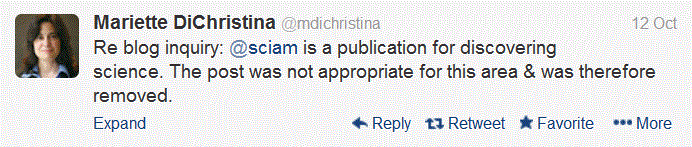
"It’s a rare thing to speak up in the face of victimization. But the secondary trauma from not being believed and being silenced (pulling a post first for the reason that it is not “discovering science,” then pivoting and claiming it was for “fact-checking”) is far too common. It’s that secondary trauma from Scientific American’s actions that crush a person. Going somewhere you trust – a blog network that prides itself on inclusivity in terms of the way it has fought intolerance in the past, in the identities of its bloggers and in its allowable content – and then being shut down? It’s like going to someone you trust and being called a liar."

Why do these issues of race and gender discrimination continue to persist in academia, which one would assume is populated by people intelligent enough to avoid these pitfalls? Dr. Clancy offers this insight:

"This is why fake gender and race blindness is so problematic, it’s why not talking about whiteness and privilege is problematic. Avoiding these things is silencing to the people who need to talk about it to reset boundaries. And if we consider ourselves allies, it’s time to start talking about this stuff."

Where I live and work I am not a minority, but I will always be a woman no matter where I am in academia. I can pretend all I want that gender discrimination or gender stereotypes do not exist. I can chant "It doesn't matter, it doesn't matter" until I pass out (it may be time to break out a post or two of my experiences). I can think that my colleagues and I are intelligent enough not to let discrimination and stereotypes be an influencing factor.

Gender and race discrimination are not like the Ravenous Bugbladder Beast of Traal who believes if you can't see it, it can't see you. Ignoring the problem won't make it go away. Ignoring the problem allows it to accumulate in the dark corners like society's unsightly dust-bunnies, only to be discovered when they roll out from under the couch in front of your dinner guests. We leave ourselves in the uncomfortable position of reacting rather than acting. We sweep away the accumulated dust of the ages and pretend it was never there.

By admitting there is a problem with race and gender discrimination in academia, we are essentially admitting to ourselves that we are not intelligent enough as a community to passively weed out discrimination. Fortunately for us, we are intelligent enough to identify when a strategy is not working. If this recent incident highlights nothing else, it is that our current strategy for dealing with gender and racial discrimination in academia with fake blindness is not working.

This is not news to people like Dr. Lee, who does tremendous outreach work in STEM to engage under-represented youth. This is not news to anyone who has ever blogged about sexism or racism in academia. This is not news to all those people who provide outreach and mentorship to counteract racial and gender discrimination. However, it is still to easy for those having not experienced this kind of discrimination to dismiss these voices as being "over-sensitive", "over-emotional", or "over-reactionary", all of which are dismissive attitudes that lead to secondary victimization. They are dismissed because we believe that as scientists we are above this behavior.

We are above this behavior. So let us actively be better. As Dr. Clancy explains in her post, this will require some self reflection. Asking a question as simple as "Is there a correlation between how I behave around a colleague and the race/gender of that colleague?" is a key beginning. We examine phenomena all the time: that's what we do as scientists. Sometimes the phenomena are aesthetically unappealing. We just have to gonad up and do the work. An intelligent person doesn't want to discover that they may have behavioral traits they would attribute to the 1950s.

I want to be very clear on this next point, mostly because the most common argument I hear against focusing attention on racial and gender discrimination is that "it perpetuates an inferiority complex." Those are two different issues. A person belonging to an under-represented group in STEM does not need this attention because they lack the ability. That is ludicrous. What is lacking are support and encouragement: support and encouragement for kids everywhere to enter STEM careers, support and encouragement from role models with whom kids can identify personally, and support and encouragement for those who report discrimination are growing, but there is still a long way to go.

We can all do more. We can mentor. We can visit public schools and connect with kids. We can be vocal about our experiences in academia, no matter how uncomfortable or seemingly personal, because if it happens to a scientist it is part of life in the sciences. Our goal should be to talk gender and race discrimination to death because that is all it deserves. If we truly want to clean academia's house we'll have to air out the musty corners and deal with the dust-bunnies, because ignoring them won't make them go away.

SAS.

Friday, October 11, 2013

Respect in Science: When saying "No" gets you called a "Whore". #StandingwithDNLee

What do you get when you are a busy scientist and you are asked to do work for free for a supposedly professional science-based blog, but you respond politely with "Thank you very much, but I have to decline your offer. Have a great day." (paraphrased)?

It turns out that you get called a whore.

This happened to biologist and STEM promoter DNLee. This happened just recently, as in within the last 48 hours. Rather than silently feel rightly outraged yet powerless to counteract the most blatant unprofessional conduct I have heard of in a long time, DNLee shines the world's largest halogen light on this bad behavior and shares the interaction via blog and video.

Like many others, I am sharing DNLee's blog post. This is my small part to keep the light shining on this grotesquely unprofessional behavior. As the old adage goes, sunlight is the best disinfectant.

Here is DNLee's post, unedited (in-between the dashed lines):
-----------------------------------------------

wachemshehao hao kwangu mtapoa

I got this wrap cloth from Tanzania. It’s a khanga. It was the first khanga I purchased while I was in Africa for my nearly 3 month stay for field research last year. Everyone giggled when they saw me wear it and then gave a nod to suggest, “Well, okay”. I later learned that it translates to “Give trouble to others, but not me”. I laughed, thinking how appropriate it was. I was never a trouble-starter as a kid and I’m no fan of drama, but I always took this 21st century ghetto proverb most seriously:

Don’t start none. Won’t be none.

For those not familiar with inner city anthropology – it is simply a variation of the Golden Rule. Be nice and respectful to me and I will do the same. Everyone doesn’t live by the Golden Rule it seems. (Click to embiggen.)


The Blog editor of Biology-Online dot org asked me if I would like to blog for them. I asked the conditions. He explained. I said no. He then called me out of my name.

My initial reaction was not civil, I can assure you. I’m far from rah-rah, but the inner South Memphis in me was spoiling for a fight after this unprovoked insult. I felt like Hollywood Cole, pulling my A-line T-shirt off over my head, walking wide leg from corner to corner yelling, “Aww hell nawl!” In my gut I felt so passionately:”Ofek, don’t let me catch you on these streets, homie!”

This is my official response:


It wasn’t just that he called me a whore – he juxtaposed it against my professional being: Are you urban scientist or an urban whore? Completely dismissing me as a scientist, a science communicator (whom he sought for my particular expertise), and someone who could offer something meaningful to his brand.What? Now, I’m so immoral and wrong to inquire about compensation? Plus, it was obvious me that I was supposed to be honored by the request.


After all, Dr. Important Person does it for free so what’s my problem? Listen, I ain’t him and he ain’t me. Folks have reasons – finances, time, energy, aligned missions, whatever – for doing or not doing things. Seriously, all anger aside…this rationalization of working for free and you’ll get exposure is wrong-headed. This is work. I am a professional. Professionals get paid. End of story. Even if I decide to do it pro bono (because I support your mission or I know you, whatevs) – it is still worth something. I’m simply choosing to waive that fee. But the fact is I told ol’ boy No; and he got all up in his feelings. So, go sit on a soft internet cushion, Ofek, ’cause you are obviously all butt-hurt over my rejection. And take heed of the advice on my khanga.


You don’t want none of this

Thanks to everyone who helped me focus my righteous anger on these less-celebrated equines. I appreciate your support, words of encouragement, and offers to ride down on his *$$.

-----------------------------------------------

Huzzah!

The time and talents of professionals are worth something. It matters that people, specifically scientists, realize this. Too often I hear of colleagues underselling themselves, or assuming that if they demand some sort of fair compensation for their time (e.g. consulting, documentaries, etc.) that the prospective benefactor of the talents will go elsewhere, or under-represent them. Always expecting that a highly trained professional will do everything for free disrespects their time and expertise.

To put the crap icing on top of the pile of a cake, the insult had to take a sexist approach by using the time-tested term of "whore." [Begin sarcasm] Yup, nothing puts an uppity woman in her place like calling her a whore. [End sarcasm]. This was disrespect for DNLee as both a scientist and a person.

The only way this kind of behavior will end is if these incidents are not shoved in the dark closets or swept under the rugs. Don't just dismiss this behavior, or feel that you can do nothing about it. Call it out. Expose it to the sunlight and let it shrivel and die.

Off to do my job as a researcher and collections manager for which I get paid.

Shaman out.

Update: 12-10-2013

On the blog Isis the Scientist, Dr. Isis lays down the hard truth concerning Scientific American's removal of DNLee's original post. Follow the link and read. Whether that was the intent or not, Scientific American's removal of DNLee's post (and the subsequent justification of said removal on the grounds that it wasn't science-y enough) felt like a continuation of the original disrespect shown to DNLee by the editor of Biology-Online dot org. The situation was not pretty, but deleting it will not remove the problem, especially if the problem is one of disrespecting a scientist using abusive and sexist language.

Update #2

The editor of Scientific American's blog recently posted on Twitter that they are still collecting information.

Scientific American blogs editor Twitter statement. Follow the link here to read the replies.
We'll have to wait and see what the official statement is. I'm definitely curious!
***

As a completely personal opinion, the outrageous behavior that was highlighted in this incident, as well as all those incidents that continue to be under-reported, isn't magically "fixed" by singing the "I'm Very Sorry" song. When a person's go-to response is to trot out a sexual and race based insult, that speaks to the character and maturity of the person. If they have not yet internalized that a) this type of behavior is intolerable and (most importantly) b) WHY this type of behavior is unacceptable, there are larger issues at work than just an "Oops, I made a mistake in judgement", or worse "It was just a joke!" defense. You do not get to pick-and-choose to whom you behave professionally. Period.

No matter what the final outcome of this is incident is, it demonstrates that there is still a long way to go before discrimination is culled from the world of science and science communication. Everyone needs to keep exposing these incidents to the light of day, not just for ourselves, but for all those who will follow in our academic footsteps.

SAS

Update: 13-10-2013

The Editor-in-Chief of Scientific American has posted a more formal statement. Read it here:

As another completely personal opinion, reading this left me feeling rather unsatisfied. I realize they are not yet complete in their information gathering, but here are a couple of items that spring to mind (and to the minds of many who left comments on the recent post, now that I had finished reading their comments) that I still find troubling:

1) In no way was their any mention that the behavior (hell, phrase it as "alleged behavior" if there is a need for hiney-covering) of the Biology-Online editor was inappropriate and unacceptable. A simple statement along the lines of "if this is indeed what transpired, it was wrong" would have sufficed. Respected science organizations need to step up and emphasize that mistreatment of any professional is unacceptable. Institutions such as Scientific American have the ears and eyes of so many, interested public and professionals alike, that they should be at the forefront of promoting professionalism in science. This includes letting people, especially their bloggers, share their less than smiley experiences and how they dealt with said experiences. Their stories and experiences are our stories, too. Science and science communication are the last places where dark corners should be acceptable.

2) I am not sure how the statement originally made by the Editor-in-Chief regarding the removal of DNLee's post
Link to the original post on Twitter.

is connected to the statement "Unfortunately, we could not quickly verify the facts of the blog post and consequently for legal reasons we had to remove the post." The initial post stated that what DNLee experienced and her response was not suitable for Scientific American. This recent post states that they need to investigate for legal reasons. Those sound like two completely different reasons for removing the post.

There are still specific issues that will need to be addressed to help move on from this incident, such as how Biology Online will address their editor's actions, and how Scientific American and Biology Online are connected.

We will see what happens. For now, my phasianid theropod is roasting in the oven covered with the leaves of several species of aromatic angiosperms and the liquid from fermented grapes. Have a Happy Geeksgiving!

SAS.

Sunday, March 24, 2013

Hot Science, Cold Feelings

I had thought that my first post after my laser eye surgery was going to be a cringe-worthy yet successful story of the procedure, but I had to write this post first. Do you ever encounter those moments when you think "There is no way that I will ever hear something more illogical and ridiculous than what I have just heard"? Unfortunately, these past couple of weeks contain incidents that enter the realms of the Perpetual Facepalm and the Everlasting Head-Desk.

First, my own country has essentially flipped science, scientific exchange, and support for research stations, specifically the Experimental Lakes Area Research Station, the big fat Bird. The ELA station was firmly centered in the government sniper cross-hairs, despite efforts of other political parties and scientists lobbying to keep the research station (operating for almost half a century) open. Then, Vote No. 631 in the House of Commons was sponsored by Kennedy Stewart (NDP), which stated, and I quote:

"That, in the opinion of the House: (a) public science, basic research and the free and open exchange of scientific information are essential to evidence-based policy-making; (b) federal government scientists must be enabled to discuss openly their findings with their colleagues and the public; and (c) the federal government should maintain support for its basic scientific capacity across Canada, including immediately extending funding, until a new operator is found, to the world-renowned Experimental Lakes Area Research Facility to pursue its unique research program."

Here's where a logical person will think "Who would possibly vote against this?" Logic and reason did not win the day. This vote was negatived, despite the fact that the Liberal, NDP, Green, Independent, and Bloc Quebecois parties all voted Yea. You see, we have a Conservative majority, and not one Conservative voted Yea.

Not. A. One.

You tried, Mr. Stewart. You All tried. For All who voted Yea, scientists thank You. I thank You. We are just sorry it was not enough. This will essentially continue the gag order on all federal scientists, forcing them to obtain government permission before discussing any of their findings with the public, and giving government the ability to tell a federal scientist what they can and cannot submit for publication.

I did not mean for this to turn into a political post, but I am sad, angry, and ashamed of this decision on behalf of my country. I am worried about the future of Canadian science and research. I needed to vent.

That was the Everlasting Head-Desk from my country. Prior to that, the People of the Internet provided a Perpetual Facepalm. It apparently took the People of the Internet by surprise when the administrator of the Facebook page I Fucking Love Science posted a link to her Twitter profile that included her picture. The part that surprised the People of the Internet was the "her" part.

Some people were amazed that only one person managed the IFLS page: the volume and diversity of the cool new science posts is amazing! However, because many who have a wireless connection and a keyboard also come with their Relevant and Appropriate Dialog Filters disabled, more comments than I believed possible followed these themes:

1) I'm completely surprised you're a woman!
2) You're hot!

...and my favorite combination...

3) Wow! You're hot and smart!

We meet again, Tired Old Stereotypes!

The Tired Old Stereotype #1 of the a) public perception and b) the lower numbers of women active in the STEM fields is annoying, but it is an issue that is being addressed.

The stereotypes that perplexed me are the ones related to physical appearance and science. One can infer the assumptions that led to the comments:

A) Women scientists (or women interested in science) are not attractive, and
B) Attractive women are not interested in science.

Here is where I was going to have fun with Venn Diagrams and show how illogical it is to assume that all scientists are unattractive, but then the realization dawned. I had also been trapped by the sneaky assumption that:

C) How a person (specifically, how a woman) looks is relevant.

Trying to combat assumptions A and B by promoting "Hot Fashionable Women Scientists" leads to public relations disasters, such as the original video (here's a link and a shameless redirection to one of my previous posts) for the European Commission's "Science: It's a Girl Thing!" campaign. The EC took the critiques of their original campaign seriously, and now has a page that actually profiles real women in science.

This question comes screaming into my mind:

Who gives a Flying Spaghetti Monster what a person who is interested in science looks like?!?

Yes, we are primates with complex visual processors, and the first aspect we notice about someone is the physical aspect. Yes, a portion of the population is biologically programmed to assess members of the opposite sex as potential mates. Yes, scientists are people who do not exist in a vacuum away from society (no matter how tempting this may be on the days when Everlasting Head-Desk events are encountered) and are also subjected to whatever standards society sets on appearance.

This has nothing to do with the scientific world. Scientists do not send in mug shots when they submit their research papers. Women researchers do not have to complete a special form that asks them to detail their chest-waist-hip measurements during the online paper submission process. If a new hypothesis is a great hypothesis, it will still be a great hypothesis even once you find out the researcher responsible for it has two heads and three arms, and is the worst dressed sentient being in the known Universe.

The knee-jerk reaction when meeting and greeting a woman is to compliment her on her appearance. This can range from the innocuous "You look nice" to the more insulting-yet-simultaneously-laughable comments.  We're trained to do this, and women are trained to receive these compliments as a normal part of social interactions. We're trained at an early age: Lisa Bloom's article on "How to Talk to Little Girls" highlights that using compliments on appearance as a socially acceptable icebreaker teaches girls that "...their appearance is the first thing you notice [and] tells them that looks are more important than anything." Conversations with women peers revealed that this even happens at scientific conferences. I don't think this happens among male colleagues. If it does, let me know! I'd love to hear some examples. Heck, for a good laugh I'd like to hear some awkward compliment stories from female researchers.


Barnum Brown was hot. Seriously, his core body temperature was likely slightly above normal when doing fieldwork whilst wearing his fur coat. http://www.nceas.ucsb.edu/~alroy/lefa/BBrown.html

So, a woman who is interested in science, and who operates a great social media page promoting science in all of its awesome glory, received the digital version of walking past the archetypical construction site once the People of the Internet found out her appearance. In a sad and awkward attempt to say something complimentary, they fell back on their basic social icebreaker training and produced a completely irrelevant and pathetic Facebook comment. Social programming fail.

What keeps this incident from being classified as an Everlasting Head-Desk is the amount of fun that was poked at the people who could think of nothing better to say other than "You're female" and "You're hot". I thoroughly enjoyed Dean Burnett's article in the Guardian on how women should know their place in science. Also, many of the comments did fall into the "Thanks for a great site!" and "Nice to meet you!" thread (as well as incredulity at the annoying comments). It is a thoroughly ridiculous idea that a person's gender and/or appearance should matter when it comes to science. Great discoveries do not need to be draped across models like clothes or makeup to convince people they are great discoveries. Science is hot in of itself.

I couldn't resist at least one Venn Diagram.
GO SCIENCE!

Until next time,
SAS.

Tuesday, December 18, 2012

Science: It's Getting Closer to Being a Girl Thing.

I am experiencing a form of deja-vu: I am sitting in the same chair, drinking an inhuman amount of Earl Grey tea, and watching (and re-watching) recruitment videos designed to inspire today's young women to choose science as a career. There is one important difference: this time I am not completely disgusted and insulted by the mere existence of these videos.

Let's recap: the European Commission had produced and distributed a video that they, in a Cosmo-Girl-esque attitude towards women, thought would appeal to young women and encourage them to consider a science career. All the European Commission managed to inspire was outrage: the ad (and I think I am safe calling that pandering bit of runway nonsense an ad rather than a recruitment video) spent more time featuring girls sashaying than girls titrating. I don't know how many of the links are still operational for the original video, but if you can stomach it, check out the video here. There were several parody videos created by women in science that highlighted the stereotypes of women in the academics that the EC used as A-reel.

The European Commission had little choice but to pull the original video and come up with a strategy to create a new, less insulting version. Perhaps they were impressed by the parodies, because they created a video contest and a jury chose two winners and a People's Choice out of the submissions. Let's watch, shall we?

Here is Winner #1, a submission from France:


My first viewing of this video left me slightly uneasy, but I could not immediately identify the source of my discomfort. Then, after two more viewings, I could pinpoint the source of my unease. The creators of this video were not using the love of science and exploration as inspiration: they are relying on indignation at science being a male-dominated career to motivate young women to enter the sciences.

I can see what they were trying to get at: the adage "Decisions are made by those who show up" is as true in science as it is in other aspects of life. I hope this was the central message this video was trying to inspire in young women, but the leech-like message that followed was "Science has a male agenda that must be countered."

When I hear these sentiments from a few of my female peers, I do feel indignation, but not at "those evil sexist men." I feel like I'm being asked to choose sides in a boys vs. girls game in physical education class. Gender teams have never appealed to me, either in sports sports or in arguments. Just because I have XX chromosomes does not mean that I will automatically agree with a stance taken by another person with XX chromosomes. I am capable of looking at the data and making my own decisions.

My mentors have been and are mostly men. My colleagues in vertebrate ichnology are predominantly men. I couldn't ask for a better group of people with whom to work. I have never once felt like they looked down on me or my abilities, or (worse) thought that I needed extra help because I am a woman. Maybe my experience is not the same as that of other women in science: I can't speak of their experiences. However, when I hear people say that men are pushing their agenda in the sciences to the detriment of women, I think of the great men with whom I work and feel as though they are the ones being stereotyped. Stereotypes are dangerous tools on which to rely when making career decisions. Yes, there are inequalities that exist in science. They do need to be addressed. Decisions are made by those who show up, but WHY you show up is just as important as walking through the door. Indignation and anger at inequality are not going to be enough motivation to sustain you through a scientific career. The drive must run deeper than activism.

Here is Winner #2, a submission from Australia:


The opening amused me. Apparently, you don't have to be limited to a desk job if you are in science. I'm chuckling because for the past nine days I've been Super-Glued to my desk working on a paper. I would conservatively guess that over 70% of my duties as a curator and collections manager are administrative. Most researchers I know have to wear the Administrator Hat more often than not when applying for grants, working out budgets for their research labs, and serving on committees. Anyone who believes a scientific career frees them from the shackles of filling out forms in triplicate is going to be in for quite the rude awakening on Day 1 of their position.

I digress. This video is a bit more traditional in its approach: it shows young women having fun in a traditional chemistry lab setting. That left me with a "ho-hum" feeling. It was the last segment of the video that I found the most interesting. It showed images of real women scientists and their scientific fields. THAT is more like it! I believe the key to inspiration is to lead by example, showing a real female scientist getting down and dirty in science (with me that's a literal statement: part of my project involves stalking birds in marshlands, and during excavation I wield a pick-ax and shovel) highlights that anyone with a scientific passion can and should explore their interests as a career. I would have preferred the video focus more on examples of real women scientists than the smoking beakers.

Here is the People's Choice runner-up, a submission from the States:


I like this video. It showed real young women talking about scientific achievements they want to be a part of. They were determined to send the message that they did not consider gender to be a barrier to them entering, and succeeding in, the sciences. The focus was on their drive and their goals.

The European Commission had no where to go but up in terms of producing a better recruitment video, and I think they learned that women in the scientific community have strong ideas about what they want to see for promotion.

I found myself asking "What would my ideal recruitment video look like?", especially since I was unsettled by the first video. My ideal video would be a combination of videos #2 and the People's Choice. I envision young women talking about their specific scientific goals and dreams, and pairing them with women scientists who are working in those specific fields. A link between the now and the future, and an emphasis on how today's women scientists are the leaders and the mentors for the future women researchers. Decisions are made by those who show up: we should be there to give meaningful directions.

Back to editing figure captions.

SAS out.

Thursday, June 28, 2012

Where Is The Science In This Science-Recruiting Video?

I was hoping that the Gods of Vacuity would hold out for at least a few months before forcing me to address issues surrounding women and girls in the sciences, but gosh darn you, European Commission! You had to go and create this recruitment video that you claim is designed to encourage young women to pursue careers in science. It has been circulating on the Web for some time now, but it is so annoying that I just have to comment. Note: they have since removed the official link after the barrage of negative comments, but thanks to the internet the video survives! Go on, watch it. I'll be waiting right here.


Done? How are you feeling? Do you feel irate, frustrated, and sadly amused? Did you respond, as my husband did, with "How inappropriate"? Do you need a cup of tea to soothe your nerves? I most certainly did. One pot of Earl Grey later, I feel a little more composed and ready to compose.

When I first saw this video, I had vain (no pun intended) hopes that EU was a new cosmetic-fashion company that wanted to encourage people to do cosmetic-related research. My mind could not conceive that this bit of runway fluff was an official government-sanctioned production. Yes, their reasoning is sound, and their intentions are admirable, but the resulting product reeks of damaging stereotypes and tiresome cliches.

First, there is very little reference to science, let alone women in science, in the video. Oh sure, we are shown dry ice smoking in tastefully arranged beakers, and we do see one young woman writing out an equation in shiny silver white-board marker (Look! Math!). There is one shot of iron filings (Look! Physics!) and an electronic circuit (Look! Engineering!). We see Dr. Accomplished-And-Dreamy looking through his microscope at the opening of the clip, but he is most definitely not female (Look! Biology?), and he makes a longer appearance than the symbol for hydrogen (Look! Chemistry!). The rest of the production is spent on strutting, fashionably-coiffed young women, posing for what is more likely a magazine spread than photos for a faculty website. These images are interspersed with several shots of makeup. There is not one image in this video of a woman doing real (or even "real-for-TV") science, and not one image that would inspire an intelligent girl to think "I want to do that!" There is no shortage of women out there who do exciting research. In paleontology I can think of several without needing to reach for a second pot of tea. Here's a tip, EU: if you want to inspire a young person to try a challenging career path, show them a real person to act as a role-model. I would bet that filming real women doing real science would be a lot less expensive than the released Vogue-esque "Girl Thing" video.

Second, it was very obvious that the consultants for this video did not think to appeal to young women's sense of ambition, drive, motivation, or sense of adventure. Nope, young women were shown pretty makeup and clothes. Even the official website for the "Science, It's a Girl Thing" website features makeup in the title. Head's up for all you women scientists out there: lipstick is now the official symbol of women in science. The marketing consultants are sending a damaging message to young women. Message #1: Don't bother with all that thinking and hard work, just strut your finely-dressed self into that lab and everything will fall into place. Message #2: Outward appearances are extremely important in science. Heck, Dr. Accomplished-and-Dreamy seemed very impressed with the young women in the video, but I'll bet it was not because he was intrigued by their latest hypotheses.

There are mixed opinions on women's physical appearance and femininity in academia. Is it damaging to play up one's femininity in the professional academic realm? Should we just say to heck with it and just grab whatever happens to be on top of the clean clothes pile that remotely matches? I'd love to hear some of your opinions on this topic in the comments section.

My take on the issue is quite simple. For better or worse, appearances do matter to a certain degree. We are primates with complex visual processors, and the first aspect we notice about someone is the physical aspect (hopefully it is not the olfactory aspect). How a person presents themselves to the professional world says a great deal about how comfortable and confident they themselves feel in that world. How this is expressed is a matter of personal style and preference: there is no official uniform for scientists. Lab coats are common, but that is an issue of safety, comfort, and random squirts of shark-flavored preservative fluid rather than style. How "feminine" I look depends on what I happen to be doing that day. There is no way I'm going to wear my pinstripe skirt and jacket while I reorganize fossil cabinets or pour a silicone mould, just as I would not wear my preparation clothes to introduce a guest speaker. Barring a few fashion faux pas, my wardrobe choices reflect my level of self respect. I don't need to toss around my secondary sexual characteristics to get attention, and that's not the attention I want in the first place. No matter how mini my skirt is or how high my heels are, my papers will not get published if they are crap.  So yes, for me clothing and appearance are important to a point, but as long as it is clean, comfortable, matching, occasion appropriate, and fits without substituting for a full-body scan, that's as far as I consider the issue of my appearance as a woman scientist. The "Girl Thing" video only serves to strengthen the misconception of women scientists are not feminine by trying too hard to prove that science-minded women can be feminine.

Sadly I recently encountered the issue of girls, appearance, and science while judging at a public school science fair. The judges were divided into the elementary school and the secondary school judges. I chose secondary school because I had done a few elementary judgings prior and wanted a different experience. I have never been more disappointed in a gender as I was that day. The boys' experiments were actual science or statistical experiments with hypotheses, tests, and conclusions. Out of the seven experiments done by girls, four of them focused on fashion. The questions they asked for their "experiments" were "Do boys prefer looking at girls wearing makeup or not wearing makeup?" and "Do boys like girls that dress preppy, goth, or skater?" and "What kinds of makeup attract the most attention?" Interestingly, these are questions that have much deeper implications within the social, behavioral, and evolutionary sciences, and had these girls explored any of the deeper implications, I would have strongly recommended their fashion projects for the win. However, their conclusions followed the theme of "Based on our results, girls should wear this to get boys to notice them." This is likely a continuation of the problem Lisa Bloom addressed in her Huffingtong Post article "How to talk to little girls", where girls hear more appearance-related than accomplishment- related comments early in their development. Are the EU "Girl Thing" consultants right? Are girls conditioned to value looking good over actually doing something?

I would argue that, no, many girls who are already driven to pursue the sciences are not, or are striving to overcome that issue. Whether they take the time to present themselves nicely is a different matter, but I guarantee that these young women do not worry that their scientific accomplishments will damage their femininity. They already know what it takes to be a scientist. I would be interested in seeing their reaction to the "Girl Thing" video.


What about those girls who are driven by external opinions? It could be argued that the "Girl Thing" video is targeting girls that have never considered their future beyond whether mid-thigh is the new knee-length, and that it pushes them to consider doing something while looking good. I would argue that the "Girl Thing" video portrays science as a hobby that you fit into your schedule between trips to the boutique and facials.

Lastly, what I found most disappointing about the video was that it gave absolutely no sense of what I find appealing about science - the excitement of discovery, the thrill of exploration, and the triumph of solving a previously insurmountable problem. There is no dress or lipstick color in the world that can substitute that feeling. The potential impact and contribution that just one person can make in science, no matter who you are, where you come from, or what you look like, is the message that needs to be used for recruitment. Looks fade, clothing rots, and physical attention wanes. Achievement and advancement outlast all material things, including our physical selves.