Hello, Dear Readers!
Today I rewarded myself for finishing a long-suffering paper on Saturday by participating in "That Dam Run" in Hudson's Hope - a 16 km/10 mile jaunt over the promised dam, the sediments exposed by said dam are a hot spot for Early Cretaceous Gething Formation vertebrate traces (yes, I looked for fossils on the way). The run also took us up and down the ski hill and over lovely trails lightly shrouded with yellow autumn foliage.
I am fairly low-key in my approach to running races. First, I don't ever enter a race with the idea of racing against someone. I really couldn't care less if I don't come in first. The only thought I consciously take with me into a race is "I'm going to do this." After that, I can think of whatever my mind free-associates.
Today my mind free-associated its way to life in academia as I have experienced it, and because my brain isn't necessarily creative when it wanders, it kept returning to the idea of academia as a race, and something that one should strive to "win."
I am still a graduate student, and still have another semester or two to go before I finish my research and defend. I took six years to complete my undergraduate degrees in zoology and geology, and had to withdraw from my first masters program for financial reasons. That prompted a year and a half academic hiatus while I recovered, and I resumed my academic career by finishing my masters program in five years. I am in my fifth year of my doctoral program, and for the exception of the times I have had to physically be on campus to fulfill course requirements, I have worked full time in a museum while conducting my graduate research.
If I dwelt on the pace of my academic career, it would be easy for me to focus on my graduate student colleagues who started their programs after I did and now hold PhDs. If I wanted to, I could easily feel that my progress is inferior, and potential future employers and colleagues could judge me unfavorably based on the amount of time it is taking me to finish my degree. I could focus on the faster pace of my student colleagues and think "I'm going to beat so-and-so" and use the motivation of "winning" by competing against a student colleague. I could push to publish more papers than a colleague. I could push to give more talks than a person. I could push to finish my degree before a person.
I could approach my academic career as a race against colleagues, but I won't. I blatantly refuse to compete against any colleague. I openly talk about how long it has taken me to complete my graduate work because I feel no shame or embarrassment in regards to my progress. I do not measure my progress as it relates to the progress of others. I don't need to use someone else to set my pace. I have found a pace that I can maintain in the long run, and by nature and training I am a long-distance runner.
Academia is a long-distance run. You find a pace at which you can work and present your work so that you are functional to complete more work. There are speed-training intervals that consist of mad dashes for deadlines, grants, and time-sensitive publications. Since you are running in the race with others, you'll encounter those who eagerly cheer you on, and those who purposely don't tell you about the detour ahead. If you are a woman or a person of color, you will be made to feel (indirectly or told flat out) that you need to run an extra 10 km of a standard 41 km race just to prove that you weren't specially let in to fulfill a quota, to prove that you belong in the race with everyone else. There are enough challenges in academia without approaching it with the attitude of being "better" than someone, or trying to "win". As long as you keep moving forward.
There are plenty of challenges inherent in trying to exist in academia. We don't need to make up little races against someone as an added challenge. Keep the idea of a racing out of your head. You'll free mind up to focus on why you are in the run to begin with.
Showing posts with label STEM. Show all posts
Showing posts with label STEM. Show all posts
Sunday, September 21, 2014

Friday, July 4, 2014
Tales from the Field: Return (Almost) to Dinosaur Gorge
Hello, Dear Readers!
We've hit July in the Peace Region, and after a month of meetings, paper revisions, paper writing, meetings, delegations, meetings...did I mention we had a lot of meetings in June?...I am pleased to be able to start the 2014 field season. This year we are not focusing on the hadrosaur excavation. Instead, 2014 is going to be the Year of Ichnology. Our focus is on an unnamed creek which we unofficially call "Dinosaur Gorge": a steep-walled canyon with at least two vertical (really it is a 60 degree slope, but anything that requires ropes to document it is vertical enough for me) Early Cretaceous (Valanginian - between 139 and 134 million years old) track surface on which large ornithopod, large-sized theropod, and medium-sized theropod trackways are preserved.
Our goal for the Year of Ichnology is to document this surface using both direct measurements and 3-D photogrammetry, as well as taking latex molds of sections of the trackways. We set a test rope last year and found that we could access most of the track surface safely, so the plan this year is to set at least two ropes: physics starts to interfere with stability when your rope is craned over at 50 degrees.
The mission for this afternoon was to check out both the access to the site, and to see if the water in the creek was low enough for us to safely walk. We were just about a kilometer from our destination when we encountered this in the road:
We left the truck and walked the rest of the way, scouting out potential campsites along the route. We found that the creek levels were up, but not so much as to bar our access to the track sites. We considered this mission accomplished and turned back to check out a few more vertical surfaces we had spotted on our way to the mouth of the Gorge.
One massive surface was a complete disappointment: coarse, well-sorted sand, massive channel deposits, wood impressions, centimeter diameter silt clasts, but no traces were visible, not even invertebrate traces. Following a drainage channel down to a culvert, we saw material that was more promising: fine, organic rich sand with thin silty beds. The material was out of context, but it was similar in sedimentology to what we see in the Gorge, so we knew that it was local. Sure enough, there were traces!
The coolest traces we saw today were invertebrate traces. I am drawn to the fine-grained surfaces because I am a self-admitted bird track fanatic. When you start looking for small vertebrate traces (bird, amphibian, reptile) you are entering the size range of many invertebrate traces. Not everything that looks like a bird trace is a bird trace. Take this image, for example:
Depending on how you look at it, the structure I am pointing to does superficially resemble a poorly preserved avian trace. However, I have developed a set of criteria that a trace must meet before I will squeal with glee and triumphantly eat the Chocolate Bar of Victory:
1. Is the structure tubular? Some bird prints, depending on the consistency of the sediment, can appear to be ridges, grooves, or even shallow indents, but one thing they rarely preserve as are cylinders
2. Is the structure alone? Until someone discovers the Amazing Cretaceous Unipod Bird (although I did once see a duck with a missing foot - it walked around like a pirate on a peg leg), bird tracks are not going to usually occur alone, or if they do, they are large enough to not be mistaken as an invertebrate trace. Small, Cretaceous-aged avian track-makers behaved in a similar fashion to our extant shorebirds, with one or more individuals foraging back and forth on a wet surface. If that trace is an avian trace, the structure should be repeated somewhere else on the surface, even if it is not part of a trackway.
3. Is the structure connected to an obvious burrow? You would think we shouldn't need to ask this differential, but we do, especially when we have trained our eyes to look at traces with a vertebrate filter. For example, McCrea et al. (2014) addresses an earlier report of Sarjeant and Thulborn (1986) of Duquettichnus kooli, a purported marsupial print from the Early Cretaceous Peace River Canyon. On one surface is preserved what appeared to be a marsupial foot (pes) print. However, when we examined the specimen in 2006, we turned the specimen over: the pes was actually part of an invertebrate burrow that continued on to the other side of the sample. Doctors have the "Zebra Diagnosis", and ichnology isn't immune to supposed zebras trotting around in the Cretaceous when good ol' invertebrates are far more likely. I don't think we've seen the last of invertebrate traces being misinterpreted as the traces of small vertebrates.
I did not see anything today that I would confidently say is a bird track, and although one feature did get me excited for a moment, it was time to get skeptical when you are dealing with an infill surface and the structure is an impression:
However, my ichnology spirits were refreshed with some of the best Aulichnites-like traces I have seen in this region, along with larger repichnia (crawling traces):
I highly recommend taking a course in invertebrate ichnology. Not only is it fascinating to see how different burrowing, crawling, and feeding invertebrates, for example, alter their behavior based on changing environmental conditions or are restricted to certain environments, invertebrate traces provide vertebrate paleontologists with paleoenvironmental information.
I dedicate this post to our invertebrate track-makers. Proudly line your burrows with fecal pellets, Ophiomorpha trace-maker. Your poopy home is telling us a story!
Strange Woman
References:
McCrea, R. T., L. G. Buckley, A. G. Plint, P. J. Currie, J. W. Haggart, C. W. Helm, S. G. Pemberton. 2014. A review of vertebrate track-bearing formations from the Mesozoic and earliest Cenozoic of western Canada with a description of a new theropod ichnospecies and reassignment of an avian ichnogenus, p. 5-93 in Lockley, M. G. & Lucas, S. G. (eds.), Fossil footprints of western North America. New Mexico Museum of Natural History and Science Bulletin 62.
Sarjeant, W.A.S., and Thulborn, R.A., 1986, Probable marsupial footprints from the Cretaceous sediments of British Columbia: Canadian Journal of Earth Sciences, v. 23, p. 1223-1227.
We've hit July in the Peace Region, and after a month of meetings, paper revisions, paper writing, meetings, delegations, meetings...did I mention we had a lot of meetings in June?...I am pleased to be able to start the 2014 field season. This year we are not focusing on the hadrosaur excavation. Instead, 2014 is going to be the Year of Ichnology. Our focus is on an unnamed creek which we unofficially call "Dinosaur Gorge": a steep-walled canyon with at least two vertical (really it is a 60 degree slope, but anything that requires ropes to document it is vertical enough for me) Early Cretaceous (Valanginian - between 139 and 134 million years old) track surface on which large ornithopod, large-sized theropod, and medium-sized theropod trackways are preserved.
 |
| Image of the main track surface of Dinosaur Gorge, taken August 2013. Can you see the trackways? I admit it is difficult, given the "Lonesome Death of Jordy Verrill" theme of the surface flora. Photo: L. Buckley. |
 |
| No matter what your primitive instincts tell you, moss is not a load-bearing surface. Photo: L. Buckley. |
 |
| Photo: L. Buckley. |
One massive surface was a complete disappointment: coarse, well-sorted sand, massive channel deposits, wood impressions, centimeter diameter silt clasts, but no traces were visible, not even invertebrate traces. Following a drainage channel down to a culvert, we saw material that was more promising: fine, organic rich sand with thin silty beds. The material was out of context, but it was similar in sedimentology to what we see in the Gorge, so we knew that it was local. Sure enough, there were traces!
 |
| Paired burrow openings, likely Arenicolites, are common in the sandy shore ichnofacies (the Skolithos Ichnofacies). Photo: L. Buckley. |
 |
| Photo: L. Buckley. |
1. Is the structure tubular? Some bird prints, depending on the consistency of the sediment, can appear to be ridges, grooves, or even shallow indents, but one thing they rarely preserve as are cylinders
2. Is the structure alone? Until someone discovers the Amazing Cretaceous Unipod Bird (although I did once see a duck with a missing foot - it walked around like a pirate on a peg leg), bird tracks are not going to usually occur alone, or if they do, they are large enough to not be mistaken as an invertebrate trace. Small, Cretaceous-aged avian track-makers behaved in a similar fashion to our extant shorebirds, with one or more individuals foraging back and forth on a wet surface. If that trace is an avian trace, the structure should be repeated somewhere else on the surface, even if it is not part of a trackway.
3. Is the structure connected to an obvious burrow? You would think we shouldn't need to ask this differential, but we do, especially when we have trained our eyes to look at traces with a vertebrate filter. For example, McCrea et al. (2014) addresses an earlier report of Sarjeant and Thulborn (1986) of Duquettichnus kooli, a purported marsupial print from the Early Cretaceous Peace River Canyon. On one surface is preserved what appeared to be a marsupial foot (pes) print. However, when we examined the specimen in 2006, we turned the specimen over: the pes was actually part of an invertebrate burrow that continued on to the other side of the sample. Doctors have the "Zebra Diagnosis", and ichnology isn't immune to supposed zebras trotting around in the Cretaceous when good ol' invertebrates are far more likely. I don't think we've seen the last of invertebrate traces being misinterpreted as the traces of small vertebrates.
I did not see anything today that I would confidently say is a bird track, and although one feature did get me excited for a moment, it was time to get skeptical when you are dealing with an infill surface and the structure is an impression:
 |
| Slowly puts away the Chocolate Bar of Victory, and eats the Stale Rice Cake of Defeat. Photo: L. Buckley. |
 |
| Photo: L. Buckley. |
 |
| Photo: L. Buckley. |
I dedicate this post to our invertebrate track-makers. Proudly line your burrows with fecal pellets, Ophiomorpha trace-maker. Your poopy home is telling us a story!
Strange Woman
References:
McCrea, R. T., L. G. Buckley, A. G. Plint, P. J. Currie, J. W. Haggart, C. W. Helm, S. G. Pemberton. 2014. A review of vertebrate track-bearing formations from the Mesozoic and earliest Cenozoic of western Canada with a description of a new theropod ichnospecies and reassignment of an avian ichnogenus, p. 5-93 in Lockley, M. G. & Lucas, S. G. (eds.), Fossil footprints of western North America. New Mexico Museum of Natural History and Science Bulletin 62.
Sarjeant, W.A.S., and Thulborn, R.A., 1986, Probable marsupial footprints from the Cretaceous sediments of British Columbia: Canadian Journal of Earth Sciences, v. 23, p. 1223-1227.
Sunday, March 16, 2014
Reviewing: A Thankless Job?
Hello, Dear Readers!
Excuse me for a moment while I brush the digital dust off of the blog. Ignore the cyber-spiders and the e-webs. There. That is much more presentable.
There has been a lot going on in my life since January, and much of it is not positive. I'm not going to elaborate on that here and now: those issues are still fresh and mutating, and I can't predict the outcome. I can postulate several likely outcomes, but which one will it be?
I'll focus instead on the productive side of my life. I made it a mission to continue with the paper writing storm we started in 2013. There have been delays, hurdles, and (of course) the unexpected, but 2014 is starting to bear the fruits of the academic trees we planted in 2013. First, a large ichnology publication on which I am second author is out, summarizing the work that has been done on vertebrate ichnology in western Canada over the last decade (the bulk of which includes discoveries and research by us and our volunteer team in the Peace Region.) Next, I am waiting for proofs for the published version of my M.Sc. thesis on Coelophysis dentition (this was the last update on that endeavor.) There are three collaborative papers that will be heading to press in March. All in all, not a bad academic start to 2014.
I have also been reviewing papers. If you have read my previous posts, you know that I take my role as Reviewer seriously and feel that, despite some flaws (check out the Nature's Peer Review Debate here), the peer-review system is the best means we have by which to produce and disseminate scientifically accurate information.
It takes time and effort to provide a thoughtful and constructive review of a paper. Most authors, who have also been on the Reviewer end of the process, recognize this. Most scientific papers contain an "Acknowledgements" section. There are items which should appear in the Acknowledgements section (e.g., grants, direct contributors who are not authors, etc.) It can look like the Academy Awards acceptance speech for scientists. If the current form of the paper would not exist without the input or efforts of other parties, you thank those parties. For example, in both the university and the published version of my M.Sc. thesis, I give shout-outs to the curators, collections managers, and technical staff who assisted me in accessing the specimens. I thank the people with whom I discussed the project at great length. I thank my committee. In the published version I thank all of these, and I also thank the reviewers.
Scientists, being human, sometimes take the opportunity to interject a little of their personality (humor, snark, noncompliments) into their published work (examples here and here). For the big ichnology review, we really wanted to change the heading of the Acknowledgements section to "Ichnoledgements," but apparently that was taking a joke too far. Fair enough. In a scientific paper about dogs, one would not be able to change the experiment methodology heading to "Mutterials and Methods."
I flipped through one of the papers that I had recently reviewed. I find it interesting to see how the authors incorporate my revision suggestions. As a reviewer, I know that my comments may be accepted in full or completely rejected in a letter to the journal editor (with justification as to why they are rejected). In the end, it is up to the author to decide which suggested revisions to incorporate or ignore; however, the journal editor can also insist on or add amendments to the reviewer comments. [NOTE: Don't want to incur the wrath of your editors/reviewers? Show how you incorporated their suggestions!]
One thing that caught my gaze was the Acknowledgements section. Not one reviewer was named or thanked.
Interesting.
While there is no rule that states "Thou shalt thank thy reviewers or forever burn in a pit of reality TV programming," you learn by reading (recent) paper after paper after paper after paper (etcetera, etcetera) that there are recurring themes in the Acknowledgements section. One of these is thanking the reviewers.
"Hold up, Shaman," you may ask, "why be annoyed? Aren't scientists expected to review papers? And don't you get your papers reviewed in turn?" (The extremely polite version of an actual comment received by a colleague not thanked by the authors for their review: the original comment contained the words "whining" and "self-centered.")
There are logical reasons for thanking your reviewers, especially if they are not anonymous:
In the end I waived anonymity. There was nothing I put in the review that I wouldn't have said in person to the authors were they sitting in front of me as I read the paper. That was my choice, and I can't say that my choices are right for everyone. Each reviewer has to decide what they do with the option of anonymity: every situation is slightly different.
A final word (for this post) on thanking reviewers: I believe this is just the polite thing to do. Just because reviewing papers is an expected part of our jobs doesn't mean that we do not deserve to be thanked for doing our jobs. I thank the police when I have to call them. I thank my doctor and pharmacist. I thank waitstaff and the people who make my coffee. I thank my employees and volunteers. I thank my advisers and colleagues. They are doing their jobs, and I was raised to thank the people who help me. Everyone who does something for you is a person, and people like to be acknowledged for their hard work. It's the simplest way to let that person know that you appreciate their efforts.
Thank You.
SAS.
Excuse me for a moment while I brush the digital dust off of the blog. Ignore the cyber-spiders and the e-webs. There. That is much more presentable.
There has been a lot going on in my life since January, and much of it is not positive. I'm not going to elaborate on that here and now: those issues are still fresh and mutating, and I can't predict the outcome. I can postulate several likely outcomes, but which one will it be?
I'll focus instead on the productive side of my life. I made it a mission to continue with the paper writing storm we started in 2013. There have been delays, hurdles, and (of course) the unexpected, but 2014 is starting to bear the fruits of the academic trees we planted in 2013. First, a large ichnology publication on which I am second author is out, summarizing the work that has been done on vertebrate ichnology in western Canada over the last decade (the bulk of which includes discoveries and research by us and our volunteer team in the Peace Region.) Next, I am waiting for proofs for the published version of my M.Sc. thesis on Coelophysis dentition (this was the last update on that endeavor.) There are three collaborative papers that will be heading to press in March. All in all, not a bad academic start to 2014.
I have also been reviewing papers. If you have read my previous posts, you know that I take my role as Reviewer seriously and feel that, despite some flaws (check out the Nature's Peer Review Debate here), the peer-review system is the best means we have by which to produce and disseminate scientifically accurate information.
It takes time and effort to provide a thoughtful and constructive review of a paper. Most authors, who have also been on the Reviewer end of the process, recognize this. Most scientific papers contain an "Acknowledgements" section. There are items which should appear in the Acknowledgements section (e.g., grants, direct contributors who are not authors, etc.) It can look like the Academy Awards acceptance speech for scientists. If the current form of the paper would not exist without the input or efforts of other parties, you thank those parties. For example, in both the university and the published version of my M.Sc. thesis, I give shout-outs to the curators, collections managers, and technical staff who assisted me in accessing the specimens. I thank the people with whom I discussed the project at great length. I thank my committee. In the published version I thank all of these, and I also thank the reviewers.
Scientists, being human, sometimes take the opportunity to interject a little of their personality (humor, snark, noncompliments) into their published work (examples here and here). For the big ichnology review, we really wanted to change the heading of the Acknowledgements section to "Ichnoledgements," but apparently that was taking a joke too far. Fair enough. In a scientific paper about dogs, one would not be able to change the experiment methodology heading to "Mutterials and Methods."
I flipped through one of the papers that I had recently reviewed. I find it interesting to see how the authors incorporate my revision suggestions. As a reviewer, I know that my comments may be accepted in full or completely rejected in a letter to the journal editor (with justification as to why they are rejected). In the end, it is up to the author to decide which suggested revisions to incorporate or ignore; however, the journal editor can also insist on or add amendments to the reviewer comments. [NOTE: Don't want to incur the wrath of your editors/reviewers? Show how you incorporated their suggestions!]
One thing that caught my gaze was the Acknowledgements section. Not one reviewer was named or thanked.
Interesting.
 |
| There is cranky, and then there is owl-strength cranky. Link to image. |
"Hold up, Shaman," you may ask, "why be annoyed? Aren't scientists expected to review papers? And don't you get your papers reviewed in turn?" (The extremely polite version of an actual comment received by a colleague not thanked by the authors for their review: the original comment contained the words "whining" and "self-centered.")
 |
| This cat is disappointed with your patronizing dismissal of my colleague's critique. Image link. |
- Naming your reviewers gives the final version of your paper historical transparency: everyone who reads the paper knows who had some influence on its content.This is exactly why thanking those who have directly influenced your paper is not just gratuitous thanks: great or small, they are also responsible for the final published content. Readers of that paper should know the names of the hands stirring the pot.
- Professional courtesy and respect: researchers are not sitting for hours with tense anticipation at their computer, eagerly awaiting the "BING" of an incoming email with a review request. They are writing papers, teaching and advising students, grading, serving on communities, and, somehow, having a personal life. Yes, we are expected to review, and yes, we expect ourselves to review. However, if a researcher has too much going on in the timeframe of the review request, they can decline. When a fellow researcher accepts a request to review your paper, they are taking time in their already packed professional lives to ensure your paper is ready to publish. That deserves acknowledgement.
- Naming reviewers lets your colleagues know who is functionally available to review papers on certain topics. This can be a good resource for less experienced authors who might not yet know who all the experts in their specialization who also are available to review manuscripts.
- Some journals may remove the names of the reviewers on their final formatting. This may be done to preserve a feel of complete objectivity during the review process, but in my opinion the benefits of naming reviewers outweigh the costs, especially in a field as relatively small as vertebrate paleontology. When in doubt, be transparent.
- The review is really, really bad. I'm not talking about a review that is critical and results in the rejection of the paper, but a truly piss-poor job done by the reviewer. There are some reviews that are negative without providing any feedback, insulting, or vindictive. Comments such as "This is wrong" without any follow-up information is an example of a completely useless review. Sadly, many of these stories seem to correlate with anonymous reviewers, but not all do. I feel that if a review is truly not helpful, there is little point in thanking said reviewer. They are not doing science any service.
- The reviewers are anonymous. I have mixed feelings about this. I thank my anonymous reviewers. Others do not. Reviewers may have valid reasons for remaining anonymous. Perhaps they know the authors well (a good chance in vertebrate paleontology) and want to write as objectively as possible. Perhaps they do not agree with the authors' conclusions, but do not want to risk offending a well-established colleague (something students may feel).
 |
| Yes, in this analogy the paper is a house. Image link. |
A final word (for this post) on thanking reviewers: I believe this is just the polite thing to do. Just because reviewing papers is an expected part of our jobs doesn't mean that we do not deserve to be thanked for doing our jobs. I thank the police when I have to call them. I thank my doctor and pharmacist. I thank waitstaff and the people who make my coffee. I thank my employees and volunteers. I thank my advisers and colleagues. They are doing their jobs, and I was raised to thank the people who help me. Everyone who does something for you is a person, and people like to be acknowledged for their hard work. It's the simplest way to let that person know that you appreciate their efforts.
Thank You.
SAS.
Sunday, February 16, 2014
We Have Always Been Here.

(An homage to Kosh of Babylon 5.)
(Updates: new handle,
"Just because it's publicly published does not make it accurate...Just because it's publicly published does not make it accurate..."
Oh, hello Dear Reader!
You caught me chanting my favorite Internet and popular media-related mantra. It is the mantra that I made my students repeat for every writing lab. The Internet and the public media are lousy with misinformation presented in a credible fashion. Opinion pieces are taken as fact. Cryptozoology web pages and books. Pig-chimp hybrids. Seazoria.
People working in academia are not immune to misconceptions and misinformation, as demonstrated this article by Nicolas Kristof. His article highlights, complete with affirming quotes, that academics have created for themselves a cocoon of irrelevancy in terms of public communication. Perhaps the academics in the disciplines mentioned within the article (Middle Eastern studies, international theory, history, political science) are not as active in social media and communication as they could theoretically be. I'm not one to judge what professors do or don't do with their time: Janet D. Stemwedel's article thoroughly and accurately demonstrates that a) professors have mandatory research, teaching, and service duties, and b) despite the workload, a multitude of professors do public outreach on Twitter, Facebook, and their own blogs despite these activities not being considered under "traditional outreach/service."
To preface my critique, I am not in a tenure track position. I am not working in a traditional academic position. That being said, I am an active academic (student though I am) and can comment on the relevancy of this article as it pertains to my specialty of vertebrate paleontology and related disciplines.
Paleontology, I feel, naturally leads to active public engagement. Tell a non-academic that you study fossils and chances are you will discuss the accuracies of the latest dinosaur show or the trending fossil-related news article. People love fossils. Fossils inspire awe and a voracious curiosity. Every fossil, from the fluffiest dinosaur to the boniest fish, has a uniquely fascinating story just waiting to be told, and paleontologists are fortunate enough to directly interact with these fossils to bring their stories to the world, first through scientific publications, then through the media and museum exhibits.
So, on reading quotes such as this,
'“All the disciplines have become more and more specialized and more and more quantitative, making them less and less accessible to the general public,” notes Anne-Marie Slaughter, a former dean of the Woodrow Wilson School at Princeton and now the president of the New America Foundation',
...I become a touch irate. Yes, paleontology has very specialized fields of study: histology (study of bone structure), palynology (pollen and spores), cladistics (evolutionary patterns). Heck, I have my own specialties: dinosaur tooth identification and vertebrate ichnology. These are rather extreme ends of the animal: if a dinosaur is ever found that was kicked in the teeth, I'll geek out all over the place.
What the New York Times article and those quoted within failed to acknowledge is the amount of training in basic information acquired by each rarified researcher. My paleontology training included cell biology, animal biology, ecology, earth history, earth sciences, statistics, calculus, basic anatomy, comparative vertebrate anatomy, invertebrate zoology, evolution, climate, ethology, ornithology, invertebrate paleontology, and a load of basic and specialized courses in vertebrate paleontology. A paleontologist may, for example, study the tooth patterns of an extinct fish, but that is not all they know: they represent an entire undergraduate and graduate education's worth of accumulated knowledge.
"Hold up, Strange Woman: these researchers may have the knowledge to speak on many of these subjects, but can they do it in a way that is interesting to the general public?"
Fair question, and easily answered. Nicolas Kristof does all of academia a huge service by pointing out:
'Professors today have a growing number of tools available to educate the public, from online courses to blogs to social media. Yet academics have been slow to cast pearls through Twitter and Facebook.'
[Begin sarcasm] Really? Social media exists for academics and the general public alike? It's not just a place to post pictures of cat memes? Holy crap! This is news! [End sarcasm].
The avalanche is well underway, and the above quote about the availability of social media as a tool for science communication is a pebble trying to influence the flow.
Here is a tiny list (not at all meant to be exhaustive) of paleontology-related blogs run by real-life academics (professors, researchers, and students), many who also have Twitter feeds. Many also have links to other paleontology-related blogs. Some are museum blogs, and the information on them would not be possible without input from their academic team. Some of these blogs are new. Many of these blogs have been around for a few years.
Archosaur Musings
Canadian Museum of Nature Blog
Chinleana (Triassic fun)
Dinochick Blogs (with a long list of other paleontology-related blogs!)
Green Tea and Velociraptors
Inside the Royal Tyrrell Museum
The Integrative Paleontologists (PLOS Blogs)
Jersey Boys Hunt Dinosaurs
Life Traces of the Georgia Coast (an ichno-tastic blog covering the traces of all backboned critters and those critters that likely taste good with clarified garlic butter)
Musings of a Clumsy Palaeontologist
PaleoBlog
Paleo Illustrata
Pick & Scalpel (there is also have a Facebook page, WitmerLab at Ohio University, that is full of wonderful CT-scan images and 3D reconstructions)
Pseudoplocephalus
Rantings of a Canadian Evolutionary Biologist
Tetrapod Zoology
What's in John's Freezer? (full of squishy dissection images, themed quizzes, and great skeletal anatomy)
The Whirlpool of Life
UPDATES!
Blogozoic
4th Dimensional Biology
Vertebrate paleontologists are also very active on Facebook. Many natural history museums manage both a Facebook page and a Twitter account. Are these paleontologists blogging every day? Are they on Facebook and Twitter 24/7? No, of course not. As with any other academic person, paleontologists have both busy professional and personal lives. That being said, the amount of time and energy paleontologists put into social media is astounding. This is not including the outreach they do through public talks, educational days, museum open-houses, and the media.
One of the great joys I have in my career is the large amount of public outreach opportunities that I have. Talking to school groups and womanning Fossil Road Show booths are my favorites. Outreach started very early in my education. My favorite outreach moment is when, at a fossil booth for a Museum Open House, a four year old was absolutely convinced I was Ms. Frizzle from "The Magic School Bus". He stayed to reminisce about our adventures together through the human nose. Interacting with kids about fossils is a joy. I also develop our museum's educational programming, judge science fairs, visit classrooms, manage our museum's Facebook page, and speak to the media when contacted (we don't have a PR office).
These are considered normal outreach activities, regardless if they "count" in terms of a traditional tenured academic career. I have met very few paleontologists that are put off by the idea to interacting with the public. Every scientific discipline has a subset of that community that is active in public outreach. We talk to the media. We give public talks. We run information booths. We talk to school groups. We design public museum displays based on their research. We advise on movies and documentaries. We are educators. We love what we do and want to share our fascinating world with you. We are not hiding from the public. We are not hiding from you. Ask us.
We have always been here.http://gimpasaura.blogspot.co.uk/?m=1
Monday, October 14, 2013
We're Better Than This.
Finally, we hear from Biology Online regarding the editor who called a scientist an "urban whore" when she politely declined an unpaid blogging position. An apology was posted by a site administrator this morning (read the full apology here):
"We would like to express our sincerest apologies to Danielle N. Lee (DNLee) and anyone else who may have been offended by the way our recently hired employee, Ofek, handled the conversation with her. Ofek's behaviour was completely out of line and after gathering the facts we immediately terminated his employment. Ofek failed to show the respect and prudent behavior expected of him as a contributor to Biology Online."
THIS. This is how to apologize and rectify a situation. You apologize without conditions or excuses. You deal with the inappropriate behavior in such a manner so there is no doubt of your organization's stance on an issue. You don't push ANY of the blame back onto the victim.
Kate Clancy at Scientific American delves deeper into the issue as to why so much "Twitter-rage" erupted over Scientific American's decision to pull Dr. Lee's response to the abuse by the ex-employee of Biology Online. Read it here: if you read nothing else about this incident, read this.
Dr. Clancy summarizes the situation perfectly:
"It’s a rare thing to speak up in the face of victimization. But the secondary trauma from not being believed and being silenced (pulling a post first for the reason that it is not “discovering science,” then pivoting and claiming it was for “fact-checking”) is far too common. It’s that secondary trauma from Scientific American’s actions that crush a person. Going somewhere you trust – a blog network that prides itself on inclusivity in terms of the way it has fought intolerance in the past, in the identities of its bloggers and in its allowable content – and then being shut down? It’s like going to someone you trust and being called a liar."
Why do these issues of race and gender discrimination continue to persist in academia, which one would assume is populated by people intelligent enough to avoid these pitfalls? Dr. Clancy offers this insight:
"This is why fake gender and race blindness is so problematic, it’s why not talking about whiteness and privilege is problematic. Avoiding these things is silencing to the people who need to talk about it to reset boundaries. And if we consider ourselves allies, it’s time to start talking about this stuff."
Where I live and work I am not a minority, but I will always be a woman no matter where I am in academia. I can pretend all I want that gender discrimination or gender stereotypes do not exist. I can chant "It doesn't matter, it doesn't matter" until I pass out (it may be time to break out a post or two of my experiences). I can think that my colleagues and I are intelligent enough not to let discrimination and stereotypes be an influencing factor.
Gender and race discrimination are not like the Ravenous Bugbladder Beast of Traal who believes if you can't see it, it can't see you. Ignoring the problem won't make it go away. Ignoring the problem allows it to accumulate in the dark corners like society's unsightly dust-bunnies, only to be discovered when they roll out from under the couch in front of your dinner guests. We leave ourselves in the uncomfortable position of reacting rather than acting. We sweep away the accumulated dust of the ages and pretend it was never there.
By admitting there is a problem with race and gender discrimination in academia, we are essentially admitting to ourselves that we are not intelligent enough as a community to passively weed out discrimination. Fortunately for us, we are intelligent enough to identify when a strategy is not working. If this recent incident highlights nothing else, it is that our current strategy for dealing with gender and racial discrimination in academia with fake blindness is not working.
This is not news to people like Dr. Lee, who does tremendous outreach work in STEM to engage under-represented youth. This is not news to anyone who has ever blogged about sexism or racism in academia. This is not news to all those people who provide outreach and mentorship to counteract racial and gender discrimination. However, it is still to easy for those having not experienced this kind of discrimination to dismiss these voices as being "over-sensitive", "over-emotional", or "over-reactionary", all of which are dismissive attitudes that lead to secondary victimization. They are dismissed because we believe that as scientists we are above this behavior.
We are above this behavior. So let us actively be better. As Dr. Clancy explains in her post, this will require some self reflection. Asking a question as simple as "Is there a correlation between how I behave around a colleague and the race/gender of that colleague?" is a key beginning. We examine phenomena all the time: that's what we do as scientists. Sometimes the phenomena are aesthetically unappealing. We just have to gonad up and do the work. An intelligent person doesn't want to discover that they may have behavioral traits they would attribute to the 1950s.
I want to be very clear on this next point, mostly because the most common argument I hear against focusing attention on racial and gender discrimination is that "it perpetuates an inferiority complex." Those are two different issues. A person belonging to an under-represented group in STEM does not need this attention because they lack the ability. That is ludicrous. What is lacking are support and encouragement: support and encouragement for kids everywhere to enter STEM careers, support and encouragement from role models with whom kids can identify personally, and support and encouragement for those who report discrimination are growing, but there is still a long way to go.
We can all do more. We can mentor. We can visit public schools and connect with kids. We can be vocal about our experiences in academia, no matter how uncomfortable or seemingly personal, because if it happens to a scientist it is part of life in the sciences. Our goal should be to talk gender and race discrimination to death because that is all it deserves. If we truly want to clean academia's house we'll have to air out the musty corners and deal with the dust-bunnies, because ignoring them won't make them go away.
SAS.
"We would like to express our sincerest apologies to Danielle N. Lee (DNLee) and anyone else who may have been offended by the way our recently hired employee, Ofek, handled the conversation with her. Ofek's behaviour was completely out of line and after gathering the facts we immediately terminated his employment. Ofek failed to show the respect and prudent behavior expected of him as a contributor to Biology Online."
THIS. This is how to apologize and rectify a situation. You apologize without conditions or excuses. You deal with the inappropriate behavior in such a manner so there is no doubt of your organization's stance on an issue. You don't push ANY of the blame back onto the victim.
Kate Clancy at Scientific American delves deeper into the issue as to why so much "Twitter-rage" erupted over Scientific American's decision to pull Dr. Lee's response to the abuse by the ex-employee of Biology Online. Read it here: if you read nothing else about this incident, read this.
Dr. Clancy summarizes the situation perfectly:
"It’s a rare thing to speak up in the face of victimization. But the secondary trauma from not being believed and being silenced (pulling a post first for the reason that it is not “discovering science,” then pivoting and claiming it was for “fact-checking”) is far too common. It’s that secondary trauma from Scientific American’s actions that crush a person. Going somewhere you trust – a blog network that prides itself on inclusivity in terms of the way it has fought intolerance in the past, in the identities of its bloggers and in its allowable content – and then being shut down? It’s like going to someone you trust and being called a liar."
Why do these issues of race and gender discrimination continue to persist in academia, which one would assume is populated by people intelligent enough to avoid these pitfalls? Dr. Clancy offers this insight:
"This is why fake gender and race blindness is so problematic, it’s why not talking about whiteness and privilege is problematic. Avoiding these things is silencing to the people who need to talk about it to reset boundaries. And if we consider ourselves allies, it’s time to start talking about this stuff."
Where I live and work I am not a minority, but I will always be a woman no matter where I am in academia. I can pretend all I want that gender discrimination or gender stereotypes do not exist. I can chant "It doesn't matter, it doesn't matter" until I pass out (it may be time to break out a post or two of my experiences). I can think that my colleagues and I are intelligent enough not to let discrimination and stereotypes be an influencing factor.
Gender and race discrimination are not like the Ravenous Bugbladder Beast of Traal who believes if you can't see it, it can't see you. Ignoring the problem won't make it go away. Ignoring the problem allows it to accumulate in the dark corners like society's unsightly dust-bunnies, only to be discovered when they roll out from under the couch in front of your dinner guests. We leave ourselves in the uncomfortable position of reacting rather than acting. We sweep away the accumulated dust of the ages and pretend it was never there.
By admitting there is a problem with race and gender discrimination in academia, we are essentially admitting to ourselves that we are not intelligent enough as a community to passively weed out discrimination. Fortunately for us, we are intelligent enough to identify when a strategy is not working. If this recent incident highlights nothing else, it is that our current strategy for dealing with gender and racial discrimination in academia with fake blindness is not working.
This is not news to people like Dr. Lee, who does tremendous outreach work in STEM to engage under-represented youth. This is not news to anyone who has ever blogged about sexism or racism in academia. This is not news to all those people who provide outreach and mentorship to counteract racial and gender discrimination. However, it is still to easy for those having not experienced this kind of discrimination to dismiss these voices as being "over-sensitive", "over-emotional", or "over-reactionary", all of which are dismissive attitudes that lead to secondary victimization. They are dismissed because we believe that as scientists we are above this behavior.
We are above this behavior. So let us actively be better. As Dr. Clancy explains in her post, this will require some self reflection. Asking a question as simple as "Is there a correlation between how I behave around a colleague and the race/gender of that colleague?" is a key beginning. We examine phenomena all the time: that's what we do as scientists. Sometimes the phenomena are aesthetically unappealing. We just have to gonad up and do the work. An intelligent person doesn't want to discover that they may have behavioral traits they would attribute to the 1950s.
I want to be very clear on this next point, mostly because the most common argument I hear against focusing attention on racial and gender discrimination is that "it perpetuates an inferiority complex." Those are two different issues. A person belonging to an under-represented group in STEM does not need this attention because they lack the ability. That is ludicrous. What is lacking are support and encouragement: support and encouragement for kids everywhere to enter STEM careers, support and encouragement from role models with whom kids can identify personally, and support and encouragement for those who report discrimination are growing, but there is still a long way to go.
We can all do more. We can mentor. We can visit public schools and connect with kids. We can be vocal about our experiences in academia, no matter how uncomfortable or seemingly personal, because if it happens to a scientist it is part of life in the sciences. Our goal should be to talk gender and race discrimination to death because that is all it deserves. If we truly want to clean academia's house we'll have to air out the musty corners and deal with the dust-bunnies, because ignoring them won't make them go away.
SAS.
Friday, October 11, 2013
Respect in Science: When saying "No" gets you called a "Whore". #StandingwithDNLee
What do you get when you are a busy scientist and you are asked to do work for free for a supposedly professional science-based blog, but you respond politely with "Thank you very much, but I have to decline your offer. Have a great day." (paraphrased)?
It turns out that you get called a whore.
This happened to biologist and STEM promoter DNLee. This happened just recently, as in within the last 48 hours. Rather than silently feel rightly outraged yet powerless to counteract the most blatant unprofessional conduct I have heard of in a long time, DNLee shines the world's largest halogen light on this bad behavior and shares the interaction via blog and video.
Like many others, I am sharing DNLee's blog post. This is my small part to keep the light shining on this grotesquely unprofessional behavior. As the old adage goes, sunlight is the best disinfectant.
I got this wrap cloth from Tanzania. It’s a khanga. It was the first khanga I purchased while I was in Africa for my nearly 3 month stay for field research last year. Everyone giggled when they saw me wear it and then gave a nod to suggest, “Well, okay”. I later learned that it translates to “Give trouble to others, but not me”. I laughed, thinking how appropriate it was. I was never a trouble-starter as a kid and I’m no fan of drama, but I always took this 21st century ghetto proverb most seriously:
Don’t start none. Won’t be none.
For those not familiar with inner city anthropology – it is simply a variation of the Golden Rule. Be nice and respectful to me and I will do the same. Everyone doesn’t live by the Golden Rule it seems. (Click to embiggen.)


The Blog editor of Biology-Online dot org asked me if I would like to blog for them. I asked the conditions. He explained. I said no. He then called me out of my name.
My initial reaction was not civil, I can assure you. I’m far from rah-rah, but the inner South Memphis in me was spoiling for a fight after this unprovoked insult. I felt like Hollywood Cole, pulling my A-line T-shirt off over my head, walking wide leg from corner to corner yelling, “Aww hell nawl!” In my gut I felt so passionately:”Ofek, don’t let me catch you on these streets, homie!”
This is my official response:
It wasn’t just that he called me a whore – he juxtaposed it against my professional being: Are you urban scientist or an urban whore? Completely dismissing me as a scientist, a science communicator (whom he sought for my particular expertise), and someone who could offer something meaningful to his brand.What? Now, I’m so immoral and wrong to inquire about compensation? Plus, it was obvious me that I was supposed to be honored by the request.

After all, Dr. Important Person does it for free so what’s my problem? Listen, I ain’t him and he ain’t me. Folks have reasons – finances, time, energy, aligned missions, whatever – for doing or not doing things. Seriously, all anger aside…this rationalization of working for free and you’ll get exposure is wrong-headed. This is work. I am a professional. Professionals get paid. End of story. Even if I decide to do it pro bono (because I support your mission or I know you, whatevs) – it is still worth something. I’m simply choosing to waive that fee. But the fact is I told ol’ boy No; and he got all up in his feelings. So, go sit on a soft internet cushion, Ofek, ’cause you are obviously all butt-hurt over my rejection. And take heed of the advice on my khanga.

Thanks to everyone who helped me focus my righteous anger on these less-celebrated equines. I appreciate your support, words of encouragement, and offers to ride down on his *$$.
Huzzah!
The time and talents of professionals are worth something. It matters that people, specifically scientists, realize this. Too often I hear of colleagues underselling themselves, or assuming that if they demand some sort of fair compensation for their time (e.g. consulting, documentaries, etc.) that the prospective benefactor of the talents will go elsewhere, or under-represent them. Always expecting that a highly trained professional will do everything for free disrespects their time and expertise.
To put the crap icing on top of the pile of a cake, the insult had to take a sexist approach by using the time-tested term of "whore." [Begin sarcasm] Yup, nothing puts an uppity woman in her place like calling her a whore. [End sarcasm]. This was disrespect for DNLee as both a scientist and a person.
The only way this kind of behavior will end is if these incidents are not shoved in the dark closets or swept under the rugs. Don't just dismiss this behavior, or feel that you can do nothing about it. Call it out. Expose it to the sunlight and let it shrivel and die.
Off to do my job as a researcher and collections manager for which I get paid.
Shaman out.
Update: 12-10-2013
On the blog Isis the Scientist, Dr. Isis lays down the hard truth concerning Scientific American's removal of DNLee's original post. Follow the link and read. Whether that was the intent or not, Scientific American's removal of DNLee's post (and the subsequent justification of said removal on the grounds that it wasn't science-y enough) felt like a continuation of the original disrespect shown to DNLee by the editor of Biology-Online dot org. The situation was not pretty, but deleting it will not remove the problem, especially if the problem is one of disrespecting a scientist using abusive and sexist language.
Update #2
The editor of Scientific American's blog recently posted on Twitter that they are still collecting information.
We'll have to wait and see what the official statement is. I'm definitely curious!
As a completely personal opinion, the outrageous behavior that was highlighted in this incident, as well as all those incidents that continue to be under-reported, isn't magically "fixed" by singing the "I'm Very Sorry" song. When a person's go-to response is to trot out a sexual and race based insult, that speaks to the character and maturity of the person. If they have not yet internalized that a) this type of behavior is intolerable and (most importantly) b) WHY this type of behavior is unacceptable, there are larger issues at work than just an "Oops, I made a mistake in judgement", or worse "It was just a joke!" defense. You do not get to pick-and-choose to whom you behave professionally. Period.
No matter what the final outcome of this is incident is, it demonstrates that there is still a long way to go before discrimination is culled from the world of science and science communication. Everyone needs to keep exposing these incidents to the light of day, not just for ourselves, but for all those who will follow in our academic footsteps.
SAS
Update: 13-10-2013
The Editor-in-Chief of Scientific American has posted a more formal statement. Read it here:
As another completely personal opinion, reading this left me feeling rather unsatisfied. I realize they are not yet complete in their information gathering, but here are a couple of items that spring to mind (and to the minds of many who left comments on the recent post, now that I had finished reading their comments) that I still find troubling:
1) In no way was their any mention that the behavior (hell, phrase it as "alleged behavior" if there is a need for hiney-covering) of the Biology-Online editor was inappropriate and unacceptable. A simple statement along the lines of "if this is indeed what transpired, it was wrong" would have sufficed. Respected science organizations need to step up and emphasize that mistreatment of any professional is unacceptable. Institutions such as Scientific American have the ears and eyes of so many, interested public and professionals alike, that they should be at the forefront of promoting professionalism in science. This includes letting people, especially their bloggers, share their less than smiley experiences and how they dealt with said experiences. Their stories and experiences are our stories, too. Science and science communication are the last places where dark corners should be acceptable.
2) I am not sure how the statement originally made by the Editor-in-Chief regarding the removal of DNLee's post
is connected to the statement "Unfortunately, we could not quickly verify the facts of the blog post and consequently for legal reasons we had to remove the post." The initial post stated that what DNLee experienced and her response was not suitable for Scientific American. This recent post states that they need to investigate for legal reasons. Those sound like two completely different reasons for removing the post.
There are still specific issues that will need to be addressed to help move on from this incident, such as how Biology Online will address their editor's actions, and how Scientific American and Biology Online are connected.
We will see what happens. For now, my phasianid theropod is roasting in the oven covered with the leaves of several species of aromatic angiosperms and the liquid from fermented grapes. Have a Happy Geeksgiving!
SAS.
It turns out that you get called a whore.
This happened to biologist and STEM promoter DNLee. This happened just recently, as in within the last 48 hours. Rather than silently feel rightly outraged yet powerless to counteract the most blatant unprofessional conduct I have heard of in a long time, DNLee shines the world's largest halogen light on this bad behavior and shares the interaction via blog and video.
Like many others, I am sharing DNLee's blog post. This is my small part to keep the light shining on this grotesquely unprofessional behavior. As the old adage goes, sunlight is the best disinfectant.
Here is DNLee's post, unedited (in-between the dashed lines):
-----------------------------------------------
 |
| wachemshehao hao kwangu mtapoa |
For those not familiar with inner city anthropology – it is simply a variation of the Golden Rule. Be nice and respectful to me and I will do the same. Everyone doesn’t live by the Golden Rule it seems. (Click to embiggen.)


The Blog editor of Biology-Online dot org asked me if I would like to blog for them. I asked the conditions. He explained. I said no. He then called me out of my name.
My initial reaction was not civil, I can assure you. I’m far from rah-rah, but the inner South Memphis in me was spoiling for a fight after this unprovoked insult. I felt like Hollywood Cole, pulling my A-line T-shirt off over my head, walking wide leg from corner to corner yelling, “Aww hell nawl!” In my gut I felt so passionately:”Ofek, don’t let me catch you on these streets, homie!”
This is my official response:
It wasn’t just that he called me a whore – he juxtaposed it against my professional being: Are you urban scientist or an urban whore? Completely dismissing me as a scientist, a science communicator (whom he sought for my particular expertise), and someone who could offer something meaningful to his brand.What? Now, I’m so immoral and wrong to inquire about compensation? Plus, it was obvious me that I was supposed to be honored by the request.

After all, Dr. Important Person does it for free so what’s my problem? Listen, I ain’t him and he ain’t me. Folks have reasons – finances, time, energy, aligned missions, whatever – for doing or not doing things. Seriously, all anger aside…this rationalization of working for free and you’ll get exposure is wrong-headed. This is work. I am a professional. Professionals get paid. End of story. Even if I decide to do it pro bono (because I support your mission or I know you, whatevs) – it is still worth something. I’m simply choosing to waive that fee. But the fact is I told ol’ boy No; and he got all up in his feelings. So, go sit on a soft internet cushion, Ofek, ’cause you are obviously all butt-hurt over my rejection. And take heed of the advice on my khanga.

You don’t want none of this
-----------------------------------------------
Huzzah!
The time and talents of professionals are worth something. It matters that people, specifically scientists, realize this. Too often I hear of colleagues underselling themselves, or assuming that if they demand some sort of fair compensation for their time (e.g. consulting, documentaries, etc.) that the prospective benefactor of the talents will go elsewhere, or under-represent them. Always expecting that a highly trained professional will do everything for free disrespects their time and expertise.
To put the crap icing on top of the pile of a cake, the insult had to take a sexist approach by using the time-tested term of "whore." [Begin sarcasm] Yup, nothing puts an uppity woman in her place like calling her a whore. [End sarcasm]. This was disrespect for DNLee as both a scientist and a person.
The only way this kind of behavior will end is if these incidents are not shoved in the dark closets or swept under the rugs. Don't just dismiss this behavior, or feel that you can do nothing about it. Call it out. Expose it to the sunlight and let it shrivel and die.
Off to do my job as a researcher and collections manager for which I get paid.
Shaman out.
Update: 12-10-2013
On the blog Isis the Scientist, Dr. Isis lays down the hard truth concerning Scientific American's removal of DNLee's original post. Follow the link and read. Whether that was the intent or not, Scientific American's removal of DNLee's post (and the subsequent justification of said removal on the grounds that it wasn't science-y enough) felt like a continuation of the original disrespect shown to DNLee by the editor of Biology-Online dot org. The situation was not pretty, but deleting it will not remove the problem, especially if the problem is one of disrespecting a scientist using abusive and sexist language.
Update #2
The editor of Scientific American's blog recently posted on Twitter that they are still collecting information.
 |
| Scientific American blogs editor Twitter statement. Follow the link here to read the replies. |
***
No matter what the final outcome of this is incident is, it demonstrates that there is still a long way to go before discrimination is culled from the world of science and science communication. Everyone needs to keep exposing these incidents to the light of day, not just for ourselves, but for all those who will follow in our academic footsteps.
SAS
Update: 13-10-2013
The Editor-in-Chief of Scientific American has posted a more formal statement. Read it here:
As another completely personal opinion, reading this left me feeling rather unsatisfied. I realize they are not yet complete in their information gathering, but here are a couple of items that spring to mind (and to the minds of many who left comments on the recent post, now that I had finished reading their comments) that I still find troubling:
1) In no way was their any mention that the behavior (hell, phrase it as "alleged behavior" if there is a need for hiney-covering) of the Biology-Online editor was inappropriate and unacceptable. A simple statement along the lines of "if this is indeed what transpired, it was wrong" would have sufficed. Respected science organizations need to step up and emphasize that mistreatment of any professional is unacceptable. Institutions such as Scientific American have the ears and eyes of so many, interested public and professionals alike, that they should be at the forefront of promoting professionalism in science. This includes letting people, especially their bloggers, share their less than smiley experiences and how they dealt with said experiences. Their stories and experiences are our stories, too. Science and science communication are the last places where dark corners should be acceptable.
2) I am not sure how the statement originally made by the Editor-in-Chief regarding the removal of DNLee's post
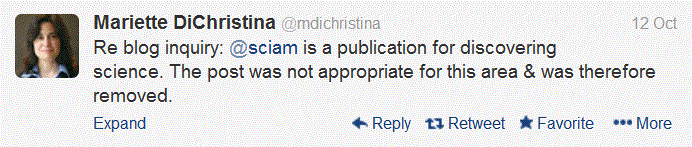 |
| Link to the original post on Twitter. |
is connected to the statement "Unfortunately, we could not quickly verify the facts of the blog post and consequently for legal reasons we had to remove the post." The initial post stated that what DNLee experienced and her response was not suitable for Scientific American. This recent post states that they need to investigate for legal reasons. Those sound like two completely different reasons for removing the post.
There are still specific issues that will need to be addressed to help move on from this incident, such as how Biology Online will address their editor's actions, and how Scientific American and Biology Online are connected.
We will see what happens. For now, my phasianid theropod is roasting in the oven covered with the leaves of several species of aromatic angiosperms and the liquid from fermented grapes. Have a Happy Geeksgiving!
SAS.
Subscribe to:
Posts (Atom)