Wednesday, October 30, 2013

Happy Halloween!

My Halloween geekitude, (or Geekoween spirit) has inspired my ichnology-themed pumpkin. He answers to the name of Ichno Facey. (If you get that bad play on words, you are as geeky - or more - than me, and you are awesome.)

Ichno Facey, the ichnology god of Halloween.
Have a Happy (and safe!) Halloween!

Friday, October 18, 2013

Eggs, Turtles, and Toast: When Pareidolia Meets Paleontology

Discoverer: "Hi, Unicorn Scientist. I have made a cool discovery. At least I think I'm on to something. Can you take a look and tell me what it is?"

Unicorn Scientist: "Sure! We like seeing new things, and like people coming in with possible finds. Let's take a look."

Discoverer: "Now, I don't want to influence your opinion, but I think it is a saddle that Bigfoot uses to ride unicorns."

There is at least a minute of respectful study of the piece of shoe leather.

Unicorn Scientist: "Well, I can see why it looks like a piece of Bigfoot unicorn saddle, but saddles for unicorns are all made out of taffeta, and are stitched together with candy-floss because unicorns have such delicate skin. There are eyelet holes here for the laces of a shoe. It has the [insert your favorite shoe brand here] symbol partially preserved."

Discoverer, Version #1: "Why aren't you confirming my interpretation? It's shaped like a unicorn's back! I thought you were an expert on unicorns!"

Discoverer, Version #2: "Well OF COURSE you would say that! You've been brainwashed by Big Unicorn and are too close-minded to see the Cover-Up of the Truth!"

Discoverer, Version #3: "You have dared to disagree with my most insightful observation. I will not rest until I expose you for the fraud that you are, for the sake of all those who wish to see a Bigfoot ride a unicorn!"
* * *
Do any of these scenarios sound familiar to you? I'll bet they do. I'll bet that if you're in a profession that is remotely scientific, you've had one of these encounters.

First, I want to state that most people who bring fossils into the museum for identification do not behave like the above Discoverer. If they bring in a funky shaped rock and I tell them that it's a cool funky shaped rock, it usually spurs a series of questions which turn that funky shaped rock into a teachable moment about erosion and different rock types. Even better, if they seem really keen we can give them a behind the scenes tour and show them tonnes of real fossils, and we may even interest them in volunteer work. Of course, the pleasant encounters stick in my mind as the general warm fuzzy feeling I get when I think about the joys and passions of being in paleontology. Those fuzzy moments are thrown into sharp abrasive contrast by those other encounters.

The other encounters involve that person who, on finding a rock or an odd-shaped shadow on a photo, have already convinced themselves of the identity of the find. It's usually a fairly spectacular find (in their mind) with an even more spectacular interpretation (again, in their mind). The person brings their find to their local scientist. The local scientist offers a different, yet less fantastic identification. The person, on seeing that the scientist does not agree with them, becomes defensive and/or outraged. Sometimes the scientist never hears from this individual again. Sometimes the scientist will have to deal with this person for the rest of their career.

My first encounter with a person like the Discoverer was back in 1999 when I was still an undergraduate. I was visiting my parents over summer break and joined them on a day of antiquing. I was browsing through the store when my parents called me over to the front counter. They had been talking with the proprietress of the shop, and somehow it came up in conversation that I was studying paleontology. The woman was very excited to talk to me: she had a fossil to show me. Before showing me the fossil, she gave me a long background explanation of finding it in the badlands of southern Alberta (promising). She had even done some preliminary research and thought it might be a scapula from a hadrosaur. Needless to say I was intrigued.

This was my first lesson in fossil identification: the bigger the set-up, the less likely the accuracy of said set-up. Lying on the counter in front of me was a glacial erratic composed of metamorphic rock. There were even garnet crystals embedded in the surface. The only aspect of this specimen that was bone-esque was that it was elongate. During my examination the proprietress stared at me with eager anticipation.

I tried my hand at tact and diplomacy (also a first). "It does have a similar shape to a bone (it really didn't, but I was trying to let her down gently), but there is no bone structure present. This is a metamorphic rock that is shaped like a bone." I pointed out the different minerals. I showed her the garnet crystals, which I thought were cool because they were of a decent size and a deep red. I told her what bone texture looks like.

She wasn't impressed. The eagerness was quickly replaced with indignant exasperation. "I thought you were a paleontologist. Clearly you don't know what you're talking about," she huffed.

I'm sure my expression was one of stunned surprise. "Well, I do, and that's not bone," was my only response. (Note: I was taken off guard by her response, and I bypassed diplomacy and defaulted to direct and blunt. I probably should have held on longer to try to educate her.) She bundled up her prize and walked away. Since my first encounter I have had many people bring in non-fossils for identification, and some are pretty darn convincing. There was a rock shaped like Pac-Man that just had to be a skull (that one was not convincing, but I had to mention it because it still amuses me.) Concretions are brought in as either eggs or turtles. A piece of railway slag looked like a bison skull. There are river-eroded igneous and metamorphic rocks that look like bone. I was once asked to identify a Bigfoot tooth (piece of calcite).

The pseudo-egg on the right is the most convincing: there are even "pores" present.
One of our largest pseudo-turtles. Concretions often preserve with what looks like shell ornamentation.
OK Nature: now you're just f**king with me. The most convincing pseudo-bone I have ever seen.
What would be the "medial" side if this were something other than eroded metamorphosed sandstone.
These wonderfully deceiving rocks are pseudofossils. I make it a point to always have some pseudofossils on hand for when someone brings in a fossil that is not a fossil. Being able to explain to the person that they are not the only ones who were "tricked" by a funky rock can go a long way to ease the disappointment. This works beautifully with kids. I love identifying rocks and fossils for kids. Even when they bring in a non-fossil, it always cheers them up to hear they have a pseudofossil.

Seeing orderly shapes where no shapes exist is the well-documented phenomenon of pareidolia: the phenomenon of perceiving patterns in randomness. One well-known example of pareidolia is the "Face on Mars" which, on thorough examination, was only an illusion visible from one angle. Our brains are likely hard-wired to do it. If you see a pony in the clouds it's your brain trying to organize information that seems unordered. Pareidolia can also send our species' reasoning skills down the path of the illogical. Dieties appear in toast and other starchy foods. A wisp of mist in a photograph becomes a shrouded ghost (same with camera straps, insects, dust specs illuminated by flash, water spots or smudges on lenses...). Skeletons are seen on Mars.

Unfortunately, pareidolia often teams up with pseudo-reasoning to create the most frustrating experience a scientist can face when working with the public. Convinced that their eyes and brains would never deceive them, those being coached by the Pareidolia-Pseudoreasoning Double Team not only are damned sure they have something, but there is no amount of evidence to the contrary will sway their interpretation. This is what science ISN'T. Science does not cherry-pick the data to support a pre-set interpretation. A proper scientific investigation looks at all the available data and then sees which interpretation best explain the data. Unfortunately, this is not how science is viewed by society: based on the Comments section of science articles, scientists are only publishing the data that support their ideas. By extension, that's how one engages in a scientific discussion.

I will be the first to admit that when I was an ichnology newbie I used pareidolia often. My mentors, being the very patient educators that they are, checked out every depression (for natural moulds) and odd-shaped sedimentary river rock (for natural casts) I though might be a track. For each pseudo-ichnite (there were many explanations that started with the phrase "That's very interesting, but...") they would carefully explain why it wasn't an actual ichnite. I think ichnofossils are more prone to pareidolia than other fossil types. Ichnofossils are, in essence, shapes in the rock (you can't look for bone texture in an ichnite), but they are shapes made by specific biologic processes.

I continued to ask questions about objects I found when prospecting, but I also paid close attention to what my mentors were showing me when we encountered actual ichnofossils. I studied the tracks of extant animals in various different sediment types. Eventually I saw enough ichnites of many different types (mammal, dinosaur, bird, turtle, crocodile, pterosaur, invertebrate burrows, etc.) that my brain began to recognize those patterns: I had developed a search image.

Does pareidolia still creep in when I am prospecting? I admit that it does, but I now use it as a prospecting aid. When I'm prospecting, I give my brain two tasks. One, I let it process shapes in the rock. If my brain applies order to the chaos of a rock ("Hey Strange Woman, that looks footprint-esque,") I stop and examine it more closely. Two, I use the accumulated experience of having seen what is and isn't a track and look for ichnologic indicators (repeated biologic structure such as digits, slide marks, skin impressions, etc.). The process is now automatic for me, but in the beginning it was a learning curve with which I struggled. If I can't apply biologic or evidence-based support to the pattern detected by my brain, I move on.

The difference between someone who is truly trying to learn and someone who is just trolling to "win a debate" with a scientist is what that person does when they are told their discovery is not a fossil. If a recent thread I've been following on a paleontology Facebook page is any example, there is no amount of data or explanation that can re-train a brain devoted to the Pareidolia-Pseudoreasoning Double Team.

"But Strange Woman", some may ask, "surely these people just need to be educated about the facts and the scientific method?" A more likely question might be "Why feed these trolls?"

Most of the scientists I know are natural educators. They see every opportunity to turn a seeming frustrating conversation into a teachable moment. When misinformation rises from the depths like a pseudological Kraken, scientist are there with the recent data (and their years of experience) to slay the Pseudoscience Beast. What is sad is that these efforts might actually feed the Beast. A recent study (link here: it's pay-walled) on the political perceptions of the public suggests that offering corrections to previously read inaccurate statements failed to reduce misperceptions (1). In fact, the study also shows that corrections tended to strengthen political misperceptions rather than correct them. If people's minds work the same way with misinformation in science (I would love to read a study on that), what hope do we have of countering misinformation, especially when those misinformation is potentially detrimental (e.g. climate change deniers, misinformation on reproductive health, anti-vaxxers, etc.)?

It's likely we will never find the magic formula of words that will break through that armor of pseudologic. That won't stop us from trying. No matter what, scientists will continue to ensure that the correct information is out there for those not caught on the circular reasoning merry-go-round.

So, Dear Reader, we are more than happy to take a look at your funky specimen. Please don't be insulted if it is not a fossil. We're not trying to trick you, just teach you. We want you to develop a fossil search image and discover something cool for science!

S.W.

1. Nyhan, B. and J. Reifler. 2010. When corrections fail: the persistence of political misperceptions. Political Behavior 32(2):303-330.

Monday, October 14, 2013

We're Better Than This.

Finally, we hear from Biology Online regarding the editor who called a scientist an "urban whore" when she politely declined an unpaid blogging position. An apology was posted by a site administrator this morning (read the full apology here):

"We would like to express our sincerest apologies to Danielle N. Lee (DNLee) and anyone else who may have been offended by the way our recently hired employee, Ofek, handled the conversation with her. Ofek's behaviour was completely out of line and after gathering the facts we immediately terminated his employment. Ofek failed to show the respect and prudent behavior expected of him as a contributor to Biology Online."

THIS. This is how to apologize and rectify a situation. You apologize without conditions or excuses. You deal with the inappropriate behavior in such a manner so there is no doubt of your organization's stance on an issue. You don't push ANY of the blame back onto the victim.

Kate Clancy at Scientific American delves deeper into the issue as to why so much "Twitter-rage" erupted over Scientific American's decision to pull Dr. Lee's response to the abuse by the ex-employee of Biology Online. Read it here: if you read nothing else about this incident, read this.

Dr. Clancy summarizes the situation perfectly:

"It’s a rare thing to speak up in the face of victimization. But the secondary trauma from not being believed and being silenced (pulling a post first for the reason that it is not “discovering science,” then pivoting and claiming it was for “fact-checking”) is far too common. It’s that secondary trauma from Scientific American’s actions that crush a person. Going somewhere you trust – a blog network that prides itself on inclusivity in terms of the way it has fought intolerance in the past, in the identities of its bloggers and in its allowable content – and then being shut down? It’s like going to someone you trust and being called a liar."

Why do these issues of race and gender discrimination continue to persist in academia, which one would assume is populated by people intelligent enough to avoid these pitfalls? Dr. Clancy offers this insight:

"This is why fake gender and race blindness is so problematic, it’s why not talking about whiteness and privilege is problematic. Avoiding these things is silencing to the people who need to talk about it to reset boundaries. And if we consider ourselves allies, it’s time to start talking about this stuff."

Where I live and work I am not a minority, but I will always be a woman no matter where I am in academia. I can pretend all I want that gender discrimination or gender stereotypes do not exist. I can chant "It doesn't matter, it doesn't matter" until I pass out (it may be time to break out a post or two of my experiences). I can think that my colleagues and I are intelligent enough not to let discrimination and stereotypes be an influencing factor.

Gender and race discrimination are not like the Ravenous Bugbladder Beast of Traal who believes if you can't see it, it can't see you. Ignoring the problem won't make it go away. Ignoring the problem allows it to accumulate in the dark corners like society's unsightly dust-bunnies, only to be discovered when they roll out from under the couch in front of your dinner guests. We leave ourselves in the uncomfortable position of reacting rather than acting. We sweep away the accumulated dust of the ages and pretend it was never there.

By admitting there is a problem with race and gender discrimination in academia, we are essentially admitting to ourselves that we are not intelligent enough as a community to passively weed out discrimination. Fortunately for us, we are intelligent enough to identify when a strategy is not working. If this recent incident highlights nothing else, it is that our current strategy for dealing with gender and racial discrimination in academia with fake blindness is not working.

This is not news to people like Dr. Lee, who does tremendous outreach work in STEM to engage under-represented youth. This is not news to anyone who has ever blogged about sexism or racism in academia. This is not news to all those people who provide outreach and mentorship to counteract racial and gender discrimination. However, it is still to easy for those having not experienced this kind of discrimination to dismiss these voices as being "over-sensitive", "over-emotional", or "over-reactionary", all of which are dismissive attitudes that lead to secondary victimization. They are dismissed because we believe that as scientists we are above this behavior.

We are above this behavior. So let us actively be better. As Dr. Clancy explains in her post, this will require some self reflection. Asking a question as simple as "Is there a correlation between how I behave around a colleague and the race/gender of that colleague?" is a key beginning. We examine phenomena all the time: that's what we do as scientists. Sometimes the phenomena are aesthetically unappealing. We just have to gonad up and do the work. An intelligent person doesn't want to discover that they may have behavioral traits they would attribute to the 1950s.

I want to be very clear on this next point, mostly because the most common argument I hear against focusing attention on racial and gender discrimination is that "it perpetuates an inferiority complex." Those are two different issues. A person belonging to an under-represented group in STEM does not need this attention because they lack the ability. That is ludicrous. What is lacking are support and encouragement: support and encouragement for kids everywhere to enter STEM careers, support and encouragement from role models with whom kids can identify personally, and support and encouragement for those who report discrimination are growing, but there is still a long way to go.

We can all do more. We can mentor. We can visit public schools and connect with kids. We can be vocal about our experiences in academia, no matter how uncomfortable or seemingly personal, because if it happens to a scientist it is part of life in the sciences. Our goal should be to talk gender and race discrimination to death because that is all it deserves. If we truly want to clean academia's house we'll have to air out the musty corners and deal with the dust-bunnies, because ignoring them won't make them go away.

SAS.

Friday, October 11, 2013

Respect in Science: When saying "No" gets you called a "Whore". #StandingwithDNLee

What do you get when you are a busy scientist and you are asked to do work for free for a supposedly professional science-based blog, but you respond politely with "Thank you very much, but I have to decline your offer. Have a great day." (paraphrased)?

It turns out that you get called a whore.

This happened to biologist and STEM promoter DNLee. This happened just recently, as in within the last 48 hours. Rather than silently feel rightly outraged yet powerless to counteract the most blatant unprofessional conduct I have heard of in a long time, DNLee shines the world's largest halogen light on this bad behavior and shares the interaction via blog and video.

Like many others, I am sharing DNLee's blog post. This is my small part to keep the light shining on this grotesquely unprofessional behavior. As the old adage goes, sunlight is the best disinfectant.

Here is DNLee's post, unedited (in-between the dashed lines):
-----------------------------------------------

wachemshehao hao kwangu mtapoa

I got this wrap cloth from Tanzania. It’s a khanga. It was the first khanga I purchased while I was in Africa for my nearly 3 month stay for field research last year. Everyone giggled when they saw me wear it and then gave a nod to suggest, “Well, okay”. I later learned that it translates to “Give trouble to others, but not me”. I laughed, thinking how appropriate it was. I was never a trouble-starter as a kid and I’m no fan of drama, but I always took this 21st century ghetto proverb most seriously:

Don’t start none. Won’t be none.

For those not familiar with inner city anthropology – it is simply a variation of the Golden Rule. Be nice and respectful to me and I will do the same. Everyone doesn’t live by the Golden Rule it seems. (Click to embiggen.)


The Blog editor of Biology-Online dot org asked me if I would like to blog for them. I asked the conditions. He explained. I said no. He then called me out of my name.

My initial reaction was not civil, I can assure you. I’m far from rah-rah, but the inner South Memphis in me was spoiling for a fight after this unprovoked insult. I felt like Hollywood Cole, pulling my A-line T-shirt off over my head, walking wide leg from corner to corner yelling, “Aww hell nawl!” In my gut I felt so passionately:”Ofek, don’t let me catch you on these streets, homie!”

This is my official response:


It wasn’t just that he called me a whore – he juxtaposed it against my professional being: Are you urban scientist or an urban whore? Completely dismissing me as a scientist, a science communicator (whom he sought for my particular expertise), and someone who could offer something meaningful to his brand.What? Now, I’m so immoral and wrong to inquire about compensation? Plus, it was obvious me that I was supposed to be honored by the request.


After all, Dr. Important Person does it for free so what’s my problem? Listen, I ain’t him and he ain’t me. Folks have reasons – finances, time, energy, aligned missions, whatever – for doing or not doing things. Seriously, all anger aside…this rationalization of working for free and you’ll get exposure is wrong-headed. This is work. I am a professional. Professionals get paid. End of story. Even if I decide to do it pro bono (because I support your mission or I know you, whatevs) – it is still worth something. I’m simply choosing to waive that fee. But the fact is I told ol’ boy No; and he got all up in his feelings. So, go sit on a soft internet cushion, Ofek, ’cause you are obviously all butt-hurt over my rejection. And take heed of the advice on my khanga.


You don’t want none of this

Thanks to everyone who helped me focus my righteous anger on these less-celebrated equines. I appreciate your support, words of encouragement, and offers to ride down on his *$$.

-----------------------------------------------

Huzzah!

The time and talents of professionals are worth something. It matters that people, specifically scientists, realize this. Too often I hear of colleagues underselling themselves, or assuming that if they demand some sort of fair compensation for their time (e.g. consulting, documentaries, etc.) that the prospective benefactor of the talents will go elsewhere, or under-represent them. Always expecting that a highly trained professional will do everything for free disrespects their time and expertise.

To put the crap icing on top of the pile of a cake, the insult had to take a sexist approach by using the time-tested term of "whore." [Begin sarcasm] Yup, nothing puts an uppity woman in her place like calling her a whore. [End sarcasm]. This was disrespect for DNLee as both a scientist and a person.

The only way this kind of behavior will end is if these incidents are not shoved in the dark closets or swept under the rugs. Don't just dismiss this behavior, or feel that you can do nothing about it. Call it out. Expose it to the sunlight and let it shrivel and die.

Off to do my job as a researcher and collections manager for which I get paid.

Shaman out.

Update: 12-10-2013

On the blog Isis the Scientist, Dr. Isis lays down the hard truth concerning Scientific American's removal of DNLee's original post. Follow the link and read. Whether that was the intent or not, Scientific American's removal of DNLee's post (and the subsequent justification of said removal on the grounds that it wasn't science-y enough) felt like a continuation of the original disrespect shown to DNLee by the editor of Biology-Online dot org. The situation was not pretty, but deleting it will not remove the problem, especially if the problem is one of disrespecting a scientist using abusive and sexist language.

Update #2

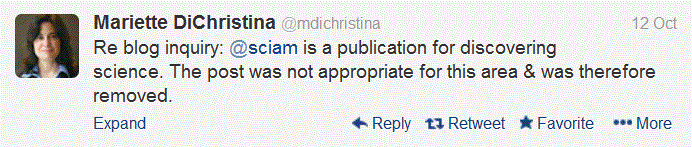
The editor of Scientific American's blog recently posted on Twitter that they are still collecting information.

Scientific American blogs editor Twitter statement. Follow the link here to read the replies.
We'll have to wait and see what the official statement is. I'm definitely curious!
***

As a completely personal opinion, the outrageous behavior that was highlighted in this incident, as well as all those incidents that continue to be under-reported, isn't magically "fixed" by singing the "I'm Very Sorry" song. When a person's go-to response is to trot out a sexual and race based insult, that speaks to the character and maturity of the person. If they have not yet internalized that a) this type of behavior is intolerable and (most importantly) b) WHY this type of behavior is unacceptable, there are larger issues at work than just an "Oops, I made a mistake in judgement", or worse "It was just a joke!" defense. You do not get to pick-and-choose to whom you behave professionally. Period.

No matter what the final outcome of this is incident is, it demonstrates that there is still a long way to go before discrimination is culled from the world of science and science communication. Everyone needs to keep exposing these incidents to the light of day, not just for ourselves, but for all those who will follow in our academic footsteps.

SAS

Update: 13-10-2013

The Editor-in-Chief of Scientific American has posted a more formal statement. Read it here:

As another completely personal opinion, reading this left me feeling rather unsatisfied. I realize they are not yet complete in their information gathering, but here are a couple of items that spring to mind (and to the minds of many who left comments on the recent post, now that I had finished reading their comments) that I still find troubling:

1) In no way was their any mention that the behavior (hell, phrase it as "alleged behavior" if there is a need for hiney-covering) of the Biology-Online editor was inappropriate and unacceptable. A simple statement along the lines of "if this is indeed what transpired, it was wrong" would have sufficed. Respected science organizations need to step up and emphasize that mistreatment of any professional is unacceptable. Institutions such as Scientific American have the ears and eyes of so many, interested public and professionals alike, that they should be at the forefront of promoting professionalism in science. This includes letting people, especially their bloggers, share their less than smiley experiences and how they dealt with said experiences. Their stories and experiences are our stories, too. Science and science communication are the last places where dark corners should be acceptable.

2) I am not sure how the statement originally made by the Editor-in-Chief regarding the removal of DNLee's post
Link to the original post on Twitter.

is connected to the statement "Unfortunately, we could not quickly verify the facts of the blog post and consequently for legal reasons we had to remove the post." The initial post stated that what DNLee experienced and her response was not suitable for Scientific American. This recent post states that they need to investigate for legal reasons. Those sound like two completely different reasons for removing the post.

There are still specific issues that will need to be addressed to help move on from this incident, such as how Biology Online will address their editor's actions, and how Scientific American and Biology Online are connected.

We will see what happens. For now, my phasianid theropod is roasting in the oven covered with the leaves of several species of aromatic angiosperms and the liquid from fermented grapes. Have a Happy Geeksgiving!

SAS.

Wednesday, August 28, 2013

Strange Woman Abroad: Chongqing Ichnology Conference, Linshu Tracks, Shandong Province.

Hello, Dear Readers! It's about time that I resume my tale of my first paleontological trip to China for the Chongqing Ichnology Conference. We've been extremely busy since our helicopter trip into northern BC: we've been prospecting exposures of Late Jurassic-Early Cretaceous rock in creek beds, and we've also been preoccupied with the recent helicopter lift of our hadrosaur skeleton (a complete success.) We have a bit of down time before our return trip to China (which is good, as I seem to have caught the flu that is making its rounds around town), so now I can turn my attentions to sorting photos.

We are now at the morning of November 21st. The original plan was for us to visit the part of the Great Wall that was in driving distance to Beijing, but it snowed the night before so the roads were not considered passable. Instead, we went to the airport early. Almost eight hours early. The drive to the airport was very interesting. Actually, driving in China interesting, period. People on motorbikes dance in between vehicles going highway speeds with intricate choreography. I admit I was convinced our 15-passenger van was going to run over a biker on more than one occasion due to the traffic density and speed.

I thought these tiny bikes would not possibly stand a chance in the heavy traffic. Turns out I was wrong!
We made it to the airport without incident. What were we going to do for almost eight hours? We had nothing to worry about: Lida booked for us a private room in one of the airport restaurants where we could relax in absolute comfort. What was our version of relaxing? Each and every one of us (me, Rich, Martin, Hendrik, Julien, Daniel, and Lida) were either writing papers, working on paper reviews, or putting the finishing touches on our presentations for the conference. One catch for renting the room was that a certain amount had to be spent on food and drink. That was no problem for us: science is hungry and thirsty work, and we were there for two meals. We were also there for several playings of the looped background music: some techno club cacophony with the repetitive lyrics of "Are you ready to make some noise? Make some noise? Make some noise?"


Forgive me, Dear Readers, but there was no way I was going to put any effort into finding either the original or the longer playing version. Suffice to say I will NEVER get those lyrics out of my head. This is what I get for not having my audiobooks handy. We arrived in Linshu the evening of September 21, and were shuttled to our hotel.

We spent two days at the Linshu tracksites. Early Cretaceous in age, they boast an ichnofauna attributed to sauropods, ankylosaurs, stegosaurs, and small, medium, and large theropods. Our first stop was in a stone quarry on the outskirts of the populated areas. Once again we were greeted by our old friend the vertical track surface.

Tectonic action pushes once horizontal track surfaces vertical, and folded and faulted sediment layers are a common occurrence with vertical track surfaces.

At over six meters in height, we needed a way to get close enough to the surface to take photos, outline tracks, and do acetate tracings.
Free-climbing a vertical track face is not an option is one wants to collect useful data. Martin Lockley (left) was doing his best impression of a mountain goat to check out a contact between two rock layers when he and I were logging the stratigraphic section for the site.

Ichno-Geek Note: A stratigraphic section is the layers of rock that are deposited one on top of the other. These sections are diagrammed to show which rock layers came first, the grain size of the rock (fine or coarse), if there are any sediment deposition structures such as ripples or scour surfaces, and what the rocks contain (burrows, tracks, bones, wood, leaves, invertebrates, etc.) You cannot develop an accurate picture of the paleoenvironment in which these track-making animals lived without knowing under what conditions the track-bearing layers were deposited.

Once again we had access to ladders, but for documenting the large track surface featured above, we had something a bit more high-tech: we had a picker truck!


Martin Lockley and Rich McCrea taking 3D photogrammetry shots of one of the track surfaces.

While Daniel Marty and Hendrik Klein, did the primary documentation on the track face, and after Martin and I did the stratigraphic section, Rich and I decided to check out the rest of the bedding surfaces for additional tracks. I may have mentioned this before, but one of the great parts of vertical track faces is that multiple bedding surfaces can be exposed. It is not uncommon for one track surface to slough off only to reveal a completely new track surface underneath. I was still on the hunt for small tracks: invertebrates, birds, small reptiles, etc., and although I saw many finely rippled surfaces, rain drop casts, and many paired U-shaped burrows, bird tracks continued to evade me.

Likely Arenicolites, one of the U-shaped burrows that is commonly part of the Skolithos ichnofacies.
Small rain drop casts on a fine-grained silty sandstone surface.
We were not completely skunked in our search for the small dinosaur ichnofauna: Rich came across one manus-pes set of a small quadrupedal herbivorous dinosaur. We exposed the rest of the surface in hopes of revealing a trackway, but only the one manus-pes set was preserved in any convincing detail.

The manus (top) and the pes (bottom) of a small quadrupedal herbivorous dinosaur. Sometimes we can't get more specific than that without a trackway showing multiple prints. Single tracks also don't tell you if you are dealing with a small adult track maker or a juvenile of an already known track maker.
Meanwhile, work was continuing on tracing the multiple trackways of a large quadrupedal track maker (the paper was submitted in May 2013 - stay tuned!)

Acetate tracings in progress, with Hendrik Klein.
Martin Lockley had also been checking out additional bedding surfaces for tracks, and made a fantastic find: didactyl (two-toed) theropod tracks!

Martin Lockley (on ladder) and Hendrik Klein measuring pace and stride of the didactyl tracks. Martin uncovered most of this surface after seeing the first track (next to Hendrik's hand). This is part of the paper that was submitted in May 2013, so I won't go into too many details here. I'll post a link to the paper once it is available online. Stay tuned!
We also found out there was a documentary being filmed about the discovery and research of the tracksites in the Linshu area. We were all interviewed, and asked to compare the tracks at this site to other track sites we had individually worked on around the world. These tracks are comparable in age to the Earliest Cretaceous track sites in western Canada, but they have a slightly different ichnofauna...at least it appears as such at this point in our research. This is one of the issues we are working on solving, thanks to recent (as in just this month!) discoveries of Late Jurassic-Early Cretaceous tracks in the Peace Region.

Rich McCrea being interviewed for the documentary, comparing the Linshu tracks to the Earliest Cretaceous tracks from south east British Columbia.
As an aside, I think I was asked one question that the other members of the field team were not. Once the scientific questions were done, the interviewer asked "Do you mind if I ask you a personal question?" I said that a personal question was fine. I had a feeling the question was related to my gender: at this point in the expedition I was the only woman on the field team. The interviewer asked "How will having a family impact your career as a scientist and field paleontologist?"

Good question.

Technically still of child-bearing age, I had given a lot of thought to this particular question. There is no doubt that having a child would drastically change the level of field work that I currently enjoy. I would be a fool to believe otherwise. That being said, I know of a few mothers who began bringing their offspring to field sites as soon as the babies could support their own heads, so it is not impossible to balance both a field career and raising a child. It also helps to have a husband who is a working team member.

It is a good thing that I had actually given the topic some thought, otherwise I might have gasped and gaped with all the grace of a beached fish. The best answer I could give was this: if we do decide to have kids, Rich and I will work as a team to make sure that both careers continue successfully, and that our kid would grow up thinking that going into the field looking for dinosaurs with Mom and Dad would be a normal part of the summer. The documentary people seemed both pleased and interested by this answer.

The acetate tracing was completed, and with help of the picker truck removed without incident.
Daniel Marty and Hendrik Klein take charge of their masterpiece.
We had a lot of interest from locals. We could not tempt these kids to come out of hiding.
Three children watching those strange paleontologists, with the didactyl track face in the background.
We were introduced to the man, a local farmer whose name I was not told, who first noticed the tracks on the exposed rock in the area.
Ray You (foreground) capturing a picture of Lida Xing (red coat) and the local farmer (right) who discovered the tracks in the area.
It is not just the quarry that has track surfaces: several outcrops in the surrounding farmlands were rich with dinosaur prints!
Meter stick for scale. Do you see the footprints?
That was a full Day One in the Linshu region.

Day Two began with a visit to a different quarry. We first investigated a natural mold trackway of a small tetradactyl (four-digit) track maker.
Rich McCrea off to scout out potential track-bearing surfaces.

The small, tetradactyl trackway. There was some discussion as to whether shallow manual impressions were preserved. Small ankylosaur? Small stegosaur? The work is in progress!
I took a stroll around this slab to the back surface to see if there were any natural casts (infills) preserved from a lower track surface. I was not disappointed!
Just above my field book is a tridactyl pes print. The rest of the tracks are obscured by overlying sediment layers.
The same natural cast track surface, cleaned up and tracks traced. It is very likely these tracks were made by a medium-sized ornithopod.
Once some of the surrounding sediment was cleared away, the prints became more visible. I noticed that our group seemed smaller. Where did they go? They (Daniel Marty, Rich McCrea, Martin Lockley, Lida Xing) were checking out yet another track-bearing surface that preserved a trackway of a sauropod.
The lighting was not ideal for these shallow tracks, but Daniel Marty (black shirt) and Rich McCrea (grey shirt) lean over to get a closer look.
From bottom left to top right: Daniel Marty, Rich McCrea, Martin Lockley, Lida Xing.
In terms of field safety (besides the scrambling around vertical surfaces like so many mountain goats), we had to watch out for were wasps. The cold weather had slowed them down, but they were still technically active and were huddled together in small cracks and crevices on the track surfaces.
This wasp was not above stinging ichnologists who disturbed her sunning activities.
Before we left this tracksite to check out other exposures, I attempted an artsy photograph of the site...

...to be photo-bombed by Daniel Marty. I love working with people who have a sense of humor! If you are not enjoying yourself while you work, what it the point?

Try as I might, I was still not successful in finding any small vertebrate traces at these sites. My zeal to locate Early Cretaceous bird tracks did not go unnoticed, and the rest of the field team did their best to solve the nonbirdieness of the area.
Lida "finds" some webbed bird tracks for me to photograph.
On our way back to the city we stopped by the village to check out their open air market.
Ray You (right) chats with a vendor.
When our guides and local representatives saw that we were interested in local crafts, they took us to the Linyi Kingwillow Arts and Crafts outlet in Linyi City. If only I had luggage space: I do love wicker and willow furniture.
Kingwillow Crafts Center.

Baskets, chairs, tables, dressers...if it could be woven, it was here!

Including this large wicker bull! From left to right: City official, Julien Divey, Martin Lockley, Rich McCrea, Lisa Buckley, Hendrik Klein, Daniel Marty, and the owner of the Kingwillow company.

The next day was a travel day: on November 24 we traveled from Linyi City to Chongqing City, for three days at a unique tracksite.

Stay tuned for more ichnology fun!

S.W.

Sunday, August 18, 2013

Five Souls On Board

There are certain aspects of my career about which I do not discuss with my parents in great gory detail. Not that the career of a field paleontologist is a sordid one by any stretch of the imagination (I have heard stories though...) but there is an element of risk involved, and I imagine that no parent wants to hear about their child entering risky situations.

Field paleontology, at least from my experiences in northeast British Columbia, is a tough job logistically and physically. To badly paraphrase one of the lines in Max Brooks' "World War Z", there are no difficulties - only challenges. The first challenge is the terrain itself. The natural resource industry has opened up access to a great deal of previously inaccessible terrain, but even with the scattered capillaries of access roads the ground is still difficult to survey. Roads take you only so far, meaning that access to a particular outcrop is gained through Good Olde Timey hiking. This brings up the second challenge: the wildlife. Pedestrian travel through the bush means coming into contact with the local inhabitants: (mountain) lions and black bears and grizzlies, oh my! Honestly, I am not worried by wildlife encounters. I don't naively tromp off into the bush smeared with bacon grease, but I don't have an illogical fear of wildlife. The resident critters are not out to get me: they would rather avoid that noisy ape crashing through the bush who smells of Deep Woods Off. We go into the wilderness prepared for an unpleasant encounter, and spray and bangers are an essential part of our field kit. 98% of my wildlife encounters have been amusing. During a three week foray into the alpine to document Early Cretaceous tracks, a juvenile Peregrine Falcon mistook our heads emerging over the crest of a hill as potential prey. We all looked up to see wings and talons screaming down on us. The falcon pulled up before impact when it realized it had made a big miscalculation in scale.

"Hmm...am I 100% sure those ape-things aren't edible?" Our Peregrine Falcon friend would hover above us while we took lunch above the tracksite. Photo credit: R. T. McCrea.

The third challenge is personal: one has to be physically (and mentally) able to break new ground while prospecting. Prospecting in northeast BC is not the same as a hike on a groomed forested trail. There are creek and river crossings, moraines and eskers to scale, bogs/marshes/beaver dams to slog, as well as trackless bush through which to whack. What looks like an easy hike on a Google Earth image more often than not turns into a six hour detour due to the ever-changing terrain (the link takes you to the abstract for an article in Canadian Geographic by Leslie Anthony, where our prospecting-by-raft expedition involved a six hour portage due to an unexpected rock fall in a river.) Trees fall. Industrious beavers transform low areas into a several kilometer long marsh. I now have a pair of boots that I use solely for bog and marsh crossings to save all of my field boots from smelling like the inside of Vulcan's toilet. This is done while not only packing your personal gear but packing all the gear you need for dealing with a fossil.

I personally love these challenges. I am far more comfortable in the wilderness than an urban setting, and don't become anxious if I am without of Internet or phone access for weeks. The hard work not only keeps me in good shape, but it also gives me an excellent reason to stay active during the non-field season. If I drop the ball physically, not only do I make it harder on myself once the field season arrives, but I increase the physical burden on my team: it's my responsibility to ensure that I am not physically the weakest link on an expedition.

No matter how long someone can hike with a full pack, there are areas that need assessing within a time frame too short to slog in on foot. If the budget allows, we take helicopter flights to extremely remote areas. As we never have the budget for a machine to be parked on stand-by at our drop off point or to fly in-and-out every day, we schedule a pick-up date and time and wave the pilot a cheery goodbye for hours, days, or weeks (depending on the length of the expedition.)

One of the most frequent comments I hear when people find out I've spent some time in a helicopter is "Oh wow, you're so lucky!" People charter helicopter trips for fun, and when you have a pilot who likes to show you some of the cool geographic features of an area close-up it's a blast. You get to see landscape that you would not otherwise ever see. The specific detail that I keep from my parents? Helicopter trips are one of those potentially risky situations.

Parents also don't want to hear about that one sedimentology professor who shared a lot of field tales of him and his colleagues, and that about 30% of the people he had worked with in the field had their stories end with "...and he died in a helicopter crash during a survey of [insert remote location here]." Keep in mind that these stories hail from the 1960s - 70s, and I imagine that quality control for both the pilots and the machines has increased since. Risky or not, if we have an opportunity to fly into an area that we would not otherwise get to on foot, we jump at the chance. My poor parents always tell me to be careful in the helicopter. That makes me giggle, because I'm sure they are imagining either that a) without that warning I'm going to ride the machine by holding onto the landing skids, or b) by me sitting in the helicopter thinking safe thoughts will be the only factor standing between a safe trip and a trip that ends in a burning pile of wreckage.

I recently returned from a prospecting trip into a fairly remote area in northern BC. It was only a day trip, but any time we go into a remote location by helicopter Rich and I pack what we call the "Oh S**T" bag. The O.S. bag contains everything we would need to survive for a few days without too much hardship if the helicopter is not able to return to pick us up (e.g. due to bad weather.) Our O.S. bag contains two hiking tarps, our bivy sacks, sleeping bag liners, a water purifier, light prepackaged snacks (to keep down food prep odors) and a light source. Our regular packs have all of our first aid material, satellite phone, bear deterrents, and rain gear.

We were up and ready to go at 5:00am and met the rest of our party at the airfield before 6:00am. We were hitching a ride with another crew that was going into the same area for road maintenance work. Gearing up for a helicopter flight always involves the safety orientation (e.g. where is the emergency locator stored?) and then the packing of the machine (bear bangers and any compressed liquids do not fly in the cockpit). We buckled ourselves in and donned our headphones and microphones. This allows us to communicate over the roar of the engines. I listened to the pilot go over his pre-flight reporting. This includes giving the location of take-off and coordinates for landing, among other logistics, and the crew manifest. The pilot then closed off the crew manifest report with this statement before take-off:

"Five souls on board."

Hearing myself and the rest of the passengers referred to as "souls on board" was a sobering moment that cut through the excitement of the helicopter flight. Sobering is the best word I can use to describe the momentary feeling. It was odd, and difficult for me to articulate because of its fleeting nature. While I plan for several eventualities that we could potentially encounter when in the Wild, there are several for which I cannot plan. For some scenarios all I can do is mitigate the severity of the situation rather than prevent it. An overly cranky bear that I inadvertently scare. A misstep on a ledge or a loose boulder. A drastic change in the weather. A freak mechanical failure of whatever machine in which I happen to be riding.

All these things and more could happen. However, all of the "What ifs?" would not be enough to keep me from the enjoyment of remote field work. The work contains risks, but they are calculated risks. Every trip yields new information that fills in yet one more piece of the puzzle for what is known of paleontology in BC and western Canada, and I plan to survey the wilderness until I am physically unable to do so. This actually keeps me from taking unnecessary risks: if I do something completely bunny-brained and permanently hurt myself, I will have done the Darwin Award version of removing myself from field work.

My parents can rest assured that I won't be bungee jumping out of helicopters or poking wolverines with pointy sticks. There is too much ground to cover before enfeeblement sets in.

Back to it!

S.W.

Monday, August 5, 2013

(Commercial) Fossil Fuel

Once again I feel as though I can't take my eyes off the Internet for a second. Tuesday morning (July 30) is the first time in 24 days that I have had to thoroughly check the fossil-related news since being out in the field and being immersed in the Tumbler Ridge Aspiring Geopark Symposium.

What headlines do I see on scrolling through the news? "Clashing Titans for Sale: Dinosaur Skeletons Headed to Auction, Not Museum." appeared in the New York Times. Cue the Everlasting Head-desk.

Many dinophiles have heard of "The Fighting Dinosaurs." Discovered in 1971 by the Polish-Mongolian Palaeontological Expedition, this evocative specimen depicts mortal combat between the Mongolian dinosaurs Velociraptor and Protoceratops, and was part of a past exhibition of the American Museum of Natural History.

Besides the visual impact, fossils such as these have great scientific importance. Much of the behavior we of dinosaurs (and other extinct animals) we infer from very detailed studies of their anatomy. With modelling technology becoming more accessible, new hypotheses on dinosaur movement and behavior are being presented and tested in the literature. [Warning: Shameless ichnology plug! One of the reasons I enjoy dinosaur ichnology is because dinosaur tracks and trackways are preserved behavior: if you want to know how an animal moves and places its limbs, you cannot ignore ichnology.] Specimens such as the Fighting Dinosaurs have the potential to show us the end results of an interaction between predator and prey, and these specimens are not common.

No other specimen has come as close as the Fighting Dinosaurs to preserving the aftermath of dual death scene. A new specimen is on the paleontological radar, and, like the recently completed Tarbosaurus case (shameless link to my previous posts here and here, which also contain several links to the media reporting on the case), it is garnering attention for all the wrong reasons.

Here is the website for the specimen now known as the Dueling Dinosaurs, which contains the background of the discovery (unfortunately none of the links to the supporting documents work at the time of this posting), and some of the speculation surrounding the specimen. The specimen was discovered on private land in deposits of the Hell Creek Formation of Tyrannosaurus rex and Triceratops horridus fame. Most of the media on this story emphasizes the purported scientific importance of the specimen. All of the media reports on the fate of the specimen: it is destined for auction at Bonhams New York on November 19, and the estimated price tag is between $7-$9 million USD.

Unlike the Tarbosaurus case, there is no last-minute restraining order or court ruling that will return the specimen to the public trust. Because the specimen was discovered on private land, it is perfectly legal in the United States for landowners to sell vertebrate fossils found on their private land. [Note: Public lands are controlled by the Bureau of Land Management.] Even a specimen of Archaeopteryx caught in the act of giving live birth to a Tyrannosaurus is not be immune to being offered for sale, or from subsequently being purchased by someone with a Bag of Holding as a pocketbook.

There are two points in this particular case that raise my hackles. First, there is a great deal of speculation (a.k.a. hype) on the supposed importance of the specimen, but there is absolutely no scientific documentation to support these claims. None of the links to the PDFs lead anywhere (and as of 2pm on 05-08-13 the site is currently offline), so there is no way for a curious researcher to examine what has been collected or noted to date. A brief look at the affiliations of those making the grand statements of significance shows us that they are associated in some way with the discovery, preparation, and marketing (for lack of a better term) of the fossil. To date, there are no peer-reviewed scientific publications on the specimens. Thomas Carr, a paleontologist who does extensive work in the Hell Creek Formation, states in his interview (follow the link) that there likely will not be any scientific study on the specimen, depending on the final purchaser.
Why not? If the ceratopsian preserved in the "Dueling Dinosaurs" specimen block is indeed a new horned dinosaur, it will need a full diagnostic work-up and publication (and no, someone stating in a news article or auction house website that it is a new species does not constitute peer-review.) If the speculations are correct, it would need to be described as a type specimen. Type specimens need to be archived in a public institution (e.g. museum, university) that a) guarantees access to any researcher who wants to study the specimen and b) is committed to storing the specimen in perpetuity. I can't stress enough the importance of this last statement. If I paint "Tuxedo Cat Bathing Her Nethers During My Last Dinner Party", that piece of work may change ownership many times during its existence. It could be damaged, stolen, or lost (likely without mourning from the art community in the case of the above mentioned work).

Type materials need stability and permanence. If I designate a new type of footprint, it is my responsibility as a researcher to choose a repository that is committed to archiving that specimen for the long haul. Ideally, 100 years from now a researcher should be able to easily locate the repository for that specimen. There is absolutely no guaranteed stability to commercially purchased/privately owned fossils. What happens if the owner dies, and the specimen is not willed to a public institution, or their progeny cares not for fossils? What if it is sold and its location becomes unknown? What if it is stolen? Will it be stored responsibly? Also, how was the specimen collected? What data, if any, were documented? What will happen to the data and associated specimens encountered during the excavation of the specimen?

Second, while no laws are being broken, I have huge ethical reservations about all that has transpired in this specimen going to auction. My stance is this: fossils are a part of the history of each and every one of us. They arose, flourished, and fell long before the creatures who would inevitably develop the distinctions between private and public land evolved. No one person has the ethical right to profit from the sale of my heritage, your heritage. We all share this heritage because it is the common heritage of our planet.

"Hold on, Strange Woman!" I hear some of you exclaiming, "How is a private person owning a fossil any different from a museum owning a fossil?"

Good question. Natural history museums hold fossil specimens in trust for the people, and are staffed with people who have been trained in the art and science of fossil conservation. I can only speak for myself, but I would not have the hubris to claim that I own a single fossil within the walls of my institution. My only claim is one of responsibility. I am responsible for the long-term care of each specimen and all the data that are associated with it. I am responsible for making these specimens available for research. I am responsible for ensuring that the research done on each specimen is done with care and diligence. I am responsible for developing the interpretive material that goes out on display for the public to see. I do not (for hyperbolic example) take the fossils under my care home and stroke them covetously in the flickering candlelight. They are neither curiosities nor porcelain collectibles. They are our past.

"Hold on again, Strange Woman!" some may be puzzling, "why doesn't a natural history museum just buy the fossil? Wouldn't that be the responsible thing to do if researchers feel so strongly about the specimen going to auction?"

Ah, if only! Back in the early days of the Bone Wars and the first exploration of places such as Dinosaur Provincial Park, museums contracted commercial fossil collectors to acquire specimens for their museums. Museums are one of the many scientific institutions that are feeling the vice-grip of budget cuts, and many are struggling to retain their own academic staff and research/collecting programs, never mind finding funds to purchase specimens. The private owners have reportedly accrued over $250,000 USD in costs related to the removal of the specimen, yet the specimen has been offered to museums for a mere $15 million.

This specimen is not being sold for cost recovery. It was not offered to well-known museums at what could be considered a donation price. This is turning fossils into profit, plain and simple. And, someone will inevitably purchase the specimen, ensuring that the cycle of collecting fossils solely for profit continues.

To those who have pockets deep enough to consider dropping $6 - $9 million on a single specimen, I truly believe there are more effective ways to leave lasting impressions on society that are fossil related. Natural history museums and research programs are struggling. These very museums create the excellent fossil displays that inspire young and old alike. They inspire the next generation of paleontologists and fossil enthusiasts. There are countless imaginative ways in which to redirect the funds that go to the purchase of fossils, including:

- renovating and upgrading a public display gallery,
- upgrading and expanding a fossil repository,
- funding a chair in paleontology research,
- funding a research program,
- funding a paleontological expedition, the results of which would be scientifically studied and publicly displayed,

and many others.

I see great potential for benefactor sciences. The benefactor makes an ethical and long-lasting contribution to paleontology - paleontology that might not otherwise be done without such support. The future stability of the museum is strengthened, as well as their ability to continue with high-quality scientific investigations and public outreach. Most important, the fossils collected as a result of benefactor science are spared the fate of the fickle commercial market. This is win-win-win.

What are your thoughts on encouraging benefactor science? Any ideas?

Until next time,

Strange Woman.