Friday, August 24, 2012

Plaster Pants, Gluey Hands, and Safety

Tally-Ho from the field!

First, a brief update on the excavation. We have completely jacketed and trenched the main body of the hadrosaur. It is now resting comfortably (and securely) on wooden blocks, with not one gram of original matrix supporting its weight. There is nothing more disconcerting than squirming yourself underneath 4000lbs of 73 million year old hadrosaur to apply plaster bandages while the block is supported by three teeny pillars of fractured siltstone and wooden struts. While underneath I just kept telling myself that being crushed to death by a dinosaur was a good way to die. The second worst event that happened was the destruction of my oldest pair of field pants. These pants owed me nothing. I bought them in 2005 and have been abusing them ever since. RIP Field Pants...may your memory last longer than the seams in your seat-area.
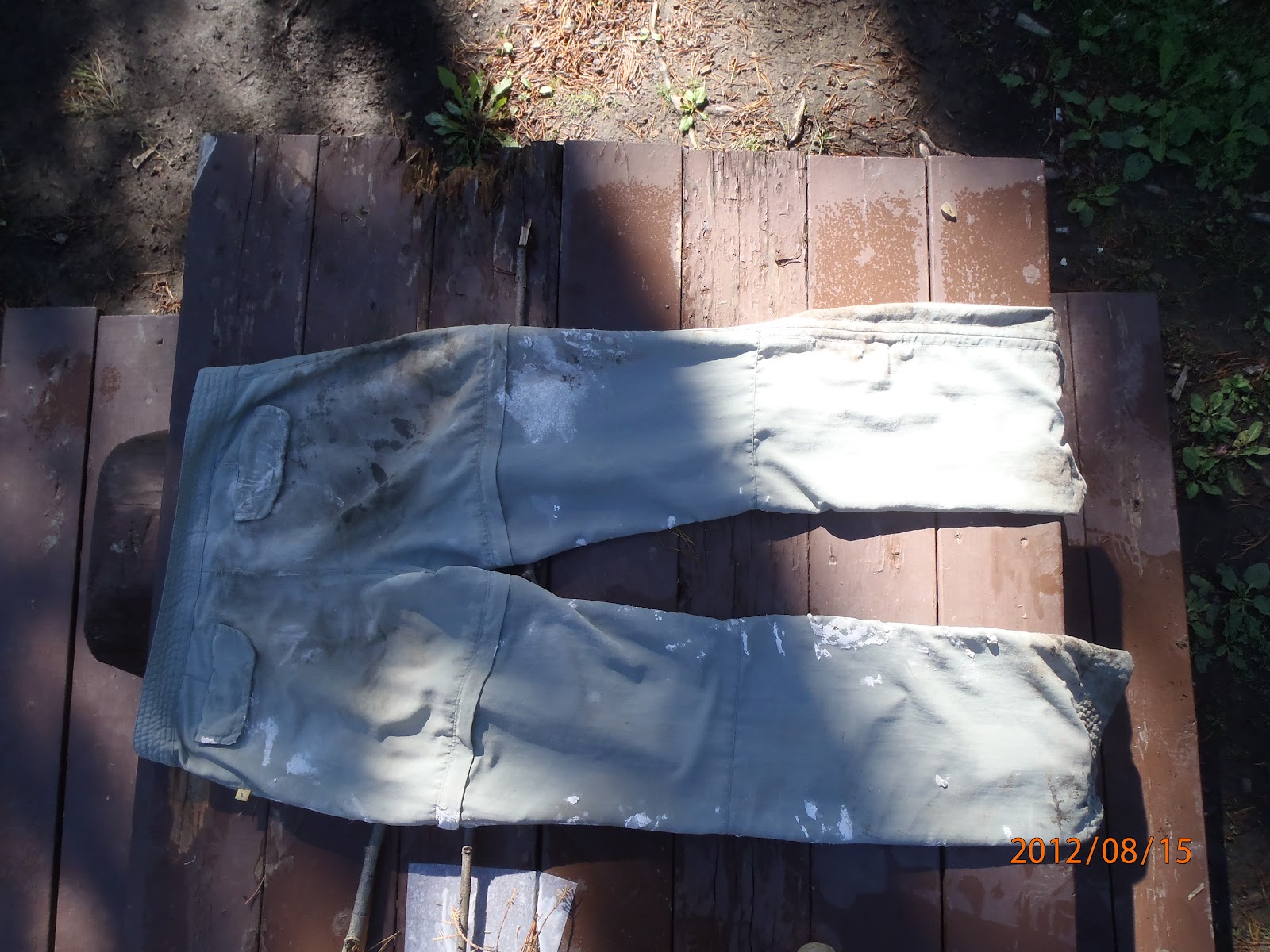
Field Pants 2005-2012. Your myriad of stains are your badges of honor.
The worst thing that happened was that a blob of plaster fell on my eye, but that was quickly remedied by emptying my CamelPak onto my face. I was wearing my glasses, but I was not wearing safety glasses. This incident was completely avoidable.

This plaster-in-the-eye incident started me thinking about some of the chemicals and materials so often used in the field of paleontology - this is not the first time I have given thought to this, mind you, but for the first time since I started this blog. Do we take the time to thoroughly research these chemicals/materials before we put ourselves in the situation of upending an entire bottle of acetone-vinyl mix (or VinAc, as we call it) on our legs, or glue a bottle of super-glue to our right hand, and then proceed to glue said hand to the workbench? Do we stress enough to our students/employees the potential hazards of long-term exposure to some of these chemicals? And, even if we do these things, do we consistently practice what we preach and wear ALL the proper safety equipment ALL the time?

You can guess from the plaster-eye incident that no, I do not always take the proper safety precautions I should. I can say that 90% of the time I do, but it's that 10% that will come back to haunt you. I know better. I'm a seemingly intelligent individual. I am also a horrid klutz...if there is a way that I can hurt myself (or those around me), I'll find it and proceed with unabashed zeal until there is nothing left around me but chaos. I really should not be let out into the field without a protective layer of Nerf. I am getting better - like any good habit, you have to train yourself, and make a conscious effort to practice proper safety procedures.

I digress. One of the chemicals with which I have routine contact is acetone. It is the solvent with which we mix our adhesive. First, does your lab/workplace have the Material Safety Data Sheets (MSDS) for all the chemicals in the lab? Here is what the MSDS sheet says regarding the toxicology of acetone. I chose acetone only because it is a chemical with which I am the most familiar. I am not picking on it unfairly - I am sure there are other chemicals that have similar or far worse effects.

Routes of Entry: Absorbed through skin. Dermal contact. Eye contact. Inhalation.

OK, not good, especially if you do not use gloves or work in a poorly ventilated environment. I should wear gloves every time I apply VinAc. This is a step that I have made a conscious effort to remedy. As VinAc is one of the consolidants that I use in collections, my accessioning kit contains a box of nitril gloves.

Chronic Effects on Human:

CARCINOGENIC EFFECTS: A4 (Not classifiable for human or animal.) by ACGIH. DEVELOPMENTAL TOXICITY: Classified Reproductive system/toxin/female, Reproductive system/toxin/male [SUSPECTED]. Causes damage to the following organs: central nervous system (CNS). May cause damage to the following organs: kidneys, the reproductive system, liver, skin.

A cheery read, eh? Since I am equipt with girl parts this is a bit troubling, considering the early years of my training when I didn't use gloves consistently while mixing acetone-based consolidants. Are these effects cumulative? While it is (even to me) a definite no-brainer that using any solvent while pregnant is dangerous, what about women who are in their child-bearing years but do not (but one day plan to) have children? What sort of wear and tear have my ova accumulated? Would I give birth to something akin to the bear in Prophecy?

All I can do at this point is to continue increasing the attention I pay to my personal safety, and continue to stress to my employees and volunteers that come into contact with the chemicals we use to prepare and preserve fossils.

On the plus side, I promised myself I would limit my exposure to the sun. I can successfully report that, despite almost 60 consecutive days in the field, I am almost as pale now as I was at the beginning of the field season. I received a touch of sunburn on my neck, but  other than that I remained vigilant with the sunscreen and spent most of the summer in long sleeved shirts, long pants, and a fairly goofy looking wide-brimmed hat.

Until next time, stay safe, don't glue yourself to the prep table, and for the love of all that is green and growing keep your coffee mug away from your solvents!

SAS


Tuesday, August 7, 2012

Brief Field Update!

Hello from the field! To be accurate, I am not posting directly from the field site as we do not have internet access. I have mixed feelings about that. The downside is that we tend to miss out on current events, such as all the Olympic coverage. The benefit is that most people we deal with know about our annual summer absence and tend to keep the last minute "I need X by tomorrow...I've known about this for a month but am just letting you know now" demands (e.g. museum statistics, financials, forms to sign, etc.) to a minimum.

I digress. I want to post an update on what we've been up to since the first week of July. We resumed the BC hadrosaur excavation on July 5th. Here's a bit of background. Since 2004 we have been prospecting the approximately 73 million year old outcrops of northeast British Columbia for dinosaur material. We knew from the finds near the Grande Prairie area that British Columbia had the potential to produce ceratopsians, hadrosaurs, tyrannosaurs, ankylosaurs, and other animals similar to the charismatic creatures discovered in the Upper Cretaceous deposits of Alberta. The first report of bone material was made by a family from the region. Unfortunately the few remains were encased in very coarse grained sandstone in a gravel pit. Why was this unfortunate? First, when paleontologists and geologists talk about grains, they are referring to the size of the particles that make up the rock in which the dinosaur bones are encased. Most of the rock layers in this region are deposited by water (lakes, streams, rivers, deltas, etc.) So, the larger the individual grains (or, the coarser the grains), the faster the water had to be to move them and deposit them. Most of the bones we find in coarse grained rock tend to be individual pieces rather than complete skeletons, and those pieces tend to be broken. The report was enough to tell us that all we needed to do was look (and look, and look, and look some more) and eventually we would encounter a site that contained a large amount of bone.

In 2007 Rich, our colleague Dr. Federico Fanti and I came across a hillside that contained a great deal of eroded bone that stretched over 10 meters. The bone was of a hadrosaur, but what kind of hadrosaur remained to be seen. This was enough for us to return to the site in 2008 and conduct a test pit. We discovered we had at least part of a disarticulated skeleton. In 2009 we discovered that a large portion of the skeleton was mostly articulated. In 2010 we discovered the pesky skeleton was missing the neck and head, and that the pectoral limbs had been pulled off prior to burial. This was also the year we found  several tyrannosaur teeth associated with the skeleton. We uncovered a large portion of the pelvic girdle, and the shape of the bones indicates that we are dealing with a crested hadrosaur. In 2011 we had planned to remove the skeleton, but the Great Weather Gods had plans of their own and rained for four weeks out of our five week field season.

This brings us to 2012. We have had a successful excavating season to date. The process of removing the skeleton is well underway. The protective plaster jacket that encases the exposed parts of the body has been expanded and reinforced. We have also started digging under the jacket and applying plaster to the underside of the skeleton. This will ensure that, when we move the jacket out of the wilderness and into the museum, the insides of the jacket won't fall out when we eventually flip the whole jacket over during the process of separating it from the hillside. We are about a week away from being ready to flip the jacket. On that day I am sure I will be so nervous I'll add to the already numerous stark-raving-white hairs on my head. Maybe this is the year I finally get a pure white streak in my hair.

We've also successfully removed the tibia, a mostly complete rib, and several smaller pieces of partial ribs. We haven't found many new skeletal elements this summer because are concentrating on removing the main part of the skeleton. However, while I was digging around the rib, I uncovered a new limb bone (likely a humerus) with a new rib laying across it. Once I sort through the many images I've taken, I'll post some pictures.

That is all the news I have for now. The next time I'm in town will likely be when the skeleton is removed.

Off to wash field laundry....

SAS 

Friday, July 13, 2012

"In An Undisclosed Location, An Unspecified Distance From Tumbler Ridge"

I was driving back from our bush camp last night, and heard the news of the Grande Prairie hadrosaur excavation vandalism on the radio (we're out of cell and internet contact at the site, so this was the first time I had heard about the incident). My initial emotional response was "Oh, for @*$@'s sake!", and when I heard about the liquor store receipt that may eventually lead to the identification of these primitive screwheads, I though "Typical". Drunken idiots and vandals (destructive and graffiti alike) are the reason we as a society cannot have nice things.

"An undisclosed location, an unspecified distance away from Tumbler Ridge". I often use this line when talking with media, funding agencies, politicians, and the general public when they ask the inevitable question about the location of the PRPRC's hadrosaur (duck-billed dinosaur) excavation. If I am feeling exceptionally wicked, I will also say "If I tell you that, I'd have no choice but to kill you." The recipient of either response usually reacts with an initial stunned and confused look, and then with laughter. To dispel the notion that I'm just being cute and coy with them, I then explain that, sadly, secrecy is the best protection for fossil sites, and even the best concealed, best cared-for localities are not immune to anthropogenic degradation (a.k.a. idiots with no deeper appreciation for heritage and culture). I wish that I had only hypothetical examples on which to draw when illustrating the importance of site security, but unfortunately I can now add the Grande Prairie incident as another too-close-to-home-for-comfort example.

Some people become insulted when I do not reveal the locations of our fossil sites. I understand that no one wants to feel like they are not trusted, but fossil vandalism and theft are as rampant in the Peace Region as they are in any other part of the world, and until I develop psychic abilities I cannot guess the motive behind the requests from the general public for locality data. I am sure 99% of the people ask out of interest and curiosity, but we have had the less than subtle ask for locations with commercial ventures in mind. At this point in time British Columbia does not have protective legislation for fossils on Crown lands, although there is a Fossil Management Framework that suggests management guidelines for fossil resource use and lists the existing legislation that can be used to protect fossil sites. These all require an oftentimes lengthy application process. As a palaeontologist I view one of my roles as "The Voice of the Fossils," and it is my view that it is in the best interest of fossils on the Crown Lands of British Columbia to have wholesale protective legislation that is specific to fossil resources. However, even protective legislation does not stop the kind of heritage destruction that occurred in Grande Prairie. What it does provide is the means for a legal investigation of the destruction, and the prosecution of the people involved.

These people do not even stop to consider that what they are damaging is a non-renewable resource. There is no bulk bin of dinosaur bones at the local warehouse store where we can get a replacement if a fossil is damaged or destroyed. Even in the apparent ossuary cornucopia of Dinosaur Provincial Park fossils are not easy to come by: it takes many man-hours of prospecting to find complete or partially complete skeletons. These animals are an irreplaceable record of an ecosystem that rose, flourished, and declined millions of years ago. Every fossil is a unique page in the only existing copy of the ecosystem-book: damaging or destroying a fossil is the equivalent of ripping out pages from the book. You've permanently lost both scientific information and educational opportunities.

There are several types of anthropogenic degradation that I have encountered in various local and international sites. 2005 saw the theft of the Tumbler Ridge Museum Foundation's "signature" theropod footprint from the Wolverine River Lantern Tour Site. The specimen was eventually turned over to the RCMP who promptly deposited it in the PRPRC Collections Facility, but the damage had been done: several other footprints were destroyed in the removal of the specimen, and the specimen itself bears permanent chisel and pry-bar gouges from the thief's activity. There are other track sites in the Peace Region that bear spray-painted messages of "I Love So-And-So" and "Evolution = Lie". (I will later provide images of this vandalism, but right now my internet access is limited and I am having issues uploading photos.) There are also cases where people, well-intentioned or not, try to make their own copies of footprints using very outdated and damaging techniques. I cannot stress enough how damaging this is to footprints, and the prints at the Cabin Pool-Flatbed site are becoming so damaged that we are considering their removal for their protection. This is a case of the selfish few ruining the visitation experience of the general dinosaur-interested public.

One criticism that I hear regarding site protection is "Why don't you hire security for the sites?" or "Why not set up webcams to monitor the sites?" I think that people either a) overestimate the amount of resources paleontologists have to devote to field activities in the first place, let alone site-specific security, or b) people underestimate the logistical difficulty of monitoring a remote location. Sometimes the sheer difficulty of accessing a site it protection enough, but it is difficult to monitor (electronically or physically) an easy-to-access location without also attracting attention to said location. If you see cameras and various electronic equipment established near a seemingly inconspicuous bit of outcrop, you are sure as heck going to investigate further. As for security personnel patrolling a patch of bush and rock, I could not think of a better way to proclaim "Something important here", save publishing the GPS coordinates in the local paper. "Out of site, out of mind" is the best approach for site security. Usually it works, but in the event it fails I want the ability to use whatever legal means necessary to charge and prosecute the perpetrators. I hope we soon hear that the Grande Prairie perpetrators are caught and given the highest penalty possible. The more examples that are made of these morons, the better.

The optimist in me hopes for the day that we do not have to worry about loutish individuals looting and damaging irreplaceable heritage sites, but the cynic in me knows that as long as there are people, there will be those that either believe they are above the law and general ethics, or are too dense to realize that their actions have permanent consequences.

This is the Shaman signing off and heading back out to an undisclosed location in the bush an unspecified distance from Tumbler Ridge. If I told you where, I'd have to kill you.


Wednesday, July 4, 2012

Tales from the Field - The Frisky Pine Tree

I am celebrating the official start of my field season by watching it rain. This creates the perfect opportunity for me to do what I have been putting off for many years...writing down some of my field stories. Welcome to the first of what I hope will be a regular series of my wacky (mis)adventures in the wilderness of northeast BC. There is no chronological order planned for these stories, but I'll focus first on my earlier misdeeds while I still remember all the details and can still decipher my own field notes.

I'm a huge Tolkien geek. When I was ten, my dad gave me his old paperback copy of "The Hobbit" that he had in university. I read that book so many times my parents began to worry about me. I can't blame them - I was obsessed, and remain so to this day. So intense was my obsession my dad a year later got me started on Stephen King novels...I guess they figured that, like for Bill Murray in "Groundhog Day", anything different was good.

I digress. My point is that a particular line from "The Hobbit" comes to mind when I think of field work:

"...things that are good to have and days that are good to spend are soon told about, and not much to listen to; while things that are uncomfortable, palpitating, and even gruesome, may make a good tale, and take a deal of telling anyway." (J.R.R. Tolkien)

Tolkien was spot on. However, these are the tales I never write down at the time they occur. I'll be the first to admit that, when I finally hit my tent/bivy/pile of leaves after an exhaustive day, writing is the furthest thing from my mind. UFOs could land in front of me at the end of a rough trek and the best documentation they would get is a scrawled "ET took last granola bar. Jerk." Bad Scientist.

This tale of gruesome adventure is from August 2007. A seismic company donated helicopter time for palaeontology activities, and we used it that summer to survey previously unexplored outcrops of Triassic marine sediments. This material is a productive source of marine reptiles, coelacanths and a plethora of other gorgeous fish fossils. A well-known Triassic marine locality in BC is Wapiti Lake Provincial Park. 

 
Day One was spent loading equipment into our truck and driving to the muster area where we waited for the helicopter pilot to drop off the seismic crews. We usually do not get the same helicopter pilot twice due to their shift rotation. Some pilots are excellent and will do crazy stunts for us in the name of science. Other pilots are so bad they forget me at the airport, but that is a story for another time. We took an hour flight to a location we picked from a topographic map. Our camp was a nice flat surface next to a small tarn and ringed with hills covered in subalpine vegetation and exposures of Mississippian limestone.

We spent the late part of the morning and the early part of the afternoon setting up camp, consisting of a tent for me and my husband and colleague Rich, a tent for our field assistant Tammy, and a small mess tent. We bring an old tent on any multi-day alpine trip for food storage and prep: making dinner in blowing rain results in soggy bread and smoldering tempers. After camp was set we took a short jaunt to the surrounding outcrop to see what we were in for specimen-wise during a full day of prospecting. Peeking out from the subalpine vegetation were small outcrops of Triassic marine, but we could see tomorrow's destination to the east, which contained large exposures of eroded Triassic-aged talus. We were ready for the morning. The sharp crisp smell in the air warned us that morning was ready to welcome us, alpine style.

On Day 2 we woke to ice, rain, and snow. We knocked icicles off our tents and surveyed the terrain. The clouds low enough to hide the mountain tops - and our destined outcrop - from view.
Happy Morning!

Palaeontologists in the Mist. This lasted the entire day.
We waited a few hours, taking pictures, playing cards, and hoping the afternoon would burn away the fog and allow us a bit of prospecting. No such luck: it drizzled on us all afternoon. Regardless, we trekked out for a hike in the hills around camp for exercise.

Day 3 dawned bright and clear. We loaded up for a full day of hard hiking and struck out. Our plan was to walk a ridge of Mississippian limestone to the Triassic outcrop of the peak on which we were camped, and cross over to the adjacent cirque. As we crested the hill we encountered a male mountain caribou. He stood his ground, not aggressive, not skittish, just watching three strangely clad primates huffing and puffing up a mountain. We crested the ridge, and worked our way across the first scree slope to get to the far cirque. We started finding specimens right along the game trail.
"Silly primates - don't they know what they're in for?"
At this time I had not refined my prospecting gear system. Every time I found a specimen I had to take off my expedition pack to grab my documentation kit. As I set down my pack to collect a small vertebral column, my binoculars decided to make a break for it. They slipped off my strap and went cartwheeling down the steep slope, hit a rock, gained some elevation, and somersaulted off a small cliff into the underbrush. If those binoculars were expecting me to go and hunt for them (and sentient), they were sorely mistaken: the only way I could have followed them was if I had tucked and rolled. To this day, those binoculars rest in the alpine of BC quivering with rage and planning my untimely demise for abandoning them.

We crossed the first scree slope and made it to the vegetation covered ridge separating the two cirques. If you've never hiked in alpine "cabbage", it is treacherous on steep slopes. I clung to rhododendron bushes and stunted pine trees for dear life. Once in the cirque we found a lot of marine reptile material
Marine reptile ribs and vertebrae. 10cm scale.

and a family of White-tailed Ptarmigan.
Find the ptarmigan!
We continued out of the cirque and gained elevation to hit the unvegetated sections. Cirques are deceptive to hike - at the base they start off as a gentle slope which gets progressively steeper the higher you go. Before I knew it, I was looking over my shoulder down what felt like a vertical slope of loose scree, stuck like a cat up a tree. I'm sure I yowled.

I couldn't decide whether to caption this "Things are looking up" or "Oh crap".

Unfortunately, Tammy became stuck too. Rich motioned for me to descend to her position and lead her along a route that a touch a panic hid from view. Not being a fan of heights, I can relate. During our ascent we did find some hybodontid shark material and more marine reptile remains.

The best laid plans of palaeontologists often have to change on the fly in the wilderness. Our original plan was to ascend the peak and walk the ridge all the way back to camp. Unfortunately there was no way we were ascending that peak. Oh sure, it looked like and easy traverse on the topographic map, but what looks navigable in the comforts of the lab can look absolutely terrifying in the field. One, the slope increased in dip the higher we went. Two, two out the three party members were nervous about heights. Three, the closer we got to our target ridge we saw that it was dangerously narrow. We could have gone back the way we came, but that was also treacherously steep; all of us slipped and slid several times, and that was when we were fully rested. Short of saying "to hell with it" and building a cabin out of scrub trees and living on the mountain like hermits, we had one option left to us: we could descend to the base of the cirque, climb down the mountain into the valley below, and walk the valley back to the drainage rill next to our camp, and climb back out. We democratically voted yea.

It was three in the afternoon when we started our descent into the valley. At first the hike was easy going. The pines and spruce were more or less thin enough to navigate through, and the slope was fairly shallow. That did not last. The slope increased its pitch, and the trees became densely packed. Pine trees grabbed at me and my gear at every step. Soon the slope was so steep that the only way I could descend was to grab onto the top of a lower tree and use it as a makeshift rope to slow my fall into the waiting branches of the trees below. Grab, jump, fall, and repeat (photos not available). On several occasions I became so entangled I had to remove my pack to get out of a tree. I periodically stopped my controlled fall to listen for Tammy. Through all of my crashing and cursing I couldn't hear if she was still behind me or had zipped ahead on an easier route. I heard a pattern of rustling and crashing, dead silence, and then the occasional utterance of a very quiet monosyllabic curse. Rich was nowhere to be seen. He can glide through the bush like a bear, pack or no.

After what seemed like hours (and I'm sure it was at least two hours) I finally saw the trees thin. The slope became shallow...the trees cleared...I WAS THROUGH! And what do I see but Rich standing there looking rather amused. He heard our entire tortured descent. When we got back to camp Rich commented that, based on our expressions on emerging from the bush, he was sure we were going to mutiny and beat him senseless for suggesting that route. Not likely, but sometimes exhaustion and frustration play havoc on people's sense of logic. Rich did a good job keeping up the morale of what probably looked like two survivors of a plane wreck. It's hard to look like a tough field babe with pine needles hanging out of your ears and with your hair matted with sap.

The hike along the valley was easy going. The terrain was nothing more complex than basic mountain bush crawling. We hiked west along the valley for about two hours. We had marked camp on the GPS, so we knew when we had reached the point where we needed to start our ascent.

We chose a drainage rill composed mostly out of firm shale for our climb. The evening chill was growing, the rill was wet, and we were none too energetic. After a snack break we started our climb. My feet and hands were cold and numb: I only noticed the bruises and scrapes on my hands when I did my best impression of the Creature of the Black Lagoon in the tub at home. My feet were in pretty decent shape as I wore steel-toed logging boots. These are miserable to hike in, but I was very appreciative of how stiff they were on that climb. All I remember from the rill was that Rich found a small, mostly complete ichthyosaur dentary. Not too bad for the battle weary.

We crested the limestone ridge just as twilight was descending. We could see our tents at the bottom of the ridge as homey, welcoming beacons reflecting the last of the afternoon sunlight. We literally ran (alright, quickly stumbled as well as we could down a slope of Mississippian reef deposits) to camp, a dry change of clothes, and a hot meal. We survived!

Stay tuned for short updates from the field!

Strange Woman.

Thursday, June 28, 2012

Where Is The Science In This Science-Recruiting Video?

I was hoping that the Gods of Vacuity would hold out for at least a few months before forcing me to address issues surrounding women and girls in the sciences, but gosh darn you, European Commission! You had to go and create this recruitment video that you claim is designed to encourage young women to pursue careers in science. It has been circulating on the Web for some time now, but it is so annoying that I just have to comment. Note: they have since removed the official link after the barrage of negative comments, but thanks to the internet the video survives! Go on, watch it. I'll be waiting right here.


Done? How are you feeling? Do you feel irate, frustrated, and sadly amused? Did you respond, as my husband did, with "How inappropriate"? Do you need a cup of tea to soothe your nerves? I most certainly did. One pot of Earl Grey later, I feel a little more composed and ready to compose.

When I first saw this video, I had vain (no pun intended) hopes that EU was a new cosmetic-fashion company that wanted to encourage people to do cosmetic-related research. My mind could not conceive that this bit of runway fluff was an official government-sanctioned production. Yes, their reasoning is sound, and their intentions are admirable, but the resulting product reeks of damaging stereotypes and tiresome cliches.

First, there is very little reference to science, let alone women in science, in the video. Oh sure, we are shown dry ice smoking in tastefully arranged beakers, and we do see one young woman writing out an equation in shiny silver white-board marker (Look! Math!). There is one shot of iron filings (Look! Physics!) and an electronic circuit (Look! Engineering!). We see Dr. Accomplished-And-Dreamy looking through his microscope at the opening of the clip, but he is most definitely not female (Look! Biology?), and he makes a longer appearance than the symbol for hydrogen (Look! Chemistry!). The rest of the production is spent on strutting, fashionably-coiffed young women, posing for what is more likely a magazine spread than photos for a faculty website. These images are interspersed with several shots of makeup. There is not one image in this video of a woman doing real (or even "real-for-TV") science, and not one image that would inspire an intelligent girl to think "I want to do that!" There is no shortage of women out there who do exciting research. In paleontology I can think of several without needing to reach for a second pot of tea. Here's a tip, EU: if you want to inspire a young person to try a challenging career path, show them a real person to act as a role-model. I would bet that filming real women doing real science would be a lot less expensive than the released Vogue-esque "Girl Thing" video.

Second, it was very obvious that the consultants for this video did not think to appeal to young women's sense of ambition, drive, motivation, or sense of adventure. Nope, young women were shown pretty makeup and clothes. Even the official website for the "Science, It's a Girl Thing" website features makeup in the title. Head's up for all you women scientists out there: lipstick is now the official symbol of women in science. The marketing consultants are sending a damaging message to young women. Message #1: Don't bother with all that thinking and hard work, just strut your finely-dressed self into that lab and everything will fall into place. Message #2: Outward appearances are extremely important in science. Heck, Dr. Accomplished-and-Dreamy seemed very impressed with the young women in the video, but I'll bet it was not because he was intrigued by their latest hypotheses.

There are mixed opinions on women's physical appearance and femininity in academia. Is it damaging to play up one's femininity in the professional academic realm? Should we just say to heck with it and just grab whatever happens to be on top of the clean clothes pile that remotely matches? I'd love to hear some of your opinions on this topic in the comments section.

My take on the issue is quite simple. For better or worse, appearances do matter to a certain degree. We are primates with complex visual processors, and the first aspect we notice about someone is the physical aspect (hopefully it is not the olfactory aspect). How a person presents themselves to the professional world says a great deal about how comfortable and confident they themselves feel in that world. How this is expressed is a matter of personal style and preference: there is no official uniform for scientists. Lab coats are common, but that is an issue of safety, comfort, and random squirts of shark-flavored preservative fluid rather than style. How "feminine" I look depends on what I happen to be doing that day. There is no way I'm going to wear my pinstripe skirt and jacket while I reorganize fossil cabinets or pour a silicone mould, just as I would not wear my preparation clothes to introduce a guest speaker. Barring a few fashion faux pas, my wardrobe choices reflect my level of self respect. I don't need to toss around my secondary sexual characteristics to get attention, and that's not the attention I want in the first place. No matter how mini my skirt is or how high my heels are, my papers will not get published if they are crap.  So yes, for me clothing and appearance are important to a point, but as long as it is clean, comfortable, matching, occasion appropriate, and fits without substituting for a full-body scan, that's as far as I consider the issue of my appearance as a woman scientist. The "Girl Thing" video only serves to strengthen the misconception of women scientists are not feminine by trying too hard to prove that science-minded women can be feminine.

Sadly I recently encountered the issue of girls, appearance, and science while judging at a public school science fair. The judges were divided into the elementary school and the secondary school judges. I chose secondary school because I had done a few elementary judgings prior and wanted a different experience. I have never been more disappointed in a gender as I was that day. The boys' experiments were actual science or statistical experiments with hypotheses, tests, and conclusions. Out of the seven experiments done by girls, four of them focused on fashion. The questions they asked for their "experiments" were "Do boys prefer looking at girls wearing makeup or not wearing makeup?" and "Do boys like girls that dress preppy, goth, or skater?" and "What kinds of makeup attract the most attention?" Interestingly, these are questions that have much deeper implications within the social, behavioral, and evolutionary sciences, and had these girls explored any of the deeper implications, I would have strongly recommended their fashion projects for the win. However, their conclusions followed the theme of "Based on our results, girls should wear this to get boys to notice them." This is likely a continuation of the problem Lisa Bloom addressed in her Huffingtong Post article "How to talk to little girls", where girls hear more appearance-related than accomplishment- related comments early in their development. Are the EU "Girl Thing" consultants right? Are girls conditioned to value looking good over actually doing something?

I would argue that, no, many girls who are already driven to pursue the sciences are not, or are striving to overcome that issue. Whether they take the time to present themselves nicely is a different matter, but I guarantee that these young women do not worry that their scientific accomplishments will damage their femininity. They already know what it takes to be a scientist. I would be interested in seeing their reaction to the "Girl Thing" video.


What about those girls who are driven by external opinions? It could be argued that the "Girl Thing" video is targeting girls that have never considered their future beyond whether mid-thigh is the new knee-length, and that it pushes them to consider doing something while looking good. I would argue that the "Girl Thing" video portrays science as a hobby that you fit into your schedule between trips to the boutique and facials.

Lastly, what I found most disappointing about the video was that it gave absolutely no sense of what I find appealing about science - the excitement of discovery, the thrill of exploration, and the triumph of solving a previously insurmountable problem. There is no dress or lipstick color in the world that can substitute that feeling. The potential impact and contribution that just one person can make in science, no matter who you are, where you come from, or what you look like, is the message that needs to be used for recruitment. Looks fade, clothing rots, and physical attention wanes. Achievement and advancement outlast all material things, including our physical selves.


Saturday, June 23, 2012

Tarbosaurus Musings - Thoughts on purchasing fossils


I remember many of the daydreams I had about becoming a paleontologist when I was a child. Their general theme was of me wandering across barren landscapes for days on end, sometimes with a trusty packhorse - depending on how young I was, it may have been a magical talking horse, but let's not dwell on that part - and finally stumbling across that complete skeleton of Tyrannosaurus rex at the last possible moment. Not once in my imaginings did lawyers, restraining orders, and the illegal fossil trade cross my mind.

Legal battles involving fossil custodianship are part of the harsh, time-consuming reality for paleontologists. The most recent incident to highlight this issue is that of the auction of a skeleton of Tarbosaurus bataar (lot 49315) in New York City a month ago by Heritage Auctions. For a summary of the situation, check out Dinosaur Tracking on the Smithsonian.com page. Also, check out the blog Pseudoplocephalus for a breakdown of why Tarbosaurus bataar is not Tyrannosaurus rex.

For my summary, here it is. Heritage Auctions and the seller originally claimed the fossil was both legally collected and legally imported into the United States. Mongolia's President Elbegdori Tsakhia and the Mongolian government hired a US legal team and claimed that, if the specimen was one of Tarbosaurus, they are known only from Mongolia. Therefore, it was illegally removed from Mongolia, and should be removed from the auction process and returned to its rightful country. Finalizing the sale of the specimen was halted through restraining order. The specimen was examined to determine its origin, and it was indeed a specimen of Tarbosaurus and had originated from Mongolia. This means the specimen was collected without the legal permission or knowledge of the Mongolian government. To date, the Manhattan US Attorney has filed papers requesting forfeiture and the seizure of the Mongolian Tarbosaurus specimen, and the specimen is now in custody

Sadly, the theft, looting, and illegal sale of Mongolia’s natural heritage occurs on a regular basis, according to Dr. Philip Currie in his recent article in New Scientist. The commercial dealing of fossils, especially vertebrate fossils, is a contentious subject among some paleontologists. The Code of Ethics for the Society of Vertebrate Paleontology is very clear on the subject of how professional paleontologists (who are members) should treat the commercial trade of vertebrate fossils: the only sale of a fossil that should be supported is that which brings a vertebrate fossil within the public trust (to a museum, university, or research center). This is very different than someone purchasing a dinosaur skull so they can have an interesting (and expensive) conversation piece in their private residence.

The Shaman's view? I am not going to discuss here the pros and cons of commercial fossil operations (perhaps that will be a subject for a later post), but I personally find the sale of vertebrate fossil specimens by individuals/companies to other individuals repellent and unethical. Unless fossil specimens for sale are directly destined for museums, universities, or any other institution that holds in trust the history of the planet, no one individual has the moral or ethical grounds to either sell or buy a fossil.

As aesthetically beautiful as fossils are, fossils are not art. Fossils were not created by any one person's hand. Fossils are not the intellectual property of any one person or group of people. The rules that apply to the art or antique world do not apply to fossils any more than they apply to a migratory bird. The care of that bird, and fossils, is the responsibility of everyone. Both the bird and fossils are the property of no one. They are citizens of the world.

Sociopolitical boundaries were not laid out with fossils in mind, and it is just chance that fossils lay within the sociopolitical boundaries that they do. Where they do occur, it is up the municipality, region, province, country, and international laws to protect the right of these fossils to remain citizens of the world, and every nation has their own success and failures in terms of fossil stewardship. Laws and public education are the only tools available with which to protect fossils from selfish acts of profiteering. I believe that one of our duties as paleontologists is to give voice to the voiceless fossils, like the Lorax speaking for the defenseless trees. Like the Lorax, it sometimes feels as though we are losing the battle for right against the might of greed and ego. I applaud the efforts of the Mongolian government in not only taking their responsibility as fossil stewards seriously, but also for bringing this issue to light in the most public way possible: using the US legal system to interfere with large amounts of money changing hands for goods and services obtained through less than honest means.

I cannot see how personally owning a fossil is about anything more than a matter of ego. As Gatekeeper of a collections facility, I take a pride in the stewardship of the collection that I manage. The responsibility of its current and future care falls on my shoulders. However, I cannot state this next point strongly enough: I, and no one who works, manages, or funds the facility, owns the fossils within its walls. We are merely caretakers, caring for the shrine to our history and keeping scientific vigil until passing the responsibility to the next caretaker.

I admit that I purchased a theropod tooth from a rock shop. I was in elementary school and on a road trip to Drumheller, Alberta with my parents.  

A photo of my shame, now donated to our institution's Educational Program.

My thought processes regarding the purchase were simple. I saw it, I liked what I saw, I could afford it, so I wanted it for my own. I was quite Gollum-esque about my purchase: I'm sure I held it and stroked it as though it were the One Ring for the rest of the trip. Hindsight has offered me this other deeper observation on my ego: was I subconsciously thinking that this was as close as I was going to get to my dreams of being an actual paleontologist for decades? Perhaps I wanted a tangible link to the future I hoped to have.

I cannot speak for the motives behind the Fabulously Rich who are willing to pay six or seven figures for rare fossils. Perhaps their thought processes are no different than those of the six-year old Shaman: it's cool and they want it. Perhaps they do it simply because they can. There are a myriad of ways to fan the flames of ego, and having fossils available as high-priced goods attracts the attention of large wallets.  It could also be that they too want a tangible link to a childhood dream of roaming the desert in search for historical treasure. Are they unaware of the rampant looting and theft that it takes to get fossils, such as those of Tarbosaurus, to auction? Is this a way they feel they can contribute to paleontology and their love of history? And, if they do know about the damage done by the illegal fossil trade, do they care?

If their motives are altruistic, there are many ways in which the wealthy can make a positive, legal, and ethically sound impact in paleontology that will outlast that of purchasing a single fossil. For example, billionare David Koch donated a large sum to the Smithsonian Museum because is a longtime fan of their dinosaur hall. Other avenues open to philanthropy include establishing research chairs and operational endowments, funding legal excavations of a dinosaur skeletons through the museum of choice, and providing capital funds to modernize fossil preparation and collections facilities. 

These are the contributions that not only go down in history, but are above reproach legally and morally. Sometimes these are the contributions that save small research programs (or large programs that have recently faced cutbacks) from going extinct. I hope the Tarbosaurus incident will encourage those that would privately purchase fossils to reconsider how they want to contribute to paleontology. I hope that one day all the time, energy, and funds used to counteract the negative impact of the illegal fossil trade will be used to further the care and discovery of our planet's natural heritage.

Saturday, June 16, 2012

I finally did it!


Greetings! Welcome to the introductory post of my very first blog. Chances are you are here because you either know me or know of me. If you know me, I salute your morbid curiosity! If you've stumbled onto this blog, I hope you find some of my posts and experiences entertaining and interesting.

1.                  My involvement in and opinions on vertebrate palaeontology. I work full time at a small, NGO research facility as a collections manager and a field researcher, which means that on most of my work days I wear the administrative supervisor hat and work on everything but research and collections work.

2.                  Life as a grad student. I am a doctoral candidate studying evolutionary biology in Canada There is no way I can top any of the experiences featured in Ph.D. Comics (www.phdcomics.com), but late night data collecting sessions might inspire a post or two. My specific experiences and views as an XX scientist are likely to be the topic of a few (but hopefully not too many) posts, especially if issues surrounding gender in sciences appear in the news that excite me.

My focus is primarily on anatomy and vertebrate ichnology, with a focus on avian anatomy. This leads to topic #3, which is:

3.                  Birds. I’m a little cuckoo (oh yes, the pun is intended) for birds. Anyone I have ever gone on hiking with has faced my frustrating obsession. I’m that annoying twitchy person you saw about 100m behind the rest of the hiking group, with binoculars glued to my face and muttering curses to the ball of feathers and spite that refuses to stay still long enough for identification. Chances are we were mid-conversation when I disappeared into the bush, arms flailing and uttering scolding calls. I am fascinated with the evolutionary history of birds, bird ecology and social behavior, nest parasitism, anatomy, conservation, etc…

4.                  Some aspects of my personal life. There will never be gory details about my married life (although my husband and professional colleague will appear from time to time), familial disputes, or anything that will cause the reader to collapse on the molecular level into a shuddering sobbing mass, crying “TMI! TMI!” What you may hear about on very slow (or busy) weeks are musings on wine, gardening, cooking, cats, running, karate, interesting social interactions, and whatever else may fall under the category of “Miscellaneous”.

Enjoy!

SAS